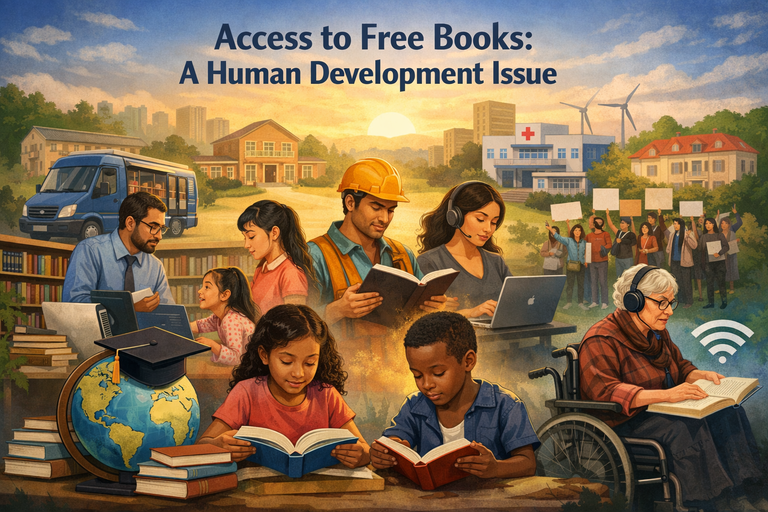
Why Access to Free Books Is a Human Development Issue, Not Just a Convenience
Access to free books is often treated as a charitable add-on a generous but nonessential gesture to help students, support libraries, or encourage a reading culture. But this framing misunderstands the scale of the issue. Books are not peripheral to development; they are central to it. They are tools that expand human capability, strengthen institutions, and shape long-term social and economic outcomes.
From a human development perspective particularly one influenced by the capability approach articulated by Amartya Sen development is not merely about GDP growth. It is about expanding what individuals are able to do and become. Literacy, knowledge access, critical thinking, and informed decision-making are core capabilities. Free access to books directly influences each of these.
When books are scarce, opportunity narrows. When books are accessible, societies widen their development horizon.
1. Books as Human Capital: The Foundation of Literacy and Learning
Literacy Is the Gateway Capability
Literacy is not simply the ability to decode words. It is the capacity to interpret, evaluate, synthesize, and apply information. It underpins:
-
Educational attainment
-
Workforce productivity
-
Health outcomes
-
Civic participation
-
Technological adaptation
-
Intergenerational mobility
Without literacy, individuals are locked out of modern economic and civic systems.
But literacy does not solidify automatically after primary school. It requires ongoing engagement with progressively challenging texts. In environments where books are unavailable outside classrooms, students lack the volume and diversity of reading required to develop fluency and comprehension.
The Book Gap and Structural Inequality
Children raised in book-rich environments tend to:
-
Enter school with stronger vocabulary
-
Develop comprehension skills faster
-
Accumulate background knowledge that supports science, math, and social studies
-
Cultivate independent learning habits
Where books are scarce due to cost, limited distribution networks, language mismatch, or weak library systems children experience a “book gap.” This gap compounds over time. By adolescence, disparities in reading exposure often translate into measurable differences in academic achievement and life opportunity.
In many low-resource settings, textbooks are shared, outdated, or insufficient in number. Students may only interact with formal curriculum materials, leaving little room for curiosity-driven exploration or extended practice.
Development implication: Free access to books reduces structural inequality by strengthening early and sustained literacy development.
2. Education Systems Cannot Operate Alone
Education systems face structural limitations: large class sizes, limited budgets, uneven teacher training, and restricted instructional hours. Schools cannot single-handedly provide the reading volume required for mastery.
Reading Volume and Skill Acquisition
Fluency depends on repeated exposure to text at appropriate levels. Research consistently shows that students who read more outside school perform better academically. Volume builds:
-
Word recognition speed
-
Vocabulary depth
-
Comprehension strategies
-
Analytical thinking
Free books expand reading opportunities beyond school walls. They allow learners to select texts that align with their interests and reading level, fostering both competence and motivation.
In under-resourced systems, free books act as force multipliers extending the reach of limited institutional capacity.
Development implication: Free books function as parallel educational infrastructure, supplementing formal schooling.
3. Health Literacy and Public Well-Being
Human development includes health, resilience, and informed decision-making.
Health Literacy as Survival Skill
People who can access and interpret written information are better able to:
-
Understand medical prescriptions
-
Follow treatment protocols
-
Evaluate public health guidance
-
Make informed reproductive and nutritional decisions
Inadequate health literacy is linked to higher hospitalization rates and poorer outcomes. Books particularly accessible, culturally relevant materials help individuals navigate health systems effectively.
Institutions such as UNESCO recognize literacy as foundational to achieving sustainable development goals, including those related to health and gender equity.
Psychological and Emotional Stability
Reading also supports mental well-being. It provides:
-
Cognitive stimulation
-
Emotional processing
-
Stress relief
-
A sense of belonging
In crisis contexts conflict zones, displacement camps, disaster-affected communities access to books can restore normalcy and continuity, particularly for children whose schooling has been disrupted.
Development implication: Books are part of health infrastructure, supporting both physical and psychological resilience.
4. Economic Mobility and Workforce Adaptability
Modern economies demand lifelong learning. Workers must continuously update skills to remain competitive.
Books as Self-Directed Learning Tools
Free access to books allows individuals to:
-
Develop foundational literacy and numeracy
-
Learn entrepreneurship and trade skills
-
Improve digital literacy
-
Prepare for certifications and competitive exams
-
Explore emerging sectors without costly enrollment
In many labor markets, informal and self-directed learning play a significant role in economic mobility. However, when learning materials are expensive, opportunity becomes stratified.
The Cost Barrier and Opportunity Concentration
If access to knowledge is paywalled, those with financial means accumulate more human capital, while low-income individuals remain excluded. This dynamic reinforces inequality.
Free books, whether physical or digital, break this feedback loop by lowering the entry cost to knowledge acquisition.
Development implication: Access to free books strengthens economic inclusion and productivity growth.
5. Language, Culture, and Identity as Development Dimensions
Development is not solely about income. It is also about dignity, cultural participation, and identity.
Mother-Tongue Materials
Children acquire literacy more effectively when reading in their home language. Mother-tongue materials:
-
Increase comprehension
-
Boost confidence
-
Reduce dropout rates
-
Facilitate second-language acquisition
Yet many communities lack books in local languages and dialects.
Representation and Cultural Relevance
Engagement increases when readers see themselves reflected in texts through characters, settings, and narratives that resonate with their lived experience.
Without culturally relevant materials, reading can feel imposed rather than empowering.
Development implication: Free access must include culturally and linguistically appropriate materials to be truly equitable.
6. Gender Equity and Disability Inclusion
Access to books intersects with social norms and structural barriers.
Gender Equity
In many contexts, girls and women face restrictions related to mobility, safety, or household labor. Free, locally accessible books allow learning to continue within domestic environments.
Informal reading groups, community libraries, and digital access platforms can support women balancing caregiving and employment responsibilities.
Disability Inclusion
Accessible formats braille, large print, audiobooks, dyslexia-friendly editions are often expensive or underproduced. Free distribution dramatically expands learning opportunities for people with disabilities.
Organizations such as the International Federation of Library Associations and Institutions advocate for inclusive library services that ensure equitable access.
Development implication: Free books mitigate systemic exclusion and promote inclusive participation.
7. Civic Participation and Democratic Strength
Books cultivate critical thinking, historical awareness, and media literacy. These competencies are essential for:
-
Evaluating political claims
-
Understanding legal rights
-
Participating in public discourse
-
Holding institutions accountable
A society where information access is restricted by income is vulnerable to misinformation and power imbalances.
Public institutions, including libraries and open educational initiatives, help maintain a broad and informed citizenry.
Development implication: Free access to books strengthens democratic resilience and social cohesion.
8. Libraries as Development Engines
Libraries are not cultural luxuries. They are development institutions.
They provide:
-
Lending without purchase
-
Literacy programs
-
Study spaces
-
Digital access
-
Community engagement
Global advocacy organizations, including the World Bank, increasingly emphasize knowledge access as part of human capital investment strategies.
In areas lacking traditional library infrastructure, mobile libraries, community book banks, and digital library platforms can extend reach.
Development implication: Investing in libraries yields long-term social returns comparable to investments in schools and clinics.
9. The Digital Transformation: Promise and Inequality
Digital publishing has revolutionized distribution. Projects such as Project Gutenberg demonstrate how public-domain collections can reach global audiences at minimal cost.
Opportunities
-
Low marginal distribution cost
-
Offline reading capability
-
Massive storage capacity
-
Rapid scaling of open-access materials
Risks
-
Device affordability barriers
-
Data costs
-
Electricity reliability
-
Language limitations
-
Accessibility feature gaps
Digital access alone does not guarantee equity. Infrastructure and inclusive design are essential.
Development implication: Digital free books must be supported by device access, connectivity, and fair licensing policies.
10. Balancing Access and Sustainability
Ensuring free access does not require undermining authors or publishers. Sustainable ecosystems may include:
-
Public funding for libraries
-
Creative Commons licensing for educational resources
-
Government bulk purchasing agreements
-
Support for public-domain preservation
-
Compensation mechanisms for creators
The objective is not universal zero-cost publishing but equitable access to high-impact materials.
Development implication: Balanced copyright policy can support both creative industries and human development.
11. Measuring Access as a Development Indicator
If free books are development infrastructure, progress must be measurable.
Key indicators may include:
-
Household access to physical or digital books
-
Reading fluency and comprehension rates
-
Library membership and usage
-
Gender parity in reading outcomes
-
Availability of local-language materials
-
Accessible-format production coverage
-
School transition and completion rates
Treating access as measurable ensures accountability and sustained policy attention.
Conclusion: Books Expand Human Capability
Free books are not peripheral conveniences. They are engines of literacy, health, economic mobility, inclusion, and democratic strength. They enable individuals to interpret the world, navigate systems, and shape their own trajectories.
When access is restricted, inequality reproduces itself across generations. When access is expanded through libraries, open resources, inclusive publishing, and equitable digital systems societies unlock human potential.
Books are not optional enrichment.
They are capability infrastructure.
And ensuring free access to them is not charity it is development policy.