How to Read a Textbook Fast Without Missing Key Ideas | Smart Study Guide
You don’t need to read every word of a textbook to understand it deeply. In fact, trying to read everything line by line is one of the slowest and least effective ways to study. The fastest readers aren’t skimmers who miss details they’re strategic readers who know what to look for and when to stop reading.
The key is to turn textbook reading into a question-driven, search-and-retrieve process, then lock in understanding through memory-based summarization. This approach blends previewing, targeted reading, and retrieval practice so you move quickly without sacrificing comprehension.
Below is a complete, student-friendly system you can use with any textbook.
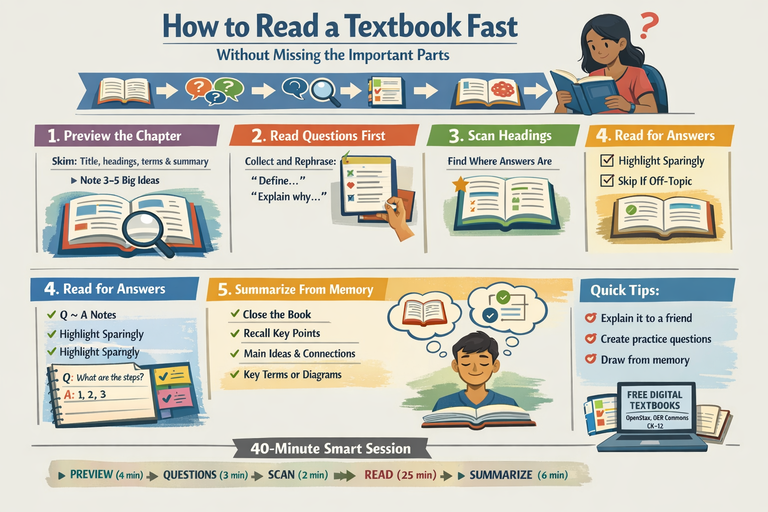
The Smart Reading Strategy (At a Glance)
Preview → Read Questions First → Scan Headings → Read for Answers → Summarize From Memory
Each step has a clear purpose. Skipping any one of them slows you down or weakens understanding.
1. Preview the Chapter
Goal: Build a mental map so you know what’s important before you start reading.
What to do (2–4 minutes)
Skim not read the following:
-
Chapter title and introduction
-
Learning objectives or outcomes
-
Section headings and subheadings
-
Bold or italicized terms
-
Figures, tables, diagrams, and captions
-
Chapter summary or conclusion
As you skim, note:
-
3–5 big ideas the chapter seems to focus on
-
Any repeated terms, models, or visuals
Why it works
Previewing creates a mental scaffold. When you later read details, your brain already knows where they belong, which increases speed and retention.
Quick tip
Pay special attention to sections with figures, diagrams, or summary boxes. Textbooks often pack core ideas into visuals more efficiently than paragraphs.
2. Read Questions First
Goal: Turn reading into a targeted search instead of passive exposure.
What to do (2–3 minutes)
Collect questions from:
-
End-of-chapter or end-of-section review questions
-
Learning objectives (“By the end of this section, you should be able to…”)
-
Assigned homework, quizzes, or lecture slides
Then rewrite them as clear prompts, such as:
-
Define…
-
Compare X and Y…
-
Explain why…
-
List the steps of…
Why it works
Questions give your brain a goal. Instead of absorbing everything equally, you read with purpose and ignore filler.
3. Scan Headings and Structure
Goal: Find where the answers are likely to be.
What to do (2 minutes)
-
Match each question to the most relevant section or subheading
-
Star sections that answer multiple questions
-
Identify figures or tables that likely contain:
-
Definitions
-
Trends
-
Steps or processes
-
Why it works
You avoid reading entire chapters unnecessarily and jump straight to high-yield sections.
4. Read for Answers (Not for Completion)
Goal: Read only as much as needed to answer your questions accurately.
What to do (15–30 minutes, depending on length)
Work section by section:
-
Read until you can answer the current question in your own words
-
Once you can answer it, stop and move on
Focus on:
-
Topic sentences (usually the first sentence of a paragraph)
-
Concluding sentences
-
Definitions in bold or italics
-
Margin notes, captions, and summary boxes
-
Worked examples
Minimal but active note-making
Use a Q → A format:
-
Write the question
-
Write a short answer (1–3 sentences, a formula, or a quick sketch)
If you highlight, do it sparingly (no more than 10–15% of the page):
-
Yellow: definitions
-
Blue: main ideas or claims
-
Green: formulas or steps
-
Pink: examples
Skip and return
If a paragraph doesn’t help answer your question, skim ahead to the next heading or figure. You can always come back if needed.
Why it works
Targeted reading keeps your speed high while tying comprehension to clear outcomes, not page counts.
5. Summarize From Memory (The Most Important Step)
Goal: Prove you actually learned the material fast.
What to do (3–5 minutes)
Close the book. Without looking, write or say:
-
The 3–5 key points of the chapter
-
How the ideas connect (cause/effect, comparison, steps in a process)
-
Any important definition, formula, or diagram you can reconstruct
Only after recalling from memory should you reopen the book to check gaps.
Why it works
This is retrieval practice, and it’s far more effective than re-reading. It strengthens understanding, reveals weak spots, and improves long-term retention.
Putting It All Together: A 40-Minute Reading Session
-
0–4 min: Preview
-
4–7 min: Read and rewrite questions
-
7–9 min: Scan headings and figures
-
9–34 min: Read for answers (Q → A notes)
-
34–40 min: Summarize from memory and list 2–3 “still fuzzy” items
Fast Doesn’t Mean Careless: Quick Comprehension Checks
Ask yourself:
-
Can I explain the main idea to a friend in 60 seconds?
-
Can I create two new exam-style questions and answer them?
-
Can I redraw one key diagram or list steps without looking?
If yes, you understood the chapter even if you didn’t read every word.
Use Free Digital Textbooks to Go Even Faster
Digital textbooks reduce friction and make strategic reading easier.
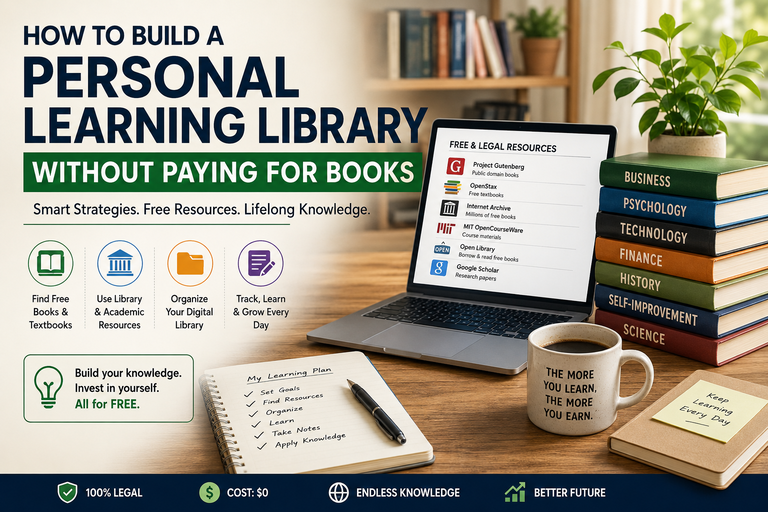
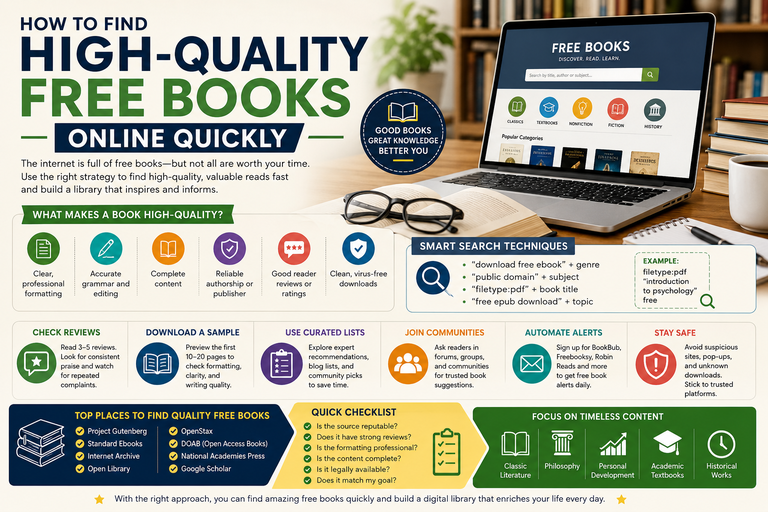
Where to find them
-
OpenStax – college-level, many subjects
-
Saylor Academy – full courses with textbooks
-
OER Commons – curated open educational resources
-
CK-12 – K–12 and intro college, strong STEM content
Time-saving digital moves
Search smart
-
Use Ctrl/Cmd + F with exact phrases in quotes
-
Try synonyms (e.g., cost-benefit vs. marginal analysis)
-
Search figure captions—they’re often concise summaries
Navigate structure
-
Use the table of contents or document outline
-
Scroll thumbnails to find pages with dense visuals
Highlight and export
-
Color-code by type (definition, claim, example, formula)
-
Add a one-line note explaining why each highlight matters
-
Export highlights into a study doc or flashcards
Collaborative annotation
-
Tools like Hypothes.is let you annotate and review later
Read aloud when stuck
-
Text-to-speech can clarify dense passages when combined with skimming visuals
Templates You Can Reuse
Q → A Notes Template
-
Question:
-
Answer (1–3 sentences):
-
Evidence/location (heading/page/figure):
-
Related term/formula:
-
Confidence (high/medium/low):
5-Sentence Chapter Wrap-Up
-
Topic:
-
Big idea #1 (why it matters):
-
Big idea #2 (how it works):
-
Example or application:
-
One question I still have:
Subject-Specific Tweaks
Math / Physics
-
Preview definitions, theorems, and worked examples first
-
Reproduce a worked example from memory
-
Summarize with: formula + conditions + “when to use it”
History / Social Sciences
-
Focus on why and how questions
-
Summarize using timelines or cause → effect chains
Biology / Chemistry
-
Target visuals: cycles, pathways, structures
-
Redraw and label diagrams from memory
Common Pitfalls (and Fixes)
-
Highlighting everything: Limit highlights and add a short note in your own words
-
Reading without questions: Always collect questions first
-
Skipping the summary step: Even 3 minutes of recall makes a huge difference
-
Ignoring confusion: Mark “still fuzzy” items and revisit them with focused searching
Two Quick Variants
Ultra-quick (15–20 minutes before class):
Preview (2) → Questions (3) → Scan (2) → Read key sections (8–10) → 3-sentence memory summary (3)
Deep-dive (60–75 minutes before an exam):
Same steps, plus flashcards from Q → A notes and one round of self-testing
Why This Strategy Works
-
Previewing builds a mental framework
-
Questions focus attention
-
Headings and visuals guide you to high-yield content
-
Reading for answers eliminates wasted effort
-
Summarizing from memory locks learning in
With practice, you’ll spend less time turning pages and more time understanding what matters. Combine the Smart Reading Strategy with free digital textbooks, and you’ll read faster, remember more, and walk into class or exams with real confidence.