Why Some Books Are Never Finished and Why That’s Still Learning
In a world obsessed with lists, streaks, and totals, finishing a book has become a kind of moral achievement. We celebrate readers who can proudly claim every title on a “must-read” list or tally up an impressive number of books at year’s end. But real reading especially the kind that fosters deep learning rarely fits such tidy metrics. Many books are not finished, and that isn’t automatically a failure of discipline or attention. Often, it’s a sign that reading is performing exactly as it should: helping you allocate time, test ideas, and pursue understanding in alignment with your goals.
Finishing a book is not synonymous with learning. Not every page offers equal value, not every book demands your full attention, and not every reading project is meant to end with a final page. Understanding this can transform how you approach reading and learning itself.
1. “Not finishing” is how adults actually learn
In school, reading is typically linear and compulsory: start at page one, end at the quiz. Outside the classroom, reading becomes goal-driven. Adults read to solve problems, clarify questions, build context, or explore interests. These goals often don’t require completion.
Consider common real-world reading motives:
-
Answer a specific question: “How does this method work?”
-
Evaluate an idea: “Is this argument credible?”
-
Gain a working vocabulary: “What are the key concepts in this field?”
-
Find tools: “Which frameworks can I apply tomorrow?”
-
Enjoy an experience: Fiction, memoir, poetry, or essays
Only some of these aims demand reading every chapter. If you found the answer, identified flaws, learned the vocabulary, or extracted the tools, stopping can be a rational endpoint.
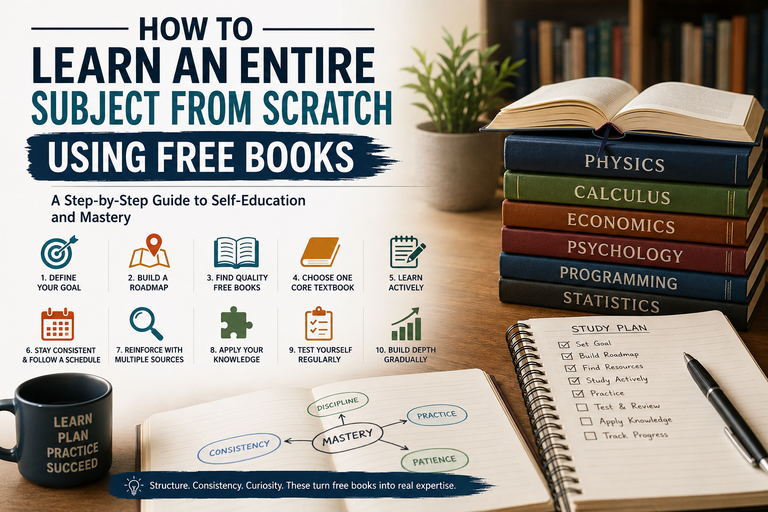
Learning is not measured in pages turned; it’s measured in what you can explain, notice, decide, and do. If 60 pages changed your thinking and the remaining 300 won’t, the learning happened finished or not.
2. The hidden economics of reading: attention is scarce
Finishing a book costs more than time it costs opportunity. Every hour spent reading is an hour not spent elsewhere.
A book may be:
-
Good, but not right for you right now
-
Important, but too technical for your current understanding
-
Relevant, but repetitive after the core idea lands
-
Enjoyable, but not enough to compete with other priorities
Assuming all reading is equal leads to wasted attention. Some books deliver value early; others require sustained effort. Treating every book as an obligation risks depleting your most limited resource: focus.
3. Many books aren’t meant to be read cover-to-cover
Surprisingly, a large number of books function better as references than as linear narratives.
Books that reward selective reading:
-
Business and productivity books: often center on a single model or idea, illustrated with examples
-
Technical and academic texts: typically meant for consultation by topic
-
History and biography: useful for specific periods or themes, not every detail
-
Anthologies and essay collections: inherently modular reading a few essays can suffice
Even fiction can be legitimately unfinished: perhaps the prose appeals, but the plot doesn’t resonate, or your emotional readiness isn’t aligned with the story.
4. Stopping can be a sign of deeper comprehension
Counterintuitively, the point where you stop reading may mark the moment you’ve understood what you needed.
Signs of a “learning-complete” stopping point:
-
You can summarize the thesis without referring to the book
-
You can explain the ideas to someone else and address basic objections
-
You’ve extracted actionable principles and understand their applications
-
You recognize patterns when the book is repeating points
In these cases, finishing may yield diminishing returns. The remaining pages aren’t worthless, but the marginal learning is low compared to other uses of your attention.
5. The psychology behind unfinished books: guilt, identity, and sunk cost
Many people feel guilty about not finishing books because they equate “not finishing” with “quitting.” These feelings often stem from three traps:
-
Identity pressure: Seeing yourself as a “reader” makes stopping feel like breaking character. Strategic readers choose what to finish.
-
Sunk cost fallacy: “I’ve already read 200 pages; I can’t stop now.” Time spent is gone focus on the next hour’s value.
-
Mistaking discipline for wisdom: Discipline matters, but wisdom lies in knowing when persistence truly pays.
Mature reading balances persistence for high-value difficulty and quitting for low-value friction.
6. “DNF” can be a deliberate reading strategy
“DNF” (did not finish) isn’t necessarily avoidance. When done deliberately, it’s curation.
Healthy DNF reasons:
-
The book’s core claim is weak or unsupported
-
Style or structure obstructs comprehension
-
Content mismatches your current level
-
You’ve obtained the key insight or framework
-
You’re reading for status rather than genuine interest
Unhealthy DNF reasons:
-
Avoiding any challenging book
-
Quitting at the first sign of effort
-
Chasing novelty without integration
DNF is best used as a tool, not a reflex.
7. Reading comes in different modes
Many frustrations vanish when you recognize that reading isn’t one activity.
Four useful modes:
-
Exploratory reading: Sampling, skimming, or browsing
-
Extractive reading: Hunting for frameworks, definitions, or steps
-
Immersive reading: Deep engagement for meaning, art, or empathy
-
Mastery reading: Slow repetition to build skill
Exploratory and extractive reading often don’t require finishing; immersive and mastery reading may but not always.
8. Unfinished books can still produce real learning
The true risk isn’t unfinished books it’s unintegrated insights. Finishing sometimes aids integration, but partial reading can be just as effective with deliberate processing.
Ways to turn partial reading into learning:
-
Write a 5-sentence summary of the book’s purpose, main points, shifts in thinking, disagreements, and next actions
-
Extract 3 quotes or concepts and explain them in your own words
-
Apply a single idea in conversation, a project, or a decision
-
Maintain a “return shelf” for paused books, noting why you stopped
This transforms “unfinished” into “processed.”
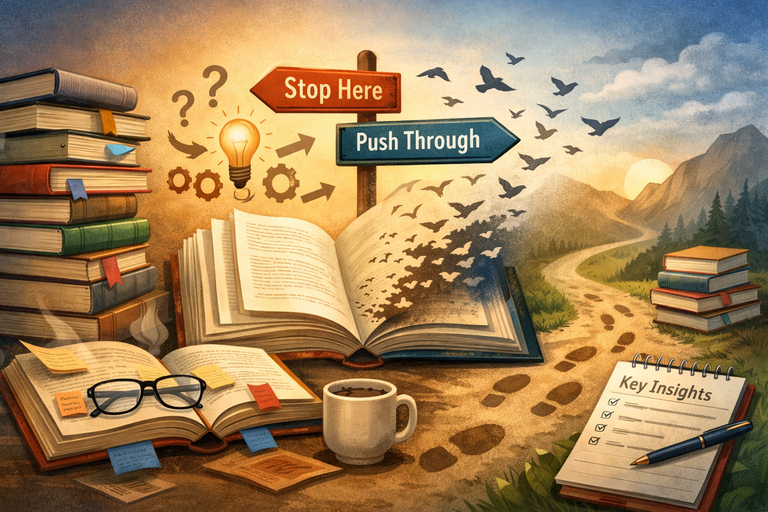
9. A framework for deciding when to finish
Push through when:
-
The book is foundational to your goals
-
You’re developing a challenging skill
-
You trust the source and expect later payoff
-
You cannot yet summarize the argument
Stop (or pause) when:
-
You can summarize and the rest is repetition
-
The reasoning is poor
-
The book no longer matches your goal
-
You’re reading out of guilt, not curiosity
A middle path: “Stop, but don’t discard.” Leave notes like:
-
“Good, but I need more basics first.”
-
“Valuable first half; repeats after chapter 4.”
-
“Not my taste; revisit later.”
This keeps your reading life strategic without being chaotic.
10. Unfinished books map your evolving mind
Books you don’t finish aren’t failures they’re markers of growth.
-
A book skipped at 22 may become essential at 32
-
A thrilling book may feel shallow years later
-
A difficult book may become approachable after building context elsewhere
In this sense, unfinished books are trail markers they show where you were, what you needed, and what you were becoming.
Conclusion: Finishing is optional; learning is not
A finished book provides closure, but learning is messy. It loops, abandons, returns, and recombines. Many books remain unfinished because your goals change, you’ve extracted what matters, or the book didn’t justify your time.
If you read with purpose sampling wisely, quitting deliberately, capturing insights, and applying what you learn an unfinished book can still be a complete act of learning.
The real question isn’t, “Did I finish it?”
It’s, “Did it change what I understand, notice, or do?