The Psychology of Free Learning: Why Students Learn Better When Cost Is Removed
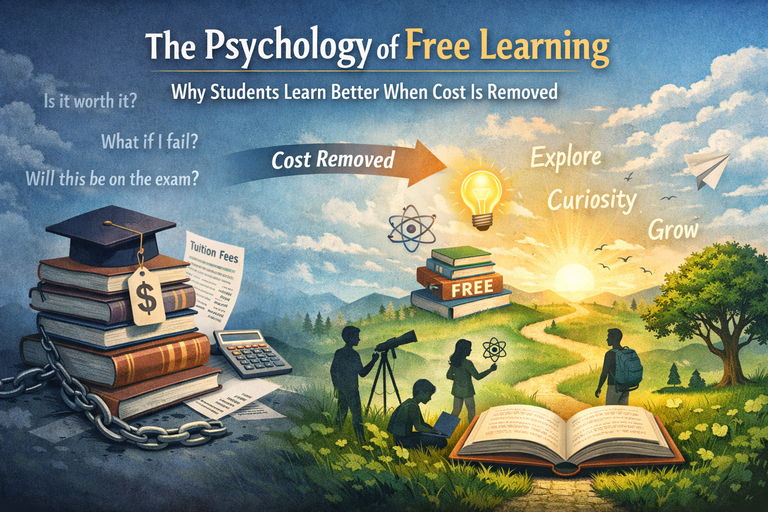
A strange thing happens when the price tag disappears: learning starts to feel less like a transaction and more like exploration.
Most conversations about education costs focus on access who can afford tuition, who can buy the textbook, who has the time and resources to study. Access matters deeply. But there is another layer that often goes unnoticed: cost doesn’t just limit entry into education; it reshapes the psychology of learning itself.
Removing financial barriers does more than widen the doorway. It changes what students do once they’re inside. It affects motivation, curiosity, risk tolerance, persistence, confidence, and over time the kind of learner a person becomes.
Free learning, whether through libraries, open educational resources (OER), public-domain books, or freely available courses, creates a fundamentally different mental environment. In that environment, students often learn better not because “free is generous,” but because the mind behaves differently when it is not defending itself against loss.
When Learning Becomes a Purchase, the Brain Treats It Like One
Paying for education can quietly turn learning into a performance of getting your money’s worth.
Once money enters the picture, students don’t only ask, “What do I want to understand?” They also begin to ask:
-
“Am I wasting my money if I don’t finish?”
-
“Which choice is safest?”
-
“Which course gives the highest return?”
-
“Which book is most likely to be on the exam?”
These are rational questions. In a world where education is expensive, they are survival questions. But psychologically, they redirect attention away from understanding and toward risk management.
Behavioral economics explains this through loss aversion: losses feel more painful than equivalent gains feel pleasurable. When a student has paid hundreds of dollars or is accumulating debt the fear of “losing” that investment becomes emotionally salient. That fear produces pressure, and pressure reliably narrows thinking.
Narrow thinking is useful for emergencies. It is not ideal for learning.
Removing cost reduces the perceived downside of exploration. When the fear of loss fades, the learner’s cognitive bandwidth opens.
Intrinsic Motivation Grows When the Transaction Fades
Self-Determination Theory (Deci & Ryan) suggests that intrinsic motivation flourishes when three psychological needs are met:
-
Autonomy – “I choose to do this.”
-
Competence – “I can improve.”
-
Relatedness – “I feel connected to others or a learning community.”
Payment pressure can quietly undermine autonomy. When learning is expensive, students often feel compelled to justify the cost to parents, to lenders, to themselves. The experience shifts from choice to obligation.
Free learning often restores autonomy. I’m here because I want to be.
This is not a motivational slogan; it is a cognitive advantage. Autonomy increases persistence, deep processing, and tolerance for confusion three traits that predict real understanding better than raw study time.
There is also the overjustification effect, where external incentives crowd out intrinsic interest. Paying for learning is not the same as being paid to learn, but it can still push students into an accounting mindset: What’s the payoff? When cost is removed, internal motivations curiosity, enjoyment, identity can reassert themselves.
Curiosity Is Fragile Under Financial Stress
Curiosity thrives in conditions of psychological safety. It needs slack: time, attention, and permission to wander.
Financial pressure consumes that slack. Stress increases cognitive load and drains working memory. Research on scarcity and “bandwidth” (notably by Mullainathan and Shafir) shows that when resources feel tight, people become narrowly focused on immediate problems. This is adaptive for survival but hostile to exploration.
Curiosity is expansive. It asks:
-
“What happens if I follow this question?”
-
“What’s the backstory of this idea?”
-
“How does this connect to something else?”
A student worried about fees, renewals, or whether they chose the “right” resource is more likely to take the shortest path to a grade not out of laziness, but because their mind is doing triage.
Free learning doesn’t remove all stress, but it removes one persistent stressor: the feeling that every hour must justify a payment. That alone can be enough to let curiosity breathe.
Free Learning Removes the Penalty for Trying and That Changes Everything
One of the strongest predictors of deep learning is productive failure: attempting a task, getting it wrong, and refining understanding through feedback. But productive failure requires the willingness to be wrong.
When wrong turns feel expensive, students avoid them.
In paid environments, “wrong” can mean:
-
buying the wrong book,
-
enrolling in the wrong course,
-
studying a topic that won’t be assessed,
-
discovering too late that something isn’t a good fit.
Free access especially to books reduces the penalty for sampling. Sampling may seem trivial, but psychologically it is profound. It allows learners to iterate: to compare explanations, switch difficulty levels, and follow emerging interests without feeling trapped.
This freedom counters the sunk cost fallacy, which keeps people invested in resources that don’t work simply because they’ve already paid. Free learning makes quitting and switching less shameful and more rational and better matches almost always lead to better outcomes.
“People Value What They Pay For” But Only Under Certain Conditions
A common objection to free learning is that people won’t take it seriously.
There is some psychological basis for this concern. Price can act as a signal of quality, and commitment can increase effort (the “IKEA effect”). Payment can also function as an external commitment device: I paid, so I’ll show up.
But these effects do not mean free learning is inferior. They mean free learning requires different structures of commitment.
When cost is removed, motivation can come from:
-
identity (“I’m the kind of person who learns”),
-
community (study groups, book clubs),
-
visible progress (tracking what you’ve read or understood),
-
meaningful goals (projects, teaching others, creating work).
Cost motivates through fear of waste. Free learning encourages motivation through interest and purpose. The latter is slower to build but far more durable.
Free Books Change the Learning Relationship
Books are a unique learning technology. They can become companions rather than assignments.
A paid textbook is often experienced as a required object tied to a grade. A free book especially one chosen voluntarily feels like an invitation.
This difference changes how students read:
-
Required reading is often extractive: What do I need for the test?
-
Chosen reading is relational: What is this author trying to show me?
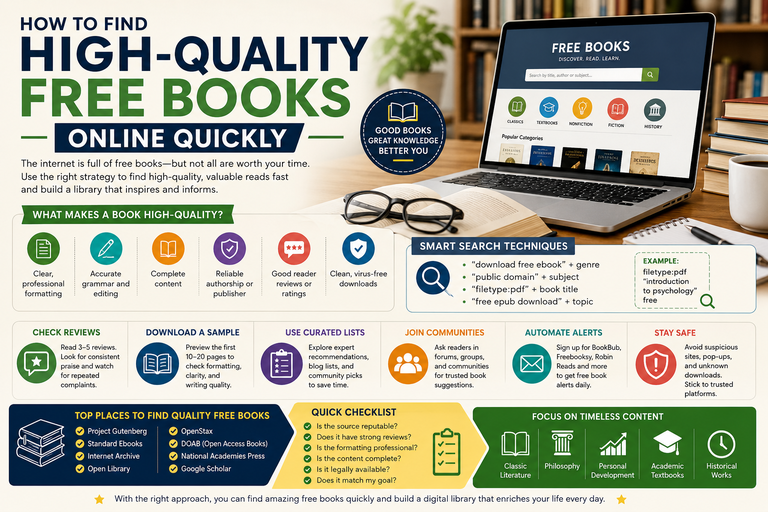
Libraries and open archives enable browsing, which is not wasted time. Browsing is intellectual courtship. It allows students to discover what resonates, what confuses them productively, and what questions naturally arise.
Free books also widen intellectual diversity. When cost is removed, students can read multiple perspectives rather than relying on a single authoritative voice. This strengthens critical thinking and makes understanding more flexible and transferable.
The Zero-Price Effect and the Permission to Begin
Behavioral research on the zero-price effect shows that “free” is not just a discount it produces a unique emotional response. Free dramatically lowers perceived risk, which increases the likelihood of starting.
This matters because the biggest barrier to learning is often not persistence it’s initiation.
The early phase of learning is awkward. Confusion is high, competence is low, and identity feels fragile. Free resources grant psychological permission to begin badly and that permission keeps learners from quitting before momentum forms.
Learning Habits Form When Knowledge Isn’t Tied to a Billing Cycle
Paid learning often teaches a subtle lesson: learning happens inside containers—courses, semesters, subscriptions.
Free learning supports a different habit loop:
-
I notice a question.
-
I look it up.
-
I read widely.
-
I return tomorrow.
This is the pattern of lifelong learners. It is less course-shaped and more life-shaped.
When books are always available through libraries, open archives, or free digital collections learning becomes ambient. Over time, this fosters an identity shift: from student who completes tasks to person who learns.
Equity Is Psychological, Not Only Financial
Removing cost also reduces invisible pressures: embarrassment about not owning materials, reluctance to ask for help, anxiety about delayed purchases, and shame about falling behind for financial reasons.
Shame is cognitively expensive. It leads to avoidance, disengagement, and silence. Free access reduces shame-based withdrawal and increases participation especially for students who already feel marginal.
Belonging is not just humane; it is educationally effective.
What Free Learning Gets Right and What It Must Still Solve
Free learning environments are powerful, but not perfect. Common challenges include:
-
choice overload,
-
lack of sequencing,
-
weak external deadlines,
-
uneven quality.
These are design problems, not failures of the model. Libraries, curated lists, open syllabi, reading guides, and learning communities solve them without sacrificing psychological freedom.
The goal is not to mimic paid education but to combine freedom with thoughtful structure.
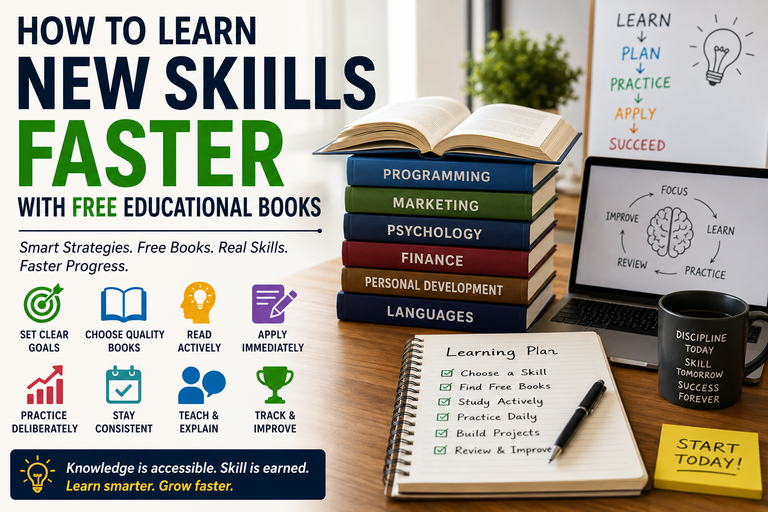
Free Books as an Engine of Deep Learning
The most underappreciated benefit of free books is not affordability it is multiplicity.
When students can access many books, they can learn the way experts do:
-
compare explanations,
-
revisit ideas at higher levels,
-
find authors who “click,”
-
integrate multiple frameworks.
Understanding built from many voices is resilient. It transfers. It lasts.
Conclusion: Removing Cost Doesn’t Remove Value It Redefines It
Paid education often defines value in terms of efficiency, credentials, and return on investment. Those matter but they are not the full psychology of learning.
When cost is removed, students are more likely to:
-
learn for internal reasons,
-
explore without fear,
-
adapt when something doesn’t work,
-
build a lasting learner identity,
-
read widely enough to develop real depth.
Free learning works not because students become more virtuous, but because the mind becomes less defensive. Curiosity returns when the stakes are humane.
And free books quiet, abundant, and endlessly patient may be one of the most powerful learning technologies ever created