
The Science Behind Reading and Knowledge Retention: How the Brain Learns and Remembers
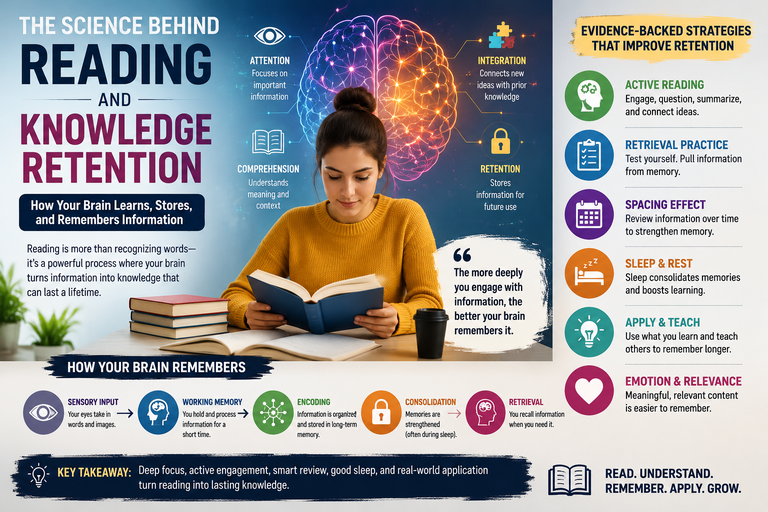
Reading is one of the most powerful tools humans have developed for acquiring knowledge, expanding understanding, and improving cognitive abilities. Whether reading a textbook, research article, novel, or online resource, the process appears simple: the eyes scan words, the brain interprets meaning, and information is stored for future use. However, beneath this seemingly straightforward activity lies a complex interaction of cognitive processes involving perception, attention, comprehension, memory, and learning.
Many people experience a common frustration: spending hours reading only to discover that they remember very little afterward. Others can read the same material and retain key concepts for months or even years. The difference is not merely intelligence or natural talent. Instead, it is largely determined by how the brain processes, stores, and retrieves information.
Understanding the science behind reading and knowledge retention can help students, professionals, researchers, and lifelong learners improve their learning efficiency. By understanding how memory works and applying evidence-based learning strategies, individuals can significantly increase comprehension and long-term retention.
Understanding the Reading Process
Reading is much more than recognizing words on a page. It is a sophisticated mental activity involving multiple stages that work together to transform written symbols into meaningful knowledge.
Decoding
The first stage of reading is decoding. During this process, the brain identifies letters, words, punctuation marks, and sentence structures. Skilled readers perform this process automatically, allowing them to focus on understanding rather than recognizing words.
Comprehension
After decoding, the brain interprets the meaning of the text. Comprehension involves understanding vocabulary, sentence structure, context, and relationships between ideas. It is at this stage that information begins to become meaningful.
Integration
The brain does not store information in isolation. Instead, it integrates new knowledge with existing knowledge structures. Readers connect new concepts to previous experiences, beliefs, and information they already possess.
Retention
The final stage is retention, where information is stored in memory for future retrieval. Successful retention depends on how deeply information is processed and how often it is reinforced over time.
How Memory Works During Reading
To understand why some information is remembered while other information is forgotten, it is important to understand the brain's memory system.
Sensory Memory
When reading, visual information first enters sensory memory. This memory system briefly stores incoming information from the environment.
Working Memory
Working memory serves as the brain's temporary workspace. It holds information long enough for the reader to understand and process what is being read.
However, working memory has limited capacity. Research suggests that individuals can only hold a small amount of information at one time. When reading material becomes too complex or unfamiliar, working memory can become overloaded, reducing comprehension and retention.
Long-Term Memory
For knowledge to be retained, it must move from working memory into long-term memory. Long-term memory has enormous storage capacity and can retain information for years.
The transfer of information from working memory to long-term memory is known as encoding. Strong encoding occurs when information is meaningful, connected to prior knowledge, and actively processed.
Why People Forget What They Read
One of the most important discoveries in cognitive science is that forgetting is natural. The brain is designed to filter information rather than store everything permanently.
Information Overload
Modern readers are exposed to vast amounts of information daily. Books, websites, social media posts, emails, and videos compete for attention. Excessive information overwhelms working memory and reduces retention.
Lack of Attention
Attention acts as the gateway to memory. If attention is weak, information is poorly encoded and quickly forgotten.
Common distractions include:
- Smartphones
- Social media notifications
- Background noise
- Multitasking
- Stress and anxiety
Absence of Reinforcement
Knowledge weakens over time if it is not revisited. Without review and retrieval, memory traces gradually fade.
Shallow Processing
Reading without reflection, questioning, or application often results in shallow learning. Information may seem familiar immediately after reading but quickly disappears because it was never deeply processed.
The Critical Role of Prior Knowledge
Prior knowledge plays a major role in determining how well new information is understood and remembered.
When readers already possess some understanding of a topic, they can:
- Interpret information more quickly
- Connect ideas more effectively
- Understand complex concepts more easily
- Remember information longer
For example, a student familiar with basic economics will learn advanced economic concepts faster than someone encountering the subject for the first time.
Knowledge builds upon knowledge. The more information people already have about a subject, the easier it becomes to acquire additional information within that field.
Active Reading and Deep Learning
Research consistently shows that active reading produces stronger learning outcomes than passive reading.
Passive reading occurs when readers simply move their eyes across the page without engaging mentally with the content.
Active reading involves interacting with the material through:
- Asking questions
- Making predictions
- Highlighting key ideas selectively
- Summarizing information
- Connecting concepts to personal experiences
- Evaluating arguments
Active engagement encourages deeper processing, which strengthens memory formation.
The Power of Retrieval Practice
One of the most effective learning techniques identified by educational psychology is retrieval practice.
Retrieval practice involves actively recalling information from memory rather than repeatedly rereading it.
Examples include:
- Self-testing
- Flashcards
- Practice exams
- Writing summaries from memory
- Teaching concepts to others
Retrieval strengthens neural pathways associated with memory. Every successful recall makes future retrieval easier and more reliable.
Studies consistently demonstrate that students who practice retrieval outperform those who rely solely on rereading.
The Spacing Effect and Long-Term Retention
Another powerful principle of memory science is the spacing effect.
The spacing effect shows that information is remembered better when learning sessions are spread over time rather than concentrated into one session.
Benefits of Spaced Learning
- Stronger long-term retention
- Better recall accuracy
- Reduced forgetting
- More efficient learning
For example, studying for thirty minutes over five days is generally more effective than studying for two and a half hours in one sitting.
Spacing creates desirable difficulty, forcing the brain to work harder to retrieve information and thereby strengthening memory.
Sleep and Memory Consolidation
Sleep plays a crucial role in transforming newly learned information into stable long-term memories.
During sleep, the brain processes and consolidates experiences from the day. Neural connections formed during learning are strengthened and organized.
Benefits of adequate sleep include:
- Improved concentration
- Better comprehension
- Enhanced memory formation
- Greater recall ability
Conversely, sleep deprivation impairs attention, learning, and retention.
Students who sacrifice sleep to study often perform worse than those who balance study with sufficient rest.
The Influence of Attention and Focus
Attention is one of the strongest predictors of successful learning.
Without attention, information cannot be effectively encoded into memory.
Factors That Reduce Attention
- Constant interruptions
- Digital distractions
- Emotional stress
- Fatigue
- Poor learning environments
Factors That Improve Attention
- Quiet study spaces
- Clear learning goals
- Scheduled study sessions
- Frequent short breaks
- Good physical health
Focused attention allows deeper cognitive processing, leading to stronger memory retention.
Emotion and Memory
Emotion significantly influences memory formation.
The brain naturally prioritizes information that is emotionally meaningful, surprising, or personally relevant.
People are more likely to remember:
- Inspiring stories
- Personal experiences
- Surprising discoveries
- Information related to goals
- Emotionally engaging content
This explains why stories often remain memorable long after specific facts have been forgotten.
Educators frequently use storytelling because it increases engagement and enhances retention.
Effective Note-Taking for Knowledge Retention
Note-taking is most effective when it encourages active processing rather than passive copying.
Effective Note-Taking Strategies
- Summarizing ideas in your own words
- Organizing information into categories
- Creating concept maps
- Writing questions about the material
- Linking ideas to real-world examples
Ineffective Note-Taking Habits
- Copying text word-for-word
- Recording excessive details
- Never reviewing notes
Good notes serve as tools for understanding rather than merely storing information.
Dual Coding and Visual Learning
Dual coding theory suggests that information is remembered better when presented through both verbal and visual formats.
Examples include:
- Diagrams
- Charts
- Mind maps
- Infographics
- Illustrations
When readers combine words with visuals, they create multiple memory pathways, increasing the likelihood of successful recall.
This is why educational materials often include images, graphs, and visual summaries.
The Importance of Chunking
The brain processes information more efficiently when it is organized into meaningful groups known as chunks.
Instead of remembering many isolated pieces of information, readers can group related concepts together.
Chunking:
- Reduces cognitive load
- Improves comprehension
- Enhances recall
- Simplifies review
Textbooks often use headings, subheadings, and structured layouts because these naturally support chunking.
Learning Through Teaching
One of the strongest methods for reinforcing knowledge is teaching it to others.
Explaining information requires individuals to:
- Organize thoughts clearly
- Identify knowledge gaps
- Retrieve information actively
- Simplify complex concepts
The process strengthens understanding and improves long-term retention.
Even teaching imaginary students or explaining concepts aloud to oneself can significantly improve learning outcomes.
Reading Speed Versus Comprehension
Many readers focus on increasing reading speed, but speed alone does not guarantee learning.
Reading too quickly can reduce:
- Comprehension
- Reflection
- Critical thinking
- Memory encoding
The most effective reading pace is one that balances efficiency with understanding.
Different types of material require different reading speeds. Complex academic texts often require slower, more deliberate reading than light recreational content.
Applying Knowledge for Lasting Retention
Knowledge becomes more durable when it is applied in real situations.
Examples include:
- Practicing newly learned skills
- Solving problems
- Completing projects
- Engaging in discussions
- Using concepts in daily life
Application transforms theoretical knowledge into practical experience, creating stronger and more meaningful memories.
Common Myths About Reading and Memory
Myth 1: Understanding Means Remembering
Understanding information once does not guarantee future recall. Reinforcement is necessary.
Myth 2: Repeated Rereading Is the Best Study Method
Research shows that retrieval practice and spaced repetition are generally more effective than repeated rereading.
Myth 3: Intelligence Determines Memory
Memory performance depends heavily on learning strategies rather than intelligence alone.
Myth 4: Multitasking Improves Productivity
Multitasking divides attention and often reduces both comprehension and retention.
Practical Strategies for Better Knowledge Retention
To maximize learning from reading:
Before Reading
- Set clear objectives.
- Preview headings and structure.
- Activate prior knowledge.
During Reading
- Read actively.
- Ask questions.
- Summarize sections.
- Make meaningful notes.
After Reading
- Test yourself.
- Review key points.
- Teach the material.
- Apply concepts in practice.
- Use spaced repetition.
Consistently applying these strategies can dramatically improve long-term retention.
Conclusion
Reading is far more than a simple act of recognizing words. It is a sophisticated cognitive process involving attention, comprehension, memory, and learning. The science of knowledge retention demonstrates that successful learning depends not only on what we read but also on how we engage with information.
Research shows that active reading, retrieval practice, spaced repetition, sufficient sleep, focused attention, and practical application are among the most effective ways to strengthen memory. By understanding the mechanisms behind learning and adopting evidence-based strategies, individuals can transform reading from a passive activity into a powerful tool for lifelong knowledge acquisition.
In an age where information is abundant but attention is scarce, mastering the science behind reading and knowledge retention is one of the most valuable skills anyone can develop. The goal is not merely to read more but to remember more, understand more deeply, and apply knowledge more effectively in everyday life