Active Recall and Spaced Repetition: A Beginner-Friendly Study Guide
If you’ve ever reread a chapter three times and still felt shaky on test day, you’ve experienced the limits of passive study. Rereading, highlighting, and rewatching lectures feel productive but they often create familiarity, not mastery.
Two simple techniques consistently outperform those methods:
-
Active recall: Actively pulling information from memory
-
Spaced repetition: Reviewing information on a smart, increasing schedule
Together, they help you build durable, flexible knowledge efficiently whether you’re learning a language, preparing for exams, or developing professional skills.
The Big Idea (In One Minute)
-
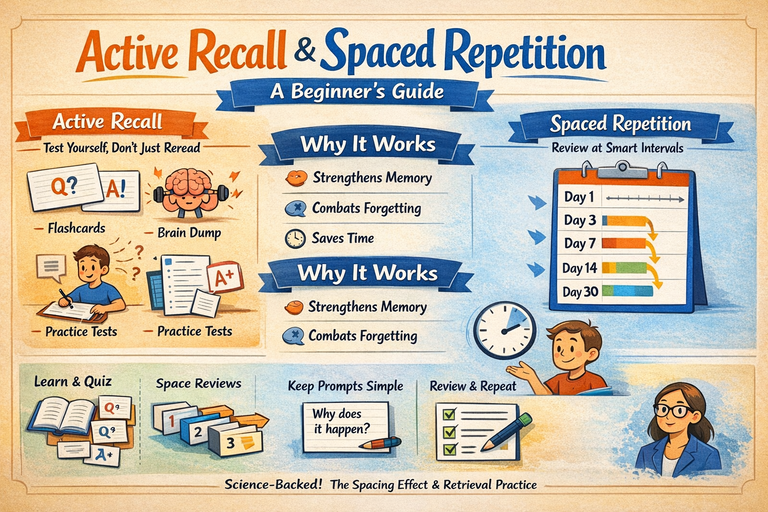
Active recall: Test yourself before looking at notes
-
Spaced repetition: Review at increasing intervals
-
Why it works:
-
Retrieval strengthens memory
-
Spacing slows forgetting
-
Combined, they beat cramming with less total study time
-
What Is Active Recall?
Active recall means trying to remember information without looking at it. Instead of re-exposing yourself to content, you practice retrieval producing the answer from memory.
This feels harder than rereading. That discomfort is a good sign. It tells your brain, “This matters store it properly.”
Passive vs Active Study
| Passive Study | Active Recall |
|---|---|
| Rereading notes | Answering questions from memory |
| Highlighting | Explaining concepts aloud |
| Rewatching videos | Solving problems cold |
Simple Ways to Practice Active Recall
You don’t need fancy tools. Start with these:
1. Closed-Book Questions
Read a section once. Close the book and ask:
-
What were the three main ideas?
-
How would I solve the key example without notes?
2. Brain Dump
After class or study:
-
Write everything you remember for 5 minutes
-
Check notes afterward and fill gaps in another color
3. Practice Tests
-
Use past questions or sample problems
-
Time yourself, no notes
-
Review mistakes carefully
4. Flashcards
-
Question on the front, answer on the back
-
Say the answer out loud before flipping
5. Teach It
Explain the topic to an imaginary student using simple language.
6. Cloze Deletions
Fill-in-the-blank prompts, such as:
“Photosynthesis occurs in the of plant cells.”
How to Write Good Recall Prompts
Not all questions are equal. High-quality prompts make recall easier and more powerful.
Best practices:
-
Make them atomic: One idea per card
-
Ask for meaning: “Why does X happen?” not just “What is X?”
-
Use context: Scenarios, diagrams, or real-world cues
-
Avoid ambiguity: One clear best answer
-
Prefer generation over recognition: Short-answer beats multiple choice
What Is Spaced Repetition?
Spaced repetition means reviewing information right before you’re likely to forget it, then gradually increasing the time between reviews.
Instead of studying something five times in one day, you study it five times over several weeks.
Each successful recall lets you wait longer before the next review.
Why Spacing Works
1. It Matches the Forgetting Curve
Memory fades fast at first, then more slowly. Spacing catches knowledge just as it starts to slip.
2. It Creates “Desirable Difficulty”
Struggling a little during recall strengthens memory and improves transfer to new situations.
3. It Saves Time
You stop wasting time on things you already know and focus on what’s at risk.
Beginner-Friendly Spacing Schedules
You don’t need complex algorithms. Try one of these:
Simple Schedule
-
Day 0 (learn)
-
Day 1
-
Day 3
-
Day 7
-
Day 14
-
Day 30
-
Day 60
Micro Schedule (Smarter Cramming)
-
Same day
-
Next day
-
3 days
-
1 week
-
2 weeks
Leitner Box System (Paper Cards)
-
Box 1: Daily
-
Box 2: Every 2–3 days
-
Box 3: Weekly
-
Box 4: Every 2 weeks
-
Box 5: Monthly
Forgot a card? Send it back to Box 1.
Putting Active Recall and Spacing Together
A Simple Weekly Loop
-
Learn – Read or watch for understanding
-
Generate prompts – Turn content into questions the same day
-
First retrieval – Test yourself within 24 hours
-
Space reviews – Only review when due
-
Apply – Solve problems, write, or teach
A 30-Minute Daily Routine
-
5 minutes: Brain dump yesterday’s key ideas
-
15 minutes: Review spaced items due today
-
10 minutes: Create 5–10 new prompts
Small, consistent sessions beat long, irregular ones.
Examples Across Subjects
Languages
-
Use sentence-based cloze cards, not isolated words
-
Recall phrases before checking scripts
-
Mix listening, speaking, and writing
Science & Medicine
-
Create step-by-step “how” and “why” prompts
-
Include mechanisms, causes, and contrasts
Math & Engineering
-
Recall definitions and theorems
-
Solve problems cold
-
Make cards for conditions, steps, and pitfalls
Programming
-
“Given this error, what are likely causes?”
-
“Write a function that…” then actually code it
Essay-Based Exams
-
Use outline prompts
-
Speak or jot a 60-second plan before checking notes
Quality Over Quantity: Making Better Cards
-
Keep answers short (1–2 sentences)
-
Split complex ideas into multiple prompts
-
Add examples or counterexamples
-
Use diagrams when structure matters
-
Delete or rewrite weak cards quickly
A good deck feels helpful, not heavy.
Common Pitfalls (And Fixes)
| Problem | Fix |
|---|---|
| Rereading without recall | Always try to recall first |
| Reviewing too often | Increase intervals if it feels too easy |
| Trivia-only cards | Add conceptual and application prompts |
| Too many new cards | Cap at 10–20 per day |
| Memorizing without understanding | Learn first, then memorize |
| Perfectionism | Forgetting guides what to study next |
Tools: Choose One and Start
-
Paper cards: Cheap, tactile, distraction-free
-
Anki: Free, powerful SRS with cloze deletions
-
RemNote / Mnemosyne / SuperMemo: Note-linked SRS tools
-
Quizlet: Good for quick sets (self-enforce spacing)
Quick-Start in 10 Minutes
-
Pick one chapter
-
Write 8–12 mixed prompts
-
Test yourself immediately
-
Schedule reviews: tomorrow, 3 days, 1 week, 2 weeks
-
Improve or delete weak cards after each review
How to Study a Chapter Using Recall and Spacing
-
Preview (5–10 min) – Skim headings and figures
-
Learn (20–40 min) – Focus on understanding
-
Generate (10 min) – Turn notes into questions
-
First recall (5–10 min) – Same day, no notes
-
Space – Review only when due
Measuring Progress (Without Chasing Perfection)
-
Track results, not hours
-
Expect slight struggle as intervals grow
-
Use real tasks as proof: exams, problems, conversations
Frequently Asked Questions
Do I still highlight?
Yes but only to mark potential prompts. Highlighting alone isn’t learning.
Read first or recall first?
For new material, read once for understanding. Then switch quickly to recall.
How many cards per day?
Usually 10–20 well-made cards keeps reviews under 30–45 minutes.
What if I forget a lot?
That’s feedback, not failure. Shorten the interval and improve understanding.
Is this only for facts?
No. Use recall for concepts, decisions, steps, and strategies.
When will I see results?
Often within a week. The biggest gains compound over months.
A Note on the Evidence
Over a century of research supports the spacing effect and the testing effect. Studies across subjects consistently show that spaced retrieval outperforms massed study for long-term retention. Psychologists describe these strategies as desirable difficulties they feel harder, but they build knowledge that lasts.
Cheat Sheet (Keep This by Your Desk)
-
Don’t look answer first
-
Keep cards small and specific
-
Stretch intervals until recall is effortful
-
Mix facts with why/how and application
-
Fix or delete bad cards fast
-
Cap daily new items
-
Protect the habit
Final Thought
If you adopt just two habits try to remember before you look, and revisit at growing intervals you’ll learn more in less time and keep it longer.
That’s the quiet superpower of active recall and spaced repetition