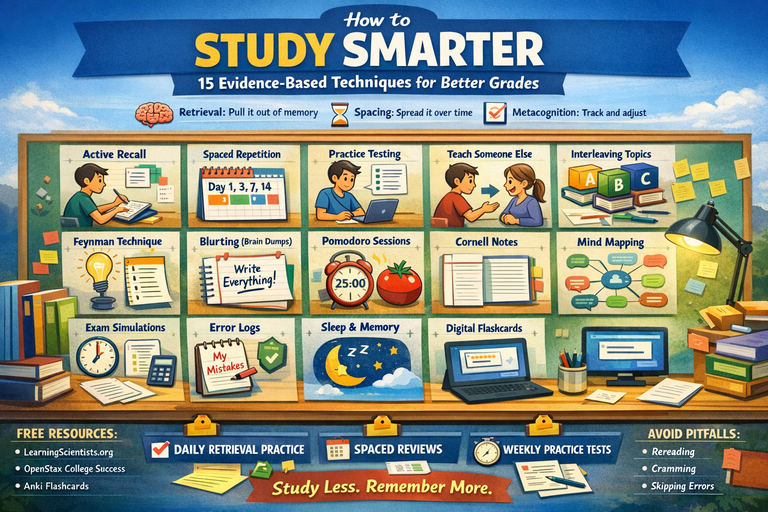
How to Study Smarter: 15 Evidence-Based Techniques for Better Grades
Studying longer doesn’t automatically mean learning more. Many students spend hours rereading notes, highlighting textbooks, or cramming the night before an exam only to forget most of it days later. Research in cognitive psychology shows that effective studying is not about time spent, but about strategy used.
The most successful students rely on a small set of science-backed techniques, applied consistently. These methods improve retention, understanding, and exam performance often while reducing total study time.
This guide breaks down 15 proven study techniques, explains why they work, and shows exactly how to use them. You’ll also find ready-to-use workflows, templates, common pitfalls, and free resources no expensive courses required.
The Big Idea: 3 Core Principles Behind Smart Studying
Almost all effective study strategies are built on three foundational principles:
1. Retrieval
Learning happens when you pull information out of your memory, not when you repeatedly push it in. Every act of recall strengthens neural pathways.
2. Spacing
Spreading study sessions over time allows forgetting to occur slightly—so relearning becomes stronger and longer-lasting.
3. Metacognition
Tracking what you know, what you don’t, and why you make mistakes allows you to adjust strategies and improve efficiently.
Master these principles, and the techniques below will work even better.
The 15 Evidence-Based Study Techniques (What, Why, How)
1. Active Recall ðŸ§
What: Deliberately recalling information from memory without looking at notes.
Why: Retrieval practice strengthens memory far more than rereading or highlighting.
How to use it:
-
After reading or a lecture, close your book and list key ideas from memory.
-
Solve problems without looking at worked solutions.
-
End each study session with 5–10 minutes of recall.
Pro tip: If you can’t explain something simply, you don’t know it well identify the gap and fix it.
2. Spaced Repetition â³
What: Reviewing material at increasing intervals (e.g., Day 1, 3, 7, 14).
Why: Spacing combats forgetting and dramatically improves long-term retention.
How to use it:
-
Use digital flashcard apps like Anki or manual Leitner boxes.
-
Avoid back-to-back reviews in one sitting spread them across days.
Pro tip: If review feels slightly difficult, that’s ideal. Easy reviews mean poor timing.
3. Practice Testing âœï¸
What: Testing yourself with questions, quizzes, or past exams.
Why: Testing is not just assessment it is learning.
How to use it:
-
Begin early with short, low-stakes quizzes.
-
Create questions from headings and learning objectives.
-
Progress to full practice exams.
Pro tip: Always answer closed-book first to avoid the illusion of knowing.
4. Teach What You Learn (The Protégé Effect) 🗣ï¸
What: Explaining concepts as if teaching someone else.
Why: Teaching forces organization, retrieval, and deeper understanding.
How to use it:
-
Write a one-page lesson or record a 2–3 minute explanation.
-
Teach a friend or an imaginary student.
Pro tip: Structure explanations using what it is, why it matters, how it works, and when it fails.
5. Interleaving Topics 🔀
What: Mixing related topics or problem types within one session.
Why: Improves discrimination and transfer exactly what exams require.
How to use it:
-
Rotate between 2–3 topics instead of studying one repeatedly.
-
For STEM: mix problem types.
-
For humanities: mix themes, authors, or perspectives.
Pro tip: Interleaving feels harder but produces better test results.
6. The Feynman Technique 🧩
What: Explaining a concept in simple language, identifying gaps, and refining.
Why: Forces clarity and reveals weak understanding.
How to use it:
-
Write the concept in plain terms.
-
Identify unclear parts.
-
Revisit sources.
-
Rewrite more simply.
Pro tip: Never copy textbook language use your own words.
7. Blurting (Brain Dumps) ðŸ“
What: Writing everything you remember on a topic within a time limit.
Why: Pure retrieval reveals what actually stuck.
How to use it:
-
Set a 5–10 minute timer.
-
Write everything you remember without notes.
-
Compare and correct.
Pro tip: Do blurting before and after studying to measure improvement.
8. Pomodoro Study Sessions â±ï¸
What: Focused work intervals with short breaks (e.g., 25 minutes on, 5 off).
Why: Improves focus, reduces fatigue, and fights procrastination.
How to use it:
-
Define a clear output for each Pomodoro.
-
Take screen-light breaks stand, stretch, hydrate.
Pro tip: Adjust intervals (20/5 or 50/10). Shorter sprints work well for ADHD.
9. Cornell Note-Taking 🗂ï¸
What: Notes divided into cues, main notes, and summaries.
Why: Encourages questioning and retrieval.
How to use it:
-
Right column: notes during class.
-
Left column: questions after class.
-
Bottom: short summary.
Pro tip: The recall stage is where learning happens not the note-taking.
10. Mind Mapping / Concept Mapping 🕸ï¸
What: Visual diagrams showing relationships between ideas.
Why: Helps organize complex material (best for understanding).
How to use it:
-
Start with a central idea.
-
Branch related concepts.
-
Label connections clearly.
Pro tip: Use mind maps to understand; use retrieval to remember.
11. Retrieval Practice (The Umbrella Skill) 🎯
What: Any method requiring recall without notes.
Why: One of the strongest findings in learning science.
How to use it:
-
Free recall summaries.
-
Closed-book problem solving.
-
Cue-answer columns.
-
Cloze deletions.
Pro tip: Aim for desirable difficulty challenging but doable.
12. Exam Simulations 🧪
What: Practicing under realistic exam conditions.
Why: Matches exam pressure and format.
How to use it:
-
Stage 1: untimed, closed-book.
-
Stage 2: timed.
-
Stage 3: full exam simulation.
Pro tip: Do a full simulation 7–10 days before the exam.
13. Error Logs (Mistake Journals) 🧾
What: A structured record of mistakes and fixes.
Why: Prevents repeating the same errors.
How to use it:
-
Log the mistake, cause, correct approach, and trigger reminder.
-
Review with spaced repetition.
Pro tip: Tag errors (conceptual, procedural, careless) to find patterns.
14. Sleep Scheduling 😴
What: Consistent 7–9 hours of sleep.
Why: Sleep consolidates memory and improves problem-solving.
How to use it:
-
Study earlier in the day.
-
Do a short review before bed.
-
Recall briefly in the morning.
Pro tip: Protect the last hour before bed from cramming and screens.
15. Digital Flashcards 💻
What: Flashcards using spaced repetition algorithms.
Why: Efficient for facts, formulas, and vocabulary.
How to use it:
-
One idea per card.
-
Use cloze deletions.
-
Add images when helpful.
Pro tip: Rewrite or delete cards you keep failing they’re poorly designed.
How to Integrate These Techniques: A Simple Weekly Workflow
Daily (45–90 min on class days):
-
1–2 Pomodoros: Active recall + flashcards
-
1–2 Pomodoros: Interleaved practice
-
1 Pomodoro: Update notes, mind maps, and error log
Twice weekly:
-
Practice testing + blurting
Weekly:
-
Timed exam practice
-
Review error log and weak areas
Nightly:
-
5-minute recall of the day’s top 3 concepts, then sleep
Common Pitfalls to Avoid
-
Rereading and highlighting as your main strategy
-
Overly wordy flashcards
-
Cramming practice exams in the final week
-
Skipping error logs
-
Confusing familiarity with mastery
Free Resources (No Paid Courses Needed)
-
The Learning Scientists – free study strategy guides
-
OpenStax College Success – free textbook
-
Learning How to Learn – free MOOC
-
Cornell Note-Taking Guide – official PDF
-
Anki – free spaced repetition app
-
Pomodoro Timers – pomofocus.io, marinara-timer.com
Bring It All Together
If you do just three things daily retrieval practice, spaced reviews, and weekly practice tests with an error log you’ll capture most of the benefits of learning science. Add focused Pomodoro sessions and consistent sleep, and you’ll study less, remember more, and perform better when it matters most.
Smart studying isn’t about working harder it’s about working strategically