Pomodoro vs Deep Work: Best Study Method for Students (Compared)
In a world full of notifications, deadlines, and cognitive overload, how you study can matter as much as what you study. Two of the most popular focus strategies the Pomodoro Technique and Deep Work are often presented as rivals. In reality, they solve different problems.
Both methods improve focus, but they serve different stages of learning and different types of tasks. Pomodoro excels at getting you started and sustaining momentum; Deep Work is designed for mastering complex material and producing high-quality output. For most students, the smartest strategy isn’t choosing one it’s combining both.
This article breaks down how each method works, when to use them, and how to blend them into a powerful, evidence-informed study system.
At-a-Glance Comparison
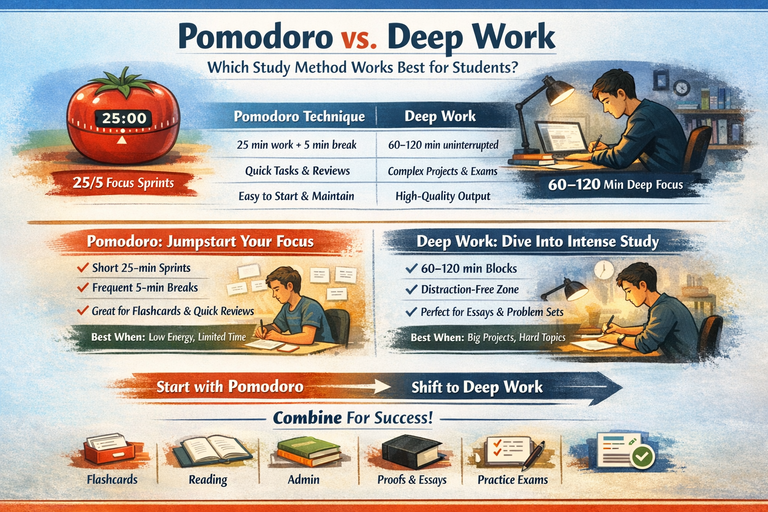
| Feature | Pomodoro Technique | Deep Work |
|---|---|---|
| Typical length | 25 min focus + 5 min break (after 4 rounds, a 15–30 min break) | 60–120 minutes of uninterrupted focus |
| Best for | Getting started, low-to-medium difficulty tasks, reviews | Complex subjects, problem sets, writing, exam simulations |
| Strengths | Reduces procrastination, creates rhythm, easy to maintain | Enables depth, flow, and high-quality output |
| Limitations | Can fragment deep thinking if overused | Harder to start; requires preparation and environment control |
| Who benefits most | Beginners, busy students, low motivation, ADHD (with tweaks) | Advanced students, big projects, serious exam prep |
| Example tasks | Flashcards, short problem reps, reading, admin | Proofs, essays, labs, capstones, full practice exams |
The Case for Pomodoro (25/5)
What It Is
The Pomodoro Technique breaks work into short, focused sprints, traditionally 25 minutes, followed by a 5-minute break. After four cycles, you take a longer break (15–30 minutes).
Why It Works
-
Reduces mental friction: Starting feels easier when you only commit to 25 minutes.
-
Prevents attention fatigue: Regular breaks counteract the “vigilance decrement,” where focus fades over time.
-
Encourages single-tasking: The timer creates urgency and boundaries.
How to Use Pomodoro Well
-
Define a clear, tiny output per sprint
-
Example: “10 Anki cards,” “2 problems,” “outline essay intro.”
-
-
Stay on the same task for 2–4 Pomodoros to maintain context.
-
Design better breaks
-
Stand, stretch, hydrate, walk, or do one breathing cycle (e.g., 4-7-8).
-
-
Customize intervals
-
15/5 → low energy or high distractibility
-
25/5 → general use
-
50/10 → reading or writing when momentum is high
-
Perfect Use-Cases
-
Overcoming procrastination
-
Spaced repetition and retrieval practice
-
Light-to-moderate problem solving
-
Reading, reviewing, and admin tasks
Common Pitfalls
-
Switching tasks every 25 minutes
-
Turning breaks into social-media sessions
-
Forcing Pomodoro on tasks that require long, uninterrupted reasoning
The Case for Deep Work (60–120 Minutes)
What It Is
Deep Work is a protected block of distraction-free, single-task focus dedicated to cognitively demanding work.
Why It Works
-
Minimizes context switching, which is costly for complex thinking
-
Enables flow states, integration of ideas, and deeper understanding
-
Matches the cognitive demands of advanced learning and creation
How to Do Deep Work Effectively
-
Pre-commit
-
Schedule a 60–90 minute block in your calendar (1–2 per day is optimal).
-
-
Define a concrete output
-
“Finish proof of Theorem 2”
-
“Draft Discussion section”
-
“Complete Section A of past paper under timed conditions”
-
-
Control the environment
-
Silence notifications, block distracting sites, clear your desk.
-
-
Entry ritual (2 minutes)
-
Write the first step, park stray thoughts, start immediately.
-
-
Exit ritual (3 minutes)
-
Log progress, note the next step, schedule the next block.
-
Perfect Use-Cases
-
Advanced problem sets and derivations
-
Essays, lab reports, research writing
-
Full-length exam simulations
-
Complex debugging or algorithm design
Common Pitfalls
-
Vague goals (“study Chapter 7”)
-
Overshooting capacity (quality drops after ~90 minutes for many)
-
Not protecting the block from interruptions
A Quick Decision Guide
Choose Pomodoro If:
-
You’re procrastinating or overwhelmed
-
You only have 15–45 minutes
-
The task is modular (reviews, short reps)
Choose Deep Work If:
-
The task requires integration or construction of ideas
-
You’re simulating exam conditions
-
You can protect a 60–120 minute window
Energy-Based Rule of Thumb
-
High-energy hours (often morning): Deep Work
-
Lower-energy hours (afternoon/evening): Pomodoro for reviews and lighter tasks
The Hybrid Approach That Works Best
The most effective students don’t pick sides they sequence.
Use Pomodoro to start. Stay if it’s working. Switch to Deep Work when momentum or depth is needed.
Example: A Class Day
-
8:30–9:00: Plan + 1 Pomodoro (activation)
-
9:00–10:30: Deep Work (hardest problem set)
-
10:30–10:50: Walk + snack
-
11:00–12:00: 2 Pomodoros (flashcards + error review)
-
Afternoon: Classes
-
16:00–17:00: 2 Pomodoros (interleaved practice)
-
19:00–20:00: Deep Work (essay draft or exam section)
-
Evening: Light admin, plan tomorrow
Example: Exam-Prep Day
-
Block 1 (90–120 min): Full timed exam section
-
Long break (20–30 min)
-
2–3 Pomodoros: Error analysis + targeted drills
-
Block 2 (60–90 min): Reattempt weak areas
-
Evening: Pomodoros for spaced repetition, then sleep
Mapping Tasks to Methods by Subject
Math / Physics / Engineering
-
Deep Work: proofs, derivations, full past papers
-
Pomodoro: formulas, definitions, quick reps, error logs
Computer Science
-
Deep Work: algorithm design, features, debugging
-
Pomodoro: documentation, katas, tests, refactoring
Biology / Medicine
-
Deep Work: case integration, pathways, exam blocks
-
Pomodoro: SRS facts, diagram labeling, recall drills
Humanities / Social Sciences
-
Deep Work: essay drafting, close reading
-
Pomodoro: quotes, summaries, reference management
Languages
-
Deep Work: immersion, long listening/reading sessions
-
Pomodoro: vocabulary SRS, grammar drills, dictation
Evidence-Informed Study Principles
-
Retrieval beats rereading: Use Pomodoro for active recall; Deep Work for synthesis and exam practice.
-
Interleaving: Mix problem types across Pomodoros to improve discrimination.
-
Spacing: Spread Pomodoros across days; schedule Deep Work 2–3 times per topic weekly.
-
Sleep matters: Short recall before bed enhances consolidation.
Adjustments for ADHD or Low Motivation
-
Shorter intervals (15/5 or 20/5)
-
Body doubling (study partners or virtual coworking)
-
Movement-based breaks
-
Temptation bundling (tea, instrumental music)
-
Hard Deep Work boundaries (library rooms, blockers, DND schedules)
Break Design Matters
5-Minute Breaks
-
Stretch, hydrate, breathe, move, rest your eyes
15–30 Minute Breaks
-
Walk outside, protein-rich snack, sunlight, or a 20-minute power nap
Avoid “break drift” by setting a break timer and staying off addictive apps.
Simple Metrics to Track Effectiveness
-
Time on task (percentage of actual focus)
-
Output per block (problems solved, pages written)
-
Error trends (decreasing repetition of mistakes)
-
Subjective focus score (1–5) after each session
What Research Suggests
-
Short, purposeful breaks sustain attention (vigilance research).
-
Complex skill development benefits from sustained, deliberate practice.
-
Flow states during uninterrupted work correlate with deeper engagement and better output.
-
The Pomodoro structure aligns with findings on attention and fatigue, even if the 25/5 split isn’t sacred.
-
Many students perform best with 60–90 minute deep blocks a useful heuristic, not a rigid rule.
A Quick-Start Plan (Today)
-
Pick one easy task and one hard task.
-
Do 1 Pomodoro to get moving on the easy task.
-
Run a 60–90 minute Deep Work block for the hard task.
-
Follow with 1–2 Pomodoros for error analysis or flashcards.
-
Log outputs and schedule your next Deep Work block.
Bottom Line
-
Pomodoro is your ignition and maintenance system perfect for momentum, reviews, and busy days.
-
Deep Work is your mastery engine essential for complex subjects and exam performance.
-
Combine both: start with Pomodoro to overcome friction, then transition into Deep Work to do your best thinking.
Aim for daily Pomodoros and 2–4 Deep Work blocks per week. That simple hybrid can help you study less, learn more, and perform better when it matters most.