How to Take Notes That Help You Remember (With Examples)
Good notes aren’t pretty they’re useful. The goal of note-taking isn’t to copy everything a teacher says or to recreate the textbook word for word. The real purpose is to create mental cues you can quickly turn into memory, understanding, and performance when it matters during exams, presentations, or real-world application.
In this guide, you’ll learn why some notes stick and others fade, explore four powerful note-taking systems, and see clear, worked examples using one topic across all methods. You’ll also get a simple workflow, subject-specific adaptations, common pitfalls, and free resources to practice no paid courses required.
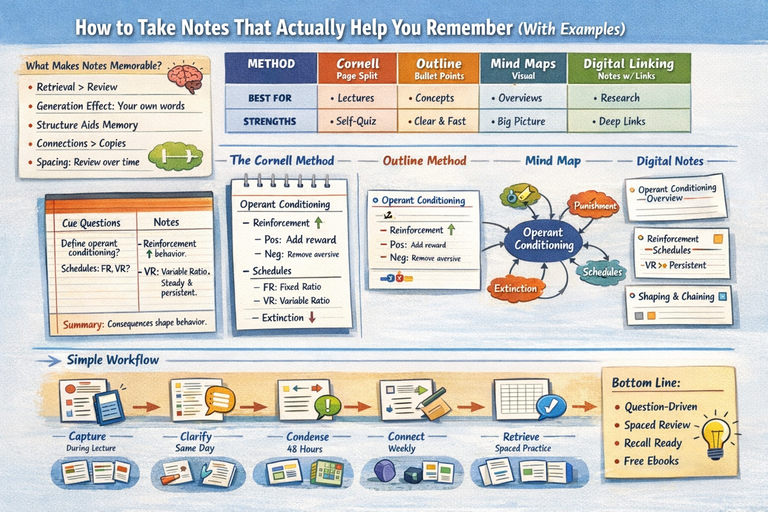
What Makes Notes Memorable (The Science in 30 Seconds)
Effective note-taking is grounded in learning science, not aesthetics.
-
Retrieval over review
Notes should help you test yourself, not just reread. Actively pulling information from memory strengthens learning far more than passive review. -
The generation effect
Writing ideas in your own words improves understanding and recall more than copying verbatim. -
Structure aids memory
Organizing notes into questions, hierarchies, or visual maps makes information easier to retrieve. -
Connections beat copies
Linking new ideas to prior knowledge and to each other creates stronger memory networks. -
Spacing matters
Revisiting and refining notes over days and weeks beats a single review session.
In short: notes are tools for thinking, not storage containers.
Which Note System Fits Your Task?
Different tasks call for different systems. Here’s a quick comparison:
| Method | Format | Best For | Strengths | Watch-outs |
|---|---|---|---|---|
| Cornell | Page split into cues, notes, summary | Lectures, textbook chapters, revision | Built-in retrieval, fast review | Useless if you skip recall |
| Outline | Hierarchical bullet points | Concept-heavy topics, readings | Clear structure, easy scanning | Can become transcription |
| Mind Maps | Visual branches linking ideas | Overviews, complex relationships | Big-picture clarity, dual coding | Needs retrieval to boost memory |
| Digital Linking | Atomic notes with backlinks | Long-term study, research | Strong connections, scalable | Easy to over-collect |
Deep Dives With Examples
(One topic across all four systems)
Topic used: Operant Conditioning (Psychology)
1. The Cornell Method 🗂ï¸
What It Is
A page divided into three zones:
-
Left: Cue questions or keywords
-
Right: Main notes
-
Bottom: Short summary (3–5 sentences)
How to Use It
-
During class/reading: Write concise notes on the right.
-
After (10 minutes): Turn your notes into cue questions on the left.
-
Review: Cover the notes, answer using cues only, then check and refine.
Example (Condensed)
Left – Cues
-
Define operant conditioning
-
Reinforcement vs punishment
-
Positive vs negative consequences
-
FR, VR, FI, VI schedules—effects?
-
Shaping vs chaining
-
What is extinction?
Right – Notes
-
Learning where behavior is shaped by consequences (Skinner).
-
Reinforcement ↑ behavior; punishment ↓ behavior.
-
Positive = add stimulus; negative = remove stimulus.
-
Schedules:
-
FR: fixed responses → high rate + pause
-
VR: variable responses → high, steady; resistant to extinction
-
FI: fixed time → scalloped pattern
-
VI: variable time → steady moderate rate
-
-
Shaping = successive approximations
-
Chaining = linking behaviors
-
Extinction = reinforcement stops → behavior declines; spontaneous recovery possible
Bottom – Summary
Operant conditioning explains how behavior changes through consequences. Reinforcement increases behavior, while punishment decreases it. Positive and negative describe adding or removing stimuli. Variable ratio schedules produce the most persistent behavior. Without reinforcement, behaviors weaken through extinction.
Pro Tips
-
Phrase cues like exam questions (“Why is VR resistant to extinction?”).
-
Star missed answers and revisit them with spaced repetition.
2. The Outline Method 🧱
What It Is
A hierarchical bullet-point structure showing main ideas and supporting details.
How to Use It
-
Limit yourself to 1–3 levels.
-
Use abbreviations and your own words.
-
Mark definitions (Def), examples (Ex), and cause/effect (→).
Example
Operant Conditioning
-
Def: Behavior shaped by consequences (Skinner)
-
Key Concepts
-
Reinforcement → ↑ behavior
-
Positive: add reward (Ex: praise)
-
Negative: remove aversive (Ex: seatbelt beep stops)
-
-
Punishment → ↓ behavior
-
Positive: add aversive (Ex: extra chores)
-
Negative: remove reward (Ex: phone taken)
-
-
-
Schedules
-
Ratio
-
FR: fixed responses → high rate + pause
-
VR: variable responses → high, steady, resistant
-
-
Interval
-
FI: scalloping
-
VI: steady moderate
-
-
-
Techniques
-
Shaping → successive approximations
-
Chaining → sequence of behaviors
-
-
Extinction
-
Reinforcement stops → behavior declines
-
Pro Tips
-
Highlight the top 20% that drives most exam questions.
-
Convert each main bullet into a practice question.
3. Mind Maps 🕸ï¸
What They Are
Visual diagrams that show relationships between ideas.
How to Use Them
-
Central idea in the middle.
-
Branch main concepts outward.
-
Add examples, effects, and arrows for cause/effect.
Example (Text Version)
Pro Tips
-
Don’t stop at drawing turn branches into recall questions.
-
Best used as a pre-study framework or post-study synthesis.
4. Digital Note Linking (Zettelkasten-Style) 🔗
What It Is
A system of small, self-contained notes linked together to form a knowledge web.
How to Use It
-
One idea per note.
-
1–3 sentence summary.
-
Links to related notes.
-
Optional tags and questions.
Example
Note: Operant Conditioning (Overview)
Summary: Learning in which behavior is shaped by consequences (Skinner). Reinforcement increases behavior; punishment decreases it.
Links: [[Reinforcement Schedules]], [[Shaping and Chaining]]
Tags: #psychology #learning
Note: Reinforcement Schedules
Summary: Ratio schedules depend on responses; interval schedules depend on time. VR schedules produce the most persistent behavior.
Question: Why does VR resist extinction?
Pro Tips
-
Add a “Questions” section to every note.
-
Weekly, write one synthesis note connecting several ideas.
A Simple Workflow That Turns Notes Into Memory
-
Capture (during class/reading)
Use Cornell or Outline. Write in your own words. Mark confusion with “?”. -
Clarify (same day, 10 minutes)
Fill gaps. Add cue questions. -
Condense (within 48 hours)
Write a short summary or create a mini mind map. -
Connect (weekly)
Link ideas across topics. Add real-world or exam examples. -
Retrieve (forever)
-
Cover-and-recall using cues
-
Flashcards with spaced repetition: 1d → 3d → 7d → 14d → monthly
-
Subject-Specific Adaptations
STEM
-
Keep a problem notebook: problem → solution → why it works → common trap.
-
Group formulas by when to use them.
-
Annotate steps with reasoning, not just math.
Humanities & Social Sciences
-
Use Claim → Evidence → Reasoning → Counterargument → Your view.
-
Track theorists, debates, and key quotes with page numbers.
Languages
-
Cornell cues as prompts (“When use imperfect tense?”).
-
Add cloze sentences and listening notes.
Medicine & Biology
-
Mind-map pathways with “↑/↓” arrows.
-
Build differential diagnosis outlines.
Quality Checks for Useful Notes
Ask yourself:
-
Can I answer the main cues without looking?
-
Did I condense this within 48 hours?
-
Are there links to prior topics?
-
Are examples or exam-style questions included?
-
Are weak spots starred and scheduled for review?
Common Pitfalls (And Fixes)
-
Transcribing slides → Use the 70/30 rule (70% your words).
-
Pretty but passive notes → Add cue questions and problems.
-
Endless digital clipping → Enforce “1 idea, 3 sentences, 2 links.”
-
No review schedule → Add 10-minute recall blocks after class.
Tools That Help (Mostly Free)
-
Notes: Google Docs, OneNote, Notability, paper + pen
-
Mind maps: XMind, Coggle, Excalidraw
-
Digital linking: Obsidian, Logseq, Notion
-
Flashcards: Anki, Mochi, RemNote
-
Scanning: Microsoft Lens, Adobe Scan
Free Ebooks to Practice With
-
OpenStax
-
LibreTexts
-
Open Textbook Library
-
MIT OpenCourseWare
-
Saylor Academy
-
OER Commons
-
NCBI Bookshelf
-
Project Gutenberg
Practice Plan
-
Read one chapter using the Outline method.
-
Convert it into a Cornell page.
-
Create a one-page mind map.
-
Make 10 flashcards.
-
Write 3 linked digital notes.
A 30-Minute Quick Start (Today)
-
5 min: Set up a Cornell page.
-
15 min: Read and take notes.
-
5 min: Write a summary.
-
5 min: Cover-and-recall; make flashcards.
Bottom Line
Good notes are compact, question-driven, and connected.
Cornell and Outline methods make recall fast. Mind maps clarify the big picture. Digital linking builds long-term understanding. Use free resources, review with spaced retrieval, and judge your notes by one standard only:
If they help you answer questions cold after a few days you’re doing it right.