How to Write Better Answers in Exams: Structure, Keywords & Timing | Winning Exam Technique
Exam success is not just about intelligence or memory. Every year, capable students lose marks not because they don’t know the content, but because they don’t communicate it in the way examiners reward.
Examiners do not mark “effort” or “neat handwriting.” They award marks for specific, measurable things:
-
relevant points
-
accurate terminology
-
clear explanation
-
evidence and examples
-
balanced judgement
-
and answers that match the command word
This means that exam technique is a skill — and like any skill, it can be learned, practised, and mastered.
This guide gives you a practical, step-by-step “winning exam formula” that works across subjects such as English, Science, Geography, History, Economics, Business, Sociology, and more.
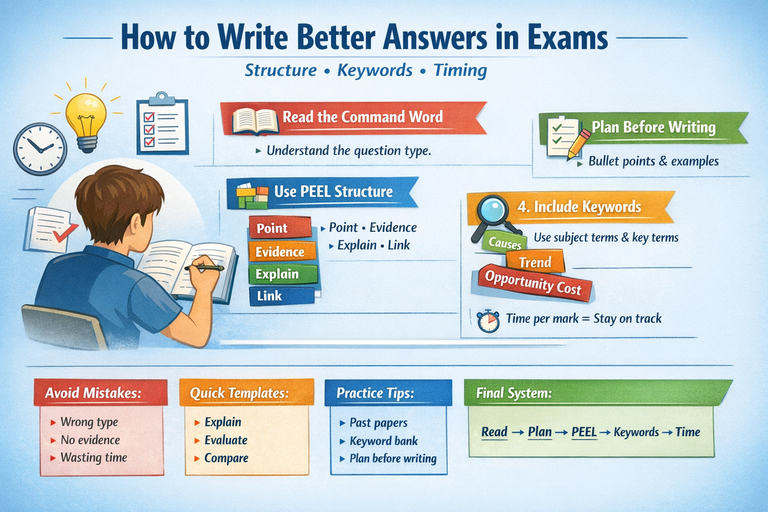
The Winning Exam Formula (Big Picture)
-
Read the command word – understand exactly what the question wants
-
Plan before writing – so every sentence earns marks
-
Use PEEL structure – so answers are clear and credited
-
Include keywords – so the examiner can tick the mark scheme
-
Manage time per mark – so you maximise your total score
Let’s break each part down in depth.
1) Read the Command Word (Don’t Answer the Wrong Question)
The command word is the most important word in the question.
It tells you how to answer.
Many students lose 20–40% of marks simply because they:
-
explain when they should evaluate
-
describe when they should analyse
-
list when they should justify
Command Words and What They Really Mean
| Command Word | What You Must Do to Get Full Marks |
|---|---|
| Define / State / Identify | Give a precise, one-sentence answer. No explanation needed. |
| Describe | Say what it is like or what happens, using detail. |
| Explain | Give reasons and show cause and effect (because → therefore). |
| Analyse | Break into parts and show how they link together. |
| Compare | Show similarities and differences clearly. |
| Evaluate / Assess / To what extent | Weigh pros and cons and reach a justified judgement. |
| Justify | Give reasons and evidence for a choice. |
| Discuss | Explore multiple viewpoints and conclude. |
The “Instruction + Topic + Focus” Technique
Every question contains three parts:
-
Instruction – the command word
-
Topic – the subject area
-
Focus – what exactly to talk about
Example:
“Analyse the impact of social media on teenagers’ mental health.”
-
Instruction: Analyse
-
Topic: social media
-
Focus: impact on mental health of teenagers
Your entire answer should stay locked onto that focus.
2) Plan Before Writing (So Every Sentence Earns Marks)
Planning is the difference between average and top-grade answers.
Even 60 seconds of planning will:
-
keep you on topic
-
stop repetition
-
ensure balance
-
protect your time
The Fast Planning Method
-
Decode the question
-
Write 3–5 bullet points that answer it
-
Add evidence/examples beside each
-
Order them logically
Marks-First Thinking
| Marks | What Examiners Expect |
|---|---|
| 2 | One or two facts |
| 4–6 | Two or three explained points |
| 8–12 | Developed paragraphs with evidence |
| 16+ | Structured essay with evaluation and conclusion |
Golden Rule:
Higher marks = deeper development, not longer waffle.
3) Use PEEL Structure (Point – Evidence – Explain – Link)
PEEL is powerful because it mirrors how mark schemes work.
PEEL Breakdown
-
Point: Direct answer to the question
-
Evidence: Fact, statistic, quote, case study, data, example
-
Explain: Why this evidence proves the point
-
Link: Back to the question
Example:
Point: Education reduces poverty by increasing employability.
Evidence: World Bank data shows that each extra year of schooling increases income by around 10%.
Explain: This is because education develops skills that employers value, allowing people to access higher-paid jobs.
Link: Therefore, education is a key factor in reducing long-term poverty.
PEEL for Evaluation: Add a Limitation
However, this is limited because education alone cannot reduce poverty without job availability and economic growth.
4) Include Keywords (Write in the Language of the Mark Scheme)
Examiners look for specific language.
Types of Keywords
-
Subject terminology – oxidation, opportunity cost, alliteration
-
Process words – causes, leads to, results in, increases
-
Evaluation words – however, more significant, limited by
-
Precision details – dates, units, names, definitions
Weak: “This affects the economy.”
Strong: “This increases GDP by stimulating consumer spending.”
5) Manage Time per Mark (Timing Is a Scoring Skill)
Time-Per-Mark Rule
Total minutes ÷ total marks = minutes per mark
Example:
90 minutes ÷ 90 marks = 1 minute per mark
How to Use It
-
Write finish times beside each question
-
Move on when time is up
-
Never sacrifice a 20-mark answer for a perfect 4-mark one
Putting It All Together: The Exam Method
-
Read the command word
-
Decode the question
-
Plan in bullets
-
Write in PEEL
-
Use keywords
-
Watch the clock
Quick Templates
Explain (6–8 marks)
-
PEEL paragraph
-
PEEL paragraph
-
Short link
Evaluate (10–20 marks)
-
Introduction: stance
-
PEEL (support)
-
PEEL (limitation)
-
Final judgement
Compare
-
Similarity + evidence
-
Difference + evidence
-
Difference + evidence
-
Conclusion
Common Mistakes That Cost Marks
| Mistake | Fix |
|---|---|
| Ignoring command word | Identify instruction first |
| Writing everything you know | Only answer the focus |
| No evidence | Add data or examples |
| Vague explanation | Use because → therefore |
| Poor timing | Use time per mark |
How to Practise This (So It Works Under
Pressure)
-
Do past papers with a timer
-
Mark using mark schemes
-
Build a keyword bank
-
Always plan before writing
Final Takeaway
Exam success is not a mystery.
It is a system:
Read → Plan → PEEL → Keywords → Time
Master this system and you turn knowledge into marks every single exam.