Memory Techniques for Students: Mnemonics, Mind Maps, and More
Remembering large amounts of information is less about having a “good memory” and more about using the right encoding and retrieval tools. Many students rely on rereading notes, highlighting textbooks, or copying summaries activities that feel productive but often create weak, short-lived memory traces.
Effective memory techniques work differently. They make information meaningful, structured, and easy to retrieve, especially under exam conditions. Instead of passively reviewing material, these techniques actively engage your brain in organizing, visualizing, and recalling information.
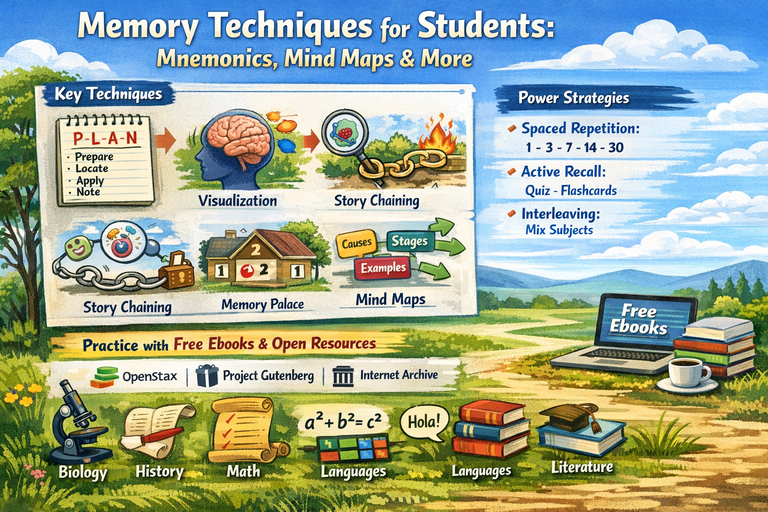
This guide explains the most powerful memory tools acronyms, visualization, story chaining, memory palaces, chunking, and mind maps and shows how to apply them across subjects. You’ll also learn how to practice these techniques using free ebooks and open educational resources.
How Memory Works (In Student-Friendly Terms)
To remember anything long-term, your brain needs three key processes to work together:
1. Encoding
This is how information enters memory. Deep encoding happens when you process meaning, make connections, and interact with ideas. Passive activities (like rereading) lead to shallow encoding.
2. Storage
Storage is how information is maintained over time. It improves when content is organized, revisited, and linked to existing knowledge.
3. Retrieval
Retrieval is pulling information out when needed during tests, exams, or writing tasks. This is the most exam-relevant skill, and it improves through practice.
Most memory techniques work because they strengthen encoding (by making information vivid or structured) and retrieval (by giving your brain strong cues).
1) Acronyms: Fast Recall for Lists and Sequences
What It Is
An acronym is a word formed from the first letters of items you want to remember.
Best For
-
Ordered processes
-
Lists of terms
-
Categories under a topic
How to Create Effective Acronyms
-
Keep them pronounceable
-
Make them meaningful, funny, or emotional
-
Avoid confusing letters (e.g., too many S or C sounds)
Generic Examples
-
P-L-A-N → Prepare, Locate, Apply, Note
-
M-A-T-H → Model, Analyze, Test, Highlight
How to Study With Acronyms (Important)
Acronyms help you recall headings, not full understanding. Strengthen them by pairing each letter with:
-
One key fact
-
One example
-
One practice question
This turns acronyms into retrieval tools, not shortcuts that hide gaps in understanding.
2) Visualization: Turn Abstract Facts Into Images
What It Is
Visualization converts information into vivid mental images. The brain remembers pictures better than plain text, especially when images are unusual or emotional.
Best For
-
Vocabulary and definitions
-
Scientific structures
-
Historical events
-
Language learning
-
Any concept that can be symbolized
How to Do It
-
Choose the concept.
-
Create an image that is:
-
exaggerated (big, loud, strange)
-
emotional or surprising
-
interactive (moving, breaking, transforming)
-
-
Link it to a keyword, location, or sound-alike cue.
Strengthen Visualization With Dual Coding
Write a short definition and draw a simple sketch. This creates two memory pathways verbal and visual making recall faster and more reliable.
3) Story Chaining: Link Many Items in One Narrative
What It Is
Story chaining links information in a sequence by embedding it in a short, exaggerated story where each item triggers the next.
Best For
-
Ordered lists
-
Multi-step processes
-
Outline or “describe” exam questions
How to Build a Story Chain
-
Turn items into characters or objects
-
Use strong actions (crash, melt, steal, explode)
-
Keep the story simple but vivid
Why It Works
Your brain is wired to remember narratives. Stories provide logical flow and strong retrieval cues, making sequences easier to recall under pressure.
Study Tip: Write only the first item of the list and see if the story pulls the rest from memory.
4) Memory Palaces (Method of Loci): High-Volume Recall Power
What It Is
A memory palace stores information in a familiar physical space (like your room or route to school), placing vivid images at fixed locations. Walking through the space mentally cues recall.
Best For
-
Long lists (10–50+ items)
-
Essay plans and arguments
-
Case studies, quotes, formulas
-
Content-heavy subjects
How to Build One (Step-by-Step)
-
Choose a familiar location
-
Identify 10–15 fixed stops
-
Assign one idea per stop
-
Create vivid images at each stop
-
Practice walking through the palace
Common Mistakes (And Fixes)
-
Too many items per location → one main idea per stop
-
Images too ordinary → exaggerate
-
No review → quick daily walkthroughs for 3–5 days
5) Chunking: Remember More by Grouping Smarter
What It Is
Chunking groups information into meaningful units. Instead of remembering many separate facts, you remember fewer structured clusters.
Best For
-
Long definitions
-
Processes and equations
-
Complex explanations
Effective Chunking Methods
-
Group by theme (causes/effects)
-
Group by pattern (stages, cycles)
-
Group by structure (frameworks)
Powerful Combination
Use one acronym per chunk. This compresses complex material into manageable recall units.
6) Mind Maps: Structure, Understanding, and Retrieval
What It Is
A mind map starts with a central idea and branches into subtopics, details, and examples.
Best For
-
Organizing chapters
-
Seeing relationships
-
Essay planning
-
Revision summaries
How to Make Mind Maps That Improve Memory
-
Use single keywords, not sentences
-
Add images and symbols
-
Use color to represent categories
-
Keep it one page per topic
The Key Step: Retrieval Practice
After creating a mind map:
-
Close your notes
-
Redraw it from memory
This reconstruction step is where memory strengthens.
7) Other High-Impact Memory Methods
A) Spaced Repetition
Review material at increasing intervals:
Day 1 → Day 3 → Day 7 → Day 14 → Day 30
This prevents forgetting and builds long-term retention.
B) Active Recall
Replace rereading with:
-
Practice questions
-
Blurting (write everything you remember)
-
Teaching concepts out loud
C) Interleaving
Mix topics or problem types in one session. This improves exam performance by training your brain to choose the right method, not just repeat one pattern.
Matching Memory Tools to Subjects
-
Biology/Medicine: memory palaces, chunking, mind maps, spaced repetition
-
History: story chaining, memory palaces, mind maps, acronyms
-
Chemistry: visualization, chunking, active recall
-
Math: chunking, retrieval practice, interleaving
-
Languages: visualization, spaced repetition, story chaining
-
Literature: memory palaces, mind maps, acronyms
Practicing With Free Ebooks and Open Resources
Free ebooks are excellent for memory training because they contain definitions, lists, and structured explanations.
Where to Find Free, Legal Ebooks
-
OpenStax
-
Project Gutenberg
-
Internet Archive / Open Library
-
Google Books previews
-
University open course materials
A 15–25 Minute Ebook Practice Routine
-
Choose 1–3 pages
-
Extract:
-
5 key terms
-
1 list
-
1 process
-
1 structure
-
-
Convert into memory tools
-
Test yourself immediately
-
Schedule spaced reviews
Common Student Mistakes (And Fixes)
-
Using mnemonics without understanding → Learn meaning first
-
Overcomplicating memory palaces → Start with 10 loci
-
Copying notes into mind maps → Use keywords + redraw from memory
-
No review schedule → Use a simple spaced plan
-
Confusing familiarity with mastery → Use active recall
A Simple 7-Day Memory Skill Plan
-
Day 1: Acronyms + flashcards
-
Day 2: Mind map + redraw from memory
-
Day 3: 10-location memory palace
-
Day 4: Story chain (10–15 items)
-
Day 5: Chunk a difficult process
-
Day 6: Mixed retrieval practice
-
Day 7: Spaced review + mini test
Repeat weekly with new content.
Conclusion
Memory improves dramatically when you move away from passive review and start using structured, cue-based tools:
-
Acronyms for fast recall
-
Visualization for sticky concepts
-
Story chaining for sequences
-
Memory palaces for high-volume recall
-
Chunking to reduce overload
-
Mind maps for structure and retrieval
Use free ebooks and open textbooks as practice material, not just reading material. Extract information, convert it into memory tools, test yourself, and review with spacing.
That combination deep encoding, active retrieval, and spaced repetition is the closest thing students have to a real memory “cheat code.