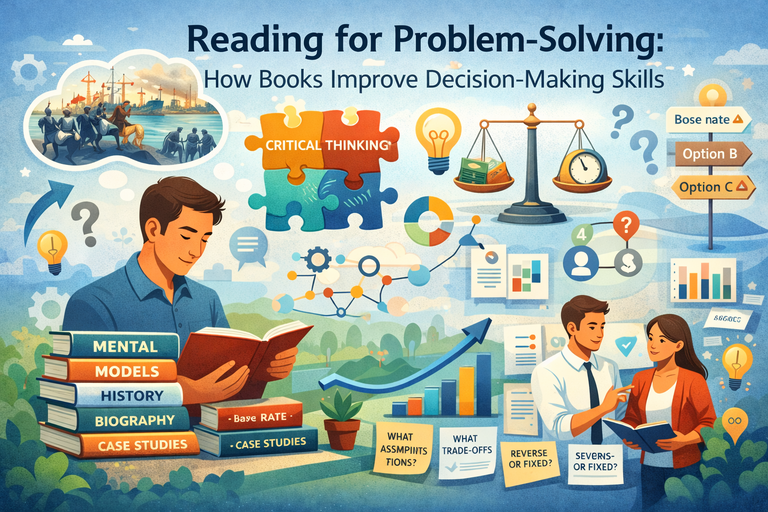
Reading for Problem-Solving: How Books Improve Decision-Making Skills
Decision-making is often framed as a talent some people are “naturally good at judgment,” others are not. In reality, judgment is a learnable skill built from three core ingredients: mental models, experience, and reflection. Books cannot replace lived experience, but they can dramatically expand the other two. They provide structured access to other people’s experiments, failures, and reasoning processes compressed into hours instead of years.
Reading for problem-solving is not the same as reading for entertainment or general knowledge. It is a deliberate approach to improving how you define problems, generate options, evaluate trade-offs, anticipate second-order effects, and learn from outcomes.
This article explores why books sharpen decision-making, what types of books help most, and how to read in a way that reliably translates into better real-world choices.
1) Why Books Improve Decisions: The Core Mechanisms
1. Books Expand Your Experience Without You Living It
Many decisions are difficult because their consequences unfold over time and across systems people, incentives, markets, institutions. Books, especially in history, biography, business, and science, allow you to observe:
-
How decisions were made under uncertainty
-
What information was missing or misinterpreted
-
Which constraints mattered more than they appeared
-
How incentives shaped outcomes
-
What unintended second- and third-order effects emerged
This is simulated experience but it is richer than abstract advice because it includes context: personalities, constraints, timing, trade-offs, and consequences.
For example, reading a historical account like The Guns of August shows how miscalculations, alliances, and timing escalated into global catastrophe. It reveals how small diplomatic moves compound under pressure—an invaluable lesson for strategic thinking.
2. Books Provide Transferable Mental Models
A mental model is a simplified explanation of how something works. Strong decision-makers do not rely on one lens they switch models depending on the situation.
Books help you build a library of models such as:
-
Opportunity cost and trade-offs
-
Feedback loops and systems thinking
-
Incentives and principal–agent problems
-
Base rates and probabilistic reasoning
-
Confirmation bias and motivated reasoning
-
Path dependence and lock-in effects
-
Reversion to the mean vs. real trend changes
Works like Thinking, Fast and Slow sharpen awareness of cognitive biases, while Super-forecasting builds probabilistic calibration.
When you can name a model, you can apply it. When you can apply multiple models, you can stress-test your reasoning.
3. Books Strengthen Problem Framing
Often, better decisions come from better framing not better intelligence.
Skilled framing transforms vague questions like:
“What should we do?”
Into sharper ones like:
-
What is the true objective?
-
What constraints are real vs. assumed?
-
What must be true for this option to work?
-
What does “good enough” look like?
-
Is this reversible or irreversible?
Books repeatedly demonstrate how experts separate symptoms from root causes and identify levers instead of reacting to surface problems.
4. Reading Builds Cognitive Stamina
Many poor decisions stem not from lack of intelligence but from shallow engagement with complexity. Modern environments fragment attention. Books train the opposite mode:
-
Sustained concentration
-
Long causal chains
-
Nuanced trade-off evaluation
-
Comfort with ambiguity
Complex decisions require patience. Reading strengthens that muscle.
5. Books Improve Metacognition
Metacognition is thinking about your thinking. The best decision-makers ask:
-
Am I overconfident?
-
What evidence would change my mind?
-
Am I confusing a compelling story with good data?
-
What incentives might distort this perspective?
Psychology, philosophy, and scientific reasoning texts cultivate this habit of self-correction.
2) What to Read for Better Decision-Making
Different genres develop different aspects of judgment.
A. History: Systems and Consequences
History shows decisions unfolding under real constraints. It teaches:
-
Long-term system behavior
-
Compounding effects
-
Hindsight bias
-
Strategic misalignment
Best for: strategic thinking, humility, and risk awareness.
B. Biographies and Memoirs: Judgment Under Pressure
Biographies reveal how leaders reason under ambiguity.
Reading Steve Jobs illustrates trade-offs between product perfection and team tension. Such narratives show how ego, persuasion, fear, and vision interact.
Best for: leadership decisions, negotiation, communication.
C. Case Studies: Structured Trade-Offs
Case-based books present:
-
Multiple options
-
Competing incentives
-
Real constraints
-
Measurable outcomes
Best for: operational and business strategy decisions.
D. Psychology and Behavioral Economics: Bias Resistance
Books like Predictably Irrational expose systematic cognitive errors:
-
Anchoring
-
Sunk cost fallacy
-
Loss aversion
-
Groupthink
Best for: avoiding predictable decision traps.
E. Probability and Statistics: Calibration
Probabilistic thinking improves:
-
Forecast accuracy
-
Risk management
-
Evidence evaluation
Understanding base rates and distributions prevents overreaction to anecdote.
Best for: forecasting and risk-sensitive decisions.
F. Philosophy and Ethics: Value Clarity
Some decisions are hard because they involve competing values.
Philosophical reading clarifies:
-
Fairness vs. efficiency trade-offs
-
Responsibility vs. outcomes
-
Individual rights vs. collective welfare
Best for: high-stakes leadership and personal life decisions.
G. Domain-Specific Deep Work
Technical decisions require domain knowledge.
Finance, cybersecurity, product design, hiring each has constraints and failure modes. Books help you understand:
-
What you cannot ignore
-
Standard methods
-
Warning signs
Best for: reducing costly ignorance and improving expert oversight.
3) Why Many Readers Don’t Improve Their Decisions
Reading alone does not guarantee better judgment. Common pitfalls include:
-
Passive reading without application
-
No retrieval (insights fade)
-
No feedback loop
-
Collecting opinions instead of building models
-
Mistaking confidence for competence
Improvement requires intentional transfer.
4) A Practical Method: How to Read for Problem-Solving
Step 1: Define a Decision Target
Before starting a book, clarify what you want to improve:
-
Hiring better team members
-
Reducing impulsive spending
-
Improving product prioritization
-
Navigating career transitions
This primes your brain to search for applicable insights.
Step 2: Read with Structured Questions
Ask while reading:
-
What problem is being solved?
-
What assumptions underlie this argument?
-
What trade-offs are acknowledged or ignored?
-
What evidence supports this claim?
-
What would falsify it?
Step 3: Extract Models, Not Quotes
Instead of highlighting sentences, extract reusable principles:
-
“Incentives drive behavior more than intentions.”
-
“Slow down when decisions are irreversible.”
-
“Check base rates before trusting intuition.”
Step 4: Create a Decision Tools Document
After each chapter, record:
-
3–5 key models
-
One memorable example
-
One application trigger
-
One experiment to test
This turns reading into capability.
Step 5: Build Reusable Templates
Examples:
-
Pre-mortem: Assume this fails. Why?
-
Option table: Benefits, costs, reversibility, time horizon
-
Bias check: What am I overvaluing?
-
Second-order map: What happens next? And then?
Step 6: Practice Retrieval
Review weekly. Use flashcards. Keep a personal checklist for major decisions.
If you cannot recall a principle at the moment of choice, it will not help you.
Step 7: Close the Loop with Reflection
After a decision:
-
What did I predict?
-
What happened?
-
What did I miss?
-
Which model would have helped?
Books raise your ceiling. Reflection raises your floor.
5) How Reading Improves Specific Decision Skills
A. Better Problem Definition
You solve the right problem more often.
B. Larger Option Sets
You escape false binaries and consider staged commitments, pilots, or reversible trials.
C. Trade-Off Awareness
You see constraints clearly and avoid unrealistic plans.
D. Risk Management
You separate likely from catastrophic risks.
E. Improved Communication
You structure arguments better and anticipate objections crucial for group decisions.
6) A 30-Day Decision-Making Reading Plan
Week 1:
Read foundational material on bias or probability. Create a one-page checklist.
Week 2:
Read historical or biographical case studies. Write three decision post-mortems.
Week 3:
Apply frameworks to one real decision. Draft a one-page brief.
Week 4:
Conduct an after-action review. Refine your top 10 decision principles.
The aim is not to finish books it is to build a reusable decision system.
7) When Reading Can Make Decisions Worse
Overconfidence
A single model applied everywhere becomes distortion.
Narrative Bias
Compelling stories overpower statistical reality.
Ideological Narrowing
Reading only one perspective reduces accuracy.
Productivity Theater
Reading replaces action.
The antidote: apply, test, revise.
Conclusion
Books do not hand you “the right answer.” They expand your models, improve framing, sharpen bias resistance, and provide simulated experience you could not easily gain alone.
The real transformation happens when reading is paired with retrieval, application, and reflection so insights surface at the moment of decision.
In the end, better decisions come not from reading more, but from reading deliberately and integrating what you learn into a living system of judgment.