Slow Reading in a Fast World: Why Deep Reading Still Matters
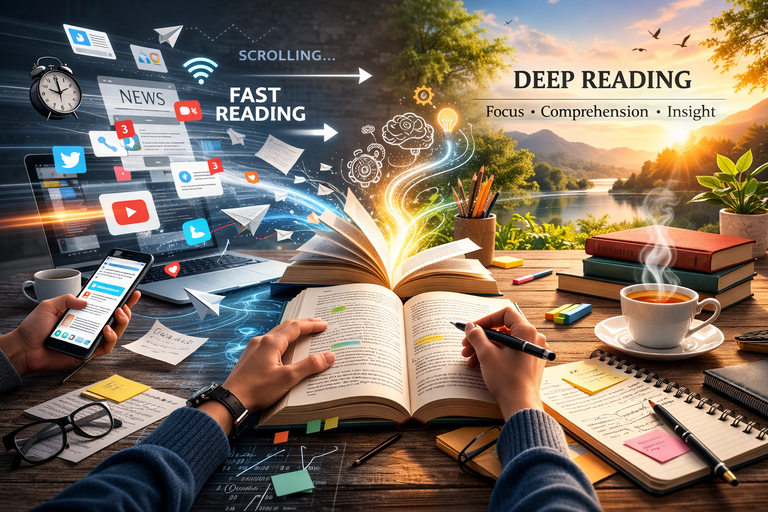
We live in an environment designed for velocity. News refreshes by the minute, messages arrive without pause, and digital platforms reward quick reactions over considered reflection. Reading has adapted accordingly: we skim headlines, scan summaries, and jump between tabs. Fast reading is not inherently bad it’s efficient, often necessary, and sometimes the only way to manage information overload.
But something important is at risk: deep reading the slow, attentive, reflective engagement with a text that changes what you understand and how you think. Slow reading is not simply reading at a slower pace. It’s reading in a way that allows meaning to unfold, arguments to be tested, emotions to be felt, and ideas to connect.
In a fast world, deep reading becomes both harder and more valuable.
This article explores what slow reading truly is, why it still matters, what we lose when it disappears, and how to reclaim it without rejecting modern life.
1) What Is Slow Reading (and What It Isn’t)?
Slow Reading Is:
-
Sustained attention on a single text long enough for its structure and logic to emerge
-
Active comprehension questioning, summarizing, predicting, evaluating
-
Reflection pausing to think, reread, annotate, or connect ideas
-
Immersion allowing tone, nuance, and subtext to register
Slow Reading Is Not:
-
A rejection of technology
-
The same as struggling through a text due to difficulty
-
Only for “serious” literature or classic novels
-
Opposed to productivity
Deep reading is a mode of engagement a cognitive and emotional posture. You can read a policy report, research paper, novel, or essay deeply. You can also read any of those superficially. The difference lies in how you attend.
2) Why Deep Reading Still Matters
A. It Builds Complex Understanding
Many ideas cannot be absorbed in fragments. Arguments unfold across pages; evidence accumulates gradually. Deep reading helps you:
-
Track cause and effect
-
Recognize assumptions
-
Understand context
-
Distinguish core claims from supporting details
-
Integrate knowledge into a coherent mental model
Skimming tells you what a text is about. Deep reading helps you grasp what it means and whether it’s convincing.
B. It Strengthens Attention and Cognitive Stamina
Attention functions like a muscle: it strengthens with use and weakens with neglect. In a distraction-heavy world, deep reading trains:
-
Sustained focus
-
Working memory
-
Patience with complexity
-
Tolerance for ambiguity
Constant switching between tasks creates mental fatigue without building endurance. Deep reading reverses that pattern.
C. It Cultivates Critical Thinking and Intellectual Independence
Modern information often arrives pre-digested summaries, bullet points, algorithm-curated takes. These formats save time but can outsource thinking.
Deep reading requires you to:
-
Evaluate reasoning independently
-
Identify rhetorical techniques
-
Compare evidence with claims
-
Form original interpretations
This practice resists intellectual passivity and builds discernment.
D. It Expands Empathy and Emotional Intelligence
Narrative immersion especially in fiction allows readers to inhabit perspectives unlike their own. Deep reading slows you down enough to notice:
-
Subtle emotional shifts
-
Conflicting motivations
-
Moral complexity
-
The gap between words and intention
Empathy develops not through slogans, but through sustained imaginative engagement.
E. It Nurtures Creativity and Insight
Creative breakthroughs often result from incubation letting ideas simmer and collide. Deep reading supports this process by:
-
Revealing patterns across chapters or books
-
Generating original questions
-
Encouraging synthesis rather than surface familiarity
Skimming produces recognition (“I’ve seen this before”). Deep reading produces insight (“I understand how this works”).
F. It Supports Civic and Democratic Life
Healthy public discourse depends on citizens capable of engaging complex ideas law, science, policy, history. These topics cannot be reduced to sound bites.
Deep reading strengthens:
-
Resistance to misinformation
-
Nuanced thinking
-
Informed decision-making
-
The ability to revise one’s views
A society trained only for speed risks sacrificing discernment.
3) What We Lose When Reading Becomes Only Fast
Shallow Comprehension
People remember topics but forget argument structures. This produces “information gloss” feeling informed without deep understanding.
Reduced Tolerance for Difficulty
Challenging texts feel unbearable when novelty becomes the norm.
Weak Memory Consolidation
Without elaboration and reflection, information fades quickly.
Diminished Joy
Reading becomes transactional rather than transformative. Absorption—a key pleasure of reading—disappears.
4) The Psychology Behind Deep Reading (Plainly Explained)
Deep reading engages multiple systems at once:
-
Language processing
-
Working memory
-
Executive control (inhibiting distractions)
-
Mental simulation (imagining scenes and consequences)
-
Metacognition (monitoring understanding)
These systems function best when attention is stable. Rapid context switching drains cognitive resources.
Fast reading optimizes for throughput.
Deep reading optimizes for integration.
Both have value but they serve different purposes.
5) When to Skim and When to Go Deep
A balanced reading life includes both.
Use fast reading when you:
-
Scan news updates
-
Review emails
-
Decide whether a text deserves deeper attention
-
Look up a specific fact
Use deep reading when you:
-
Study a complex subject
-
Evaluate arguments that influence decisions
-
Prepare to write or teach
-
Read literature you want to savor
-
Work with foundational documents
The goal isn’t to abandon speed it’s to protect depth where it matters.
6) Why Deep Reading Feels Hard Today
It’s rarely about laziness. Modern conditions work against sustained focus:
-
Constant notifications
-
Time pressure and exhaustion
-
Stress that favors short-term coping
-
Platforms engineered for engagement
-
Social pressure for instant reactions
Recognizing these forces shifts the solution from self-blame to design.
7) How to Practice Slow Reading Without Drastic Life Changes
A. Establish a Small Daily Ritual
-
Choose one primary book
-
Read 10–20 minutes at the same time daily
-
Keep the book visible
Consistency matters more than duration.
B. Reduce the Biggest Distractions
-
Put your phone in another room
-
Use airplane mode
-
Turn off notifications
You don’t need perfection just fewer interruptions.
C. Read Actively
-
Underline one key sentence per paragraph
-
Write margin notes (“Claim,” “Question,” “Example”)
-
Summarize each chapter briefly
If you can explain it, you’ve understood it.
D. Use “Pause and Paraphrase”
After a dense section, ask:
-
What did the author just say?
-
Why does it matter?
-
Do I agree?
This prevents passive word consumption.
E. Reread Strategically
Rereading strengthens integration. It’s not regression it’s reinforcement.
F. Limit Your Active Reading Queue
Too many books encourage skimming. Keep:
-
One primary deep read
-
One lighter optional read
Everything else goes on a future list.
G. Protect the First Five Minutes
Commit to just two pages. Momentum often follows.
8) Deep Reading in Digital Formats
Digital reading doesn’t eliminate depth it requires intention:
-
Use EPUB formats for readability
-
Adjust font size and spacing
-
Disable notifications
-
Avoid clicking hyperlinks mid-session
-
Export highlights and reflect afterward
The core issue isn’t screens. It’s fragmentation.
9) Teaching Slow Reading
For students, deep reading improves:
-
Academic comprehension
-
Writing quality
-
Vocabulary
-
Confidence with complexity
For families, shared slow reading builds attention habits and emotional bonding.
Discussion prompts help:
-
What surprised you?
-
What is the author arguing?
-
What question remains unanswered?
10) A 30-Day Plan to Rebuild Deep Reading
Week 1: Re-entry
-
10 minutes daily
-
Phone out of reach
-
One-sentence summary each session
Week 2: Engagement
-
15–20 minutes daily
-
Underline key sentences
-
Write 1–2 questions
Week 3: Integration
-
20–30 minutes daily
-
Five-bullet chapter summaries
-
Connect ideas to life or work
Week 4: Consolidation
-
One 45–60 minute session
-
Review notes
-
Write a one-page reflection
Depth compounds.
Conclusion: A Competitive Advantage—and a Human Need
Slow reading matters because it develops what fast culture erodes:
-
Sustained attention
-
Complex understanding
-
Independent judgment
-
Empathy
-
Insight
It is not nostalgia it is strategy. In a world optimized for speed, deep reading becomes leverage. It protects cognitive strength, intellectual independence, and inner life.
You don’t need to read everything slowly. You only need to safeguard a portion of your reading life for depth where understanding matures, thinking strengthens, and meaning takes root