The Role of Free Digital Libraries in Supporting Refugee and Displaced Learners
Refugee and displaced learners face urgent, overlapping barriers to education: disrupted schooling, lack of documentation, language transitions, limited income, unstable housing, and interrupted access to books, teachers, and safe learning spaces. According to the United Nations High Commissioner for Refugees (UNHCR), millions of displaced children and youth experience prolonged gaps in formal education, with many never returning to school at all.
In these circumstances, free digital libraries online collections of books, textbooks, articles, audiobooks, and learning resources available at no cost can become more than a convenience. They can be a lifeline for continuity of learning, a bridge to new curricula and languages, and a tool for rebuilding academic identity and hope.
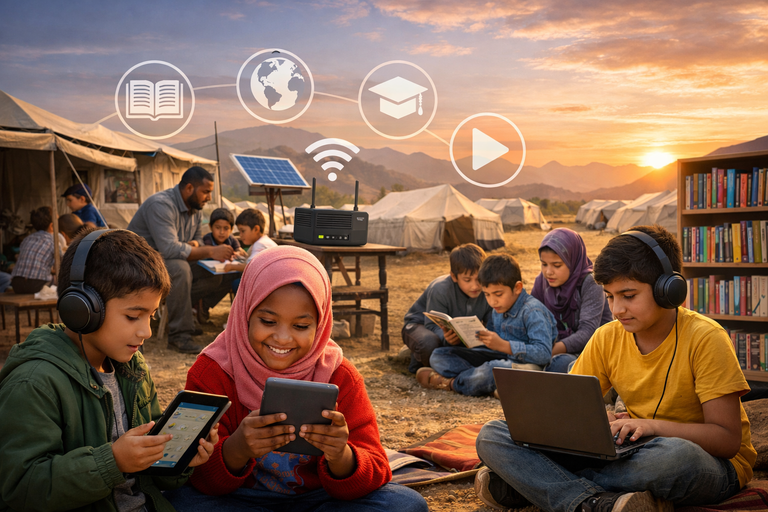
When paired with appropriate devices, connectivity solutions, localized content, and learner support, free digital libraries can help displaced learners study independently, supplement classroom learning in camps or host communities, and access credible information for career development and civic participation.
This article explores how free digital libraries support displaced learners, what makes them effective, the challenges that limit their impact, and practical steps governments, NGOs, schools, and communities can take to deploy them responsibly.
1) Understanding the Educational Reality of Displacement
Displacement reshapes education in ways that are both immediate and long-term:
Interrupted Schooling
Learners may miss months or years of education due to conflict, transit, or resettlement. Even after arrival in host communities, administrative delays and overcrowded schools can prolong exclusion.
Language Barriers
Learners often need resources in their home language and the host-country language simultaneously. Without bilingual support, they risk falling behind academically while trying to decode a new language.
Credential Gaps
Missing transcripts or exam records can block re-entry into formal education systems. Many learners must rely on informal study until assessment opportunities become available.
Trauma and Stress
Exposure to violence, instability, and loss can affect concentration, memory, and motivation. Learning environments must account for psychosocial realities.
Material Scarcity
Books, supplies, and quiet study spaces may be unavailable. Libraries, if present, may lack up-to-date or culturally relevant materials.
Digital Inequality
Smartphones are common even in displacement contexts but data costs, electricity, device ownership, and reliable internet access are inconsistent.
Free digital libraries do not solve all these problems. However, they directly address the resource gap and create pathways around disrupted access to physical libraries and textbooks.
2) What Counts as a “Free Digital Library”?
In displaced education contexts, a free digital library may include:
-
Open Educational Resources (OER): Openly licensed textbooks and learning modules that can be reused and adapted.
-
Public domain collections: Books whose copyright has expired.
-
Open-access research repositories: Scholarly materials available without paywalls.
-
Children’s digital book platforms: Leveled readers and literacy tools.
-
Audiobook repositories: Especially important for emerging readers or learners with visual impairments.
-
Offline digital libraries: Local servers or preloaded devices that provide access without internet connectivity.
Examples of global digital collections include Project Gutenberg (public domain books), Internet Archive (books and educational media), Worldreader (mobile reading in low-resource settings), and Khan Academy (free learning modules across subjects).
A critical distinction: “free to access” does not always mean “free to reuse.” Open licenses such as Creative Commons allow translation, adaptation, and printing, which are often essential in displacement contexts.
3) Core Roles Free Digital Libraries Play for Displaced Learners
A. Restoring Continuity of Learning
Displacement often breaks the link between learner and curriculum. Free digital libraries provide:
-
Textbooks aligned with primary, secondary, and vocational levels
-
Bridge content to fill learning gaps
-
Exam preparation materials for equivalency exams
Even when formal schooling is unavailable, curated digital libraries enable structured independent study, preserving academic momentum.
B. Supporting Multilingual and Transitional Language Learning
Language is one of the greatest barriers to educational integration. Digital libraries can:
-
Provide bilingual resources and parallel texts
-
Offer graded readers for host-country language acquisition
-
Include dictionaries, literacy apps, and audio-assisted reading
Reading in a familiar language preserves identity and reduces stress. Simultaneously, host-language materials support integration and academic advancement.
C. Enabling Learning on Low Budgets and Limited Infrastructure
Physical book distribution in humanitarian settings is expensive and logistically complex. Digital libraries reduce marginal costs:
-
One device can hold hundreds of books
-
Materials can be updated instantly
-
Offline libraries function in low-connectivity environments
Tools such as Learning Equality’s offline learning systems or portable servers developed by humanitarian partners allow entire communities to access libraries without internet connectivity.
D. Providing Inclusive Access for Diverse Learning Needs
Displaced learners span all ages and abilities. Digital libraries can support inclusion through:
-
Audiobooks and text-to-speech features
-
Adjustable font sizes and contrast
-
Multiple file formats (EPUB, PDF, HTML)
-
Screen reader compatibility
Inclusive design is critical because displacement often reduces access to specialized educational services.
E. Supporting Psychosocial Wellbeing
Access to stories and culturally familiar literature can:
-
Reintroduce routine through daily reading
-
Provide emotional processing through narrative
-
Strengthen family bonds via shared reading
Digital libraries can also include health literacy and coping resources—carefully curated to ensure safety and cultural sensitivity.
F. Building Digital Literacy and Independent Learning Skills
Using digital libraries builds competencies such as:
-
Searching and evaluating information
-
Note-taking and study planning
-
Navigating platforms and file management
-
Responsible online behavior
These skills enhance employability and long-term participation in host-country education systems.
G. Supporting Teachers and Facilitators
Refugee education often relies on volunteers and under-resourced educators. Digital libraries can supply:
-
Teacher guides and lesson plans
-
Printable worksheets
-
Subject-matter references
-
Professional development materials
Organizations such as UNICEF frequently integrate digital learning resources into emergency education responses to strengthen classroom quality.
4) Delivery Models: How Digital Libraries Reach Learners
1. Online Web and Mobile Access
Effective where connectivity exists. Must prioritize:
-
Lightweight design
-
Downloadable content
-
Low-data modes
-
Minimal login barriers
2. Offline Local Servers
Portable devices broadcasting Wi-Fi hotspots with preloaded libraries—ideal for camps and remote communities.
3. Preloaded Devices
Tablets, e-readers, or memory cards containing curated libraries practical in low-bandwidth areas.
4. Community Access Points
Schools, NGOs, and community centers can host:
-
Charging stations
-
Device-lending programs
-
Reading clubs
-
Digital literacy workshops
Shared infrastructure reduces cost and improves safeguarding.
5) Why Digital Libraries Matter Specifically in Displacement
Rapid Scaling and Portability
Displaced populations move across borders. A digital library can travel with them.
Cost-Efficiency
Open licensing reduces reproduction and adaptation costs.
Updatable Content
Health advisories, legal rights guides, and curriculum materials can be updated quickly critical in humanitarian contexts.
Learner Agency
Choice fosters autonomy. Self-directed reading rebuilds confidence and academic identity.
6) Challenges and Risks
Despite their promise, digital libraries face barriers:
-
Connectivity and power constraints
-
Language and cultural mismatches
-
Licensing misunderstandings
-
Misinformation risks
-
Privacy and safeguarding concerns
-
Accessibility gaps for learners with disabilities
-
Credential recognition barriers
“Free” does not automatically mean accessible. Implementation must address infrastructure, legal, cultural, and safety dimensions.
7) What Makes a Digital Library Effective for Refugee Education?
High-impact digital libraries are:
-
Offline-first
-
Multilingual
-
Curriculum-aligned
-
Clearly leveled
-
Accessible across devices
-
Carefully curated
-
Privacy-conscious
-
Supported by teacher resources
-
Integrated into real learning ecosystems
Technology alone is insufficient. Human support teachers, facilitators, peer groups remains essential.
8) Practical Implementation Recommendations
For Governments
-
Encourage open educational resource adoption
-
Integrate digital libraries into accelerated learning programs
-
Support community digital access points
For NGOs and Humanitarian Agencies
-
Conduct needs assessments before curation
-
Plan for charging and device access
-
Provide teacher training
-
Establish safeguarding and data protection policies
For Schools and Learning Centers
-
Create structured reading routines
-
Offer onboarding sessions
-
Pair digital reading with psychosocial support
For Technologists
-
Build lightweight, multilingual, accessible platforms
-
Enable offline downloads
-
Prioritize privacy-by-design
-
Offer educator tools without invasive analytics
For Community Organizations
-
Run family literacy programs
-
Facilitate peer learning groups
-
Collect user feedback to improve usability
9) Measuring Impact
Success indicators should go beyond download counts:
-
Active user engagement
-
Literacy gains and language progression
-
Exam readiness
-
Teacher confidence and resource use
-
Equity in participation
-
Ethical measurement of learner wellbeing and motivation
Mixed-method evaluations combining quantitative and qualitative feedback offer the clearest picture.
10) Future Directions
Free digital libraries are evolving toward:
-
More open textbooks in diverse languages
-
Improved accessibility standards
-
Offline AI-supported tutoring (with privacy safeguards)
-
Credential-linked learning pathways
-
Community publishing models allowing displaced learners to legally share their own stories
The future lies not in technology alone, but in digital tools embedded within supportive educational ecosystems.
Conclusion
Free digital libraries play a crucial role in refugee and displaced education by restoring access to books and learning materials, enabling multilingual and self-directed learning, supporting teachers, and fostering wellbeing through reading.
Their impact is greatest when they are curated, accessible, offline-capable, safe, and integrated with real human support systems. In contexts where traditional education systems break down, digital libraries make knowledge portable, affordable, and reachable.
In displacement, education is both a right and a stabilizing force. Thoughtfully deployed free digital libraries help protect that right preserving continuity, dignity, and hope for learners rebuilding their lives.