Why Consistent Reading Is More Powerful Than Last-Minute Studying
Many learners rely on last-minute studying because it feels efficient: a few intense hours (or nights) of cramming can sometimes produce acceptable exam scores. At first glance, it seems like a smart shortcut. But this approach has hidden costs. Knowledge gained through cramming is often fragile information fades quickly, understanding is shallow, and stress levels spike, reducing performance when it matters most.
Consistent reading, on the other hand, is far more powerful because it aligns with how the brain actually learns. By reading regularly whether for school, professional exams, or career development you strengthen memory, deepen comprehension, and develop skills that continue to grow long after the exam or project is over.
This article explores why consistent reading outperforms last-minute studying and how you can apply it effectively.
1. The Brain Learns Better Through “Spacing,” Not Cramming
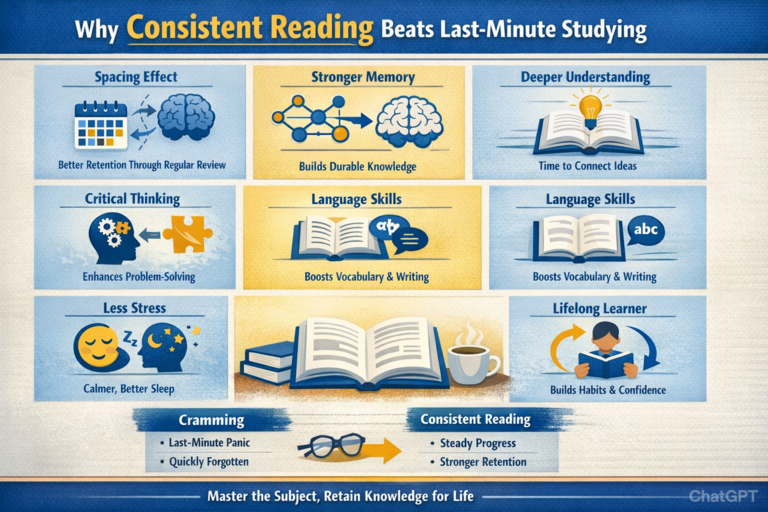
One of the strongest findings in cognitive science is the spacing effect: the brain retains information longer when learning is spread over time rather than compressed into a single marathon session.
Why spacing works:
-
Every time you revisit a topic, your brain rebuilds and strengthens the memory.
-
You identify gaps in understanding and repair them.
-
Repeated exposure under varying conditions makes recall more reliable.
Why cramming fails:
Cramming creates an illusion of mastery. You may recognize content because you just saw it, but recognition is not the same as recall or deep understanding. Once the exam is over or even after a single night’s sleep the information often fades because it never consolidated into long-term memory.
2. Consistent Reading Improves Long-Term Memory and Recall
Learning isn’t just about storing information; it’s about retrieving it effectively. Consistent reading strengthens both encoding (how information is stored) and retrieval (how it’s recalled).
With regular reading:
-
Concepts are revisited repeatedly, making recall easier.
-
Strong memory pathways are formed, connecting ideas instead of storing isolated facts.
-
Learning becomes integrated, allowing you to apply knowledge in new contexts.
With last-minute studying:
-
Memorization often outweighs understanding.
-
Recall relies heavily on short-term memory and stress-driven alertness.
-
Knowledge remains fragmented, making problem-solving and application difficult.
3. Real Learning Requires Understanding, Not Just Exposure
Deep comprehension comes from time and repeated exposure. Consistent reading gives your mind space to process ideas fully.
Benefits of steady reading:
-
Difficult concepts have time to “settle.”
-
You can link new material to prior knowledge.
-
Confusing sections can be revisited without panic.
Risks of cramming:
-
Learners focus on likely exam questions rather than fundamentals.
-
Foundational concepts may be skipped.
-
Understanding is sacrificed for speed.
This difference is especially noticeable in exams that test application, like essays, case studies, and problem-solving tasks.
4. Consistency Builds Stronger Vocabulary and Language Skills
Reading isn’t only about content; it’s also about developing the tools to work with that content.
With regular reading:
-
Vocabulary and subject-specific terminology expand naturally.
-
Reading speed improves without compromising comprehension.
-
Writing skills, clarity, and grammar improve essential for essays, reports, and professional communication.
-
Complex questions and instructions become easier to understand.
Cramming may allow you to “cover” material quickly but rarely enhances language skills, which rely on repeated exposure and practice.
5. It Reduces Stress and Improves Exam Performance
Cramming often comes with high emotional costs:
-
Anxiety and panic
-
Sleep deprivation
-
Poor focus
-
Shallow recall under pressure
Consistent reading changes the emotional experience:
-
You feel prepared in advance.
-
Revision becomes faster and less stressful.
-
Better sleep improves memory consolidation.
-
Calm, confident mindsets improve accuracy and performance.
In short, consistent reading doesn’t just build knowledge it creates the conditions under which you can use that knowledge effectively.
6. Consistent Reading Makes Revision Shorter and More Effective
A common misconception is that steady study takes longer. In reality, it often reduces total study time because the effort is distributed and retention is stronger.
Benefits:
-
Revision becomes a quick refresher instead of relearning from scratch.
-
Less time is wasted re-reading the same material.
-
Weak areas can be targeted instead of covering everything again.
Cramming, by contrast, forces large volumes of material to be reprocessed quickly, often with poor comprehension and rapid forgetting.
7. Consistent Reading Strengthens Critical Thinking and Application
Many exams and real-world tasks require more than memorization:
-
Analyzing arguments
-
Comparing viewpoints
-
Solving unfamiliar problems
-
Applying principles to new scenarios
Consistent reading trains the brain to:
-
Follow complex reasoning chains
-
Recognize patterns across topics
-
Think beyond memorized definitions
Cramming, focused on short-term recall and likely questions, collapses under unfamiliar challenges.
8. It Shapes Identity: You Become “A Reader” and “A Learner”
Consistency is more than a technique it shapes habits and self-perception.
With regular reading:
-
Discipline is built without extreme stress.
-
Confidence grows steadily.
-
A lifelong learning mindset develops, useful for studies, work, and career growth.
Cramming often creates a cycle: stress → last-minute studying → temporary success/failure → relief → avoidance → more stress. Consistency breaks that cycle.
9. Why Last-Minute Studying Still Feels Tempting (and How to Replace It)
Cramming feels productive because:
-
It creates urgency.
-
You see immediate “coverage” of topics.
-
It matches short deadlines.
But the same sense of progress can be achieved through structured, consistent reading.
Practical strategies:
-
Set a daily target: 15–30 minutes or 5–10 pages.
-
Follow a weekly plan: e.g., two chapters plus one review session.
-
End each session with a quick summary in your own words (3–5 bullet points).
-
Include retrieval practice: close the book and write down what you remember.
-
Review after 24 hours and again after a week to strengthen retention.
Consistency doesn’t require long hours; it requires repetition.
10. A Simple Example: Consistent Reading vs. Cramming
Cramming approach:
-
8–10 hours the night before the exam
-
Extensive re-reading and highlighting
-
High stress, poor sleep
-
Knowledge fades quickly after the exam
Consistent reading approach (over 2–3 weeks):
-
30–45 minutes most days
-
Short summaries + self-testing
-
Weekly review session
-
Lower stress, stronger recall, better application
Even when total hours are similar, consistent reading produces superior results because learning is reinforced repeatedly.
Conclusion
Consistent reading is more powerful than last-minute studying because it aligns with how the brain naturally learns. It strengthens long-term memory through spacing, enhances comprehension, builds language and critical thinking skills, reduces stress, and makes revision faster and more effective.
While last-minute studying may help you survive an exam, consistent reading turns studying into steady progress, mastery, and lifelong knowledge retention. It doesn’t just prepare you for tests it prepares you for learning, thinking, and performing at a high level in any situation.