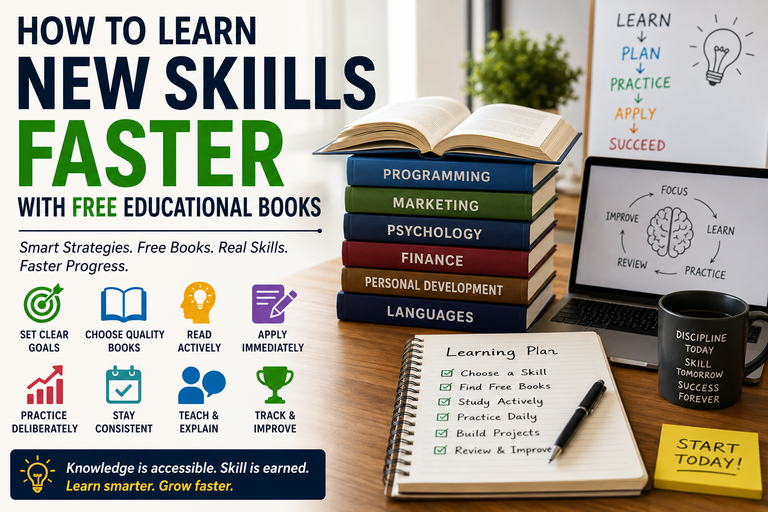

Turning Reading Into Action: How to Apply What You Learn From Books
Many readers finish books inspired but fail to take meaningful action afterward. Insight alone doesn’t create change. Books provide information, strategies, and motivation, but translating them into real-life results requires structure: a clear goal, actionable steps, practice, feedback, and follow-through.
The good news is that applying what you read is a skill and like any skill, it can be systematized. This article presents a comprehensive framework to convert reading into action through intentional book selection, active reading, note-taking, and practical implementation methods.
1) Start With a Purpose: Read for an Outcome, Not Just for Completion
Actionable reading begins before opening a book.
Ask yourself: “What problem am I trying to solve?” Examples include:
-
Negotiating a salary
-
Establishing a sustainable exercise routine
-
Writing clearer professional reports
-
Managing stress or anxiety
A clear purpose helps you:
-
Choose books that match your goal
-
Focus on relevant ideas
-
Translate insights into practical next steps
Define a “success condition”:
Make your goal specific and measurable:
-
“Complete 8 workouts in 30 days.”
-
“Use a structured agenda in my next three meetings.”
-
“Apply for 10 jobs with updated resumes and portfolios.”
Books are tools; outcomes determine their effectiveness.
2) Choose Books That Are Easy to Apply
Not all books are created for behavior change. Prioritize those that provide:
-
Clear frameworks and models
-
Step-by-step procedures
-
Case studies and examples
-
Exercises and prompts
-
Guidance on common mistakes
Use the “one-book rule”: Focus on one primary book for a single goal, apply it for 2–4 weeks, then expand to other perspectives. Overloading ideas reduces the likelihood of action.
3) Read Actively: Turn Pages Into Decisions
Passive reading rarely produces results. Active reading requires translating content into choices:
3-Question Method:
-
What is the author’s claim?
-
What should I do differently?
-
Where will I apply it next?
Highlight less, decide more: Only mark passages that you will convert into notes, experiments, or checklists.
4) Convert Ideas Into “Action Notes,” Not Just Summaries
Notes should be prescriptive: “I will…”, not descriptive.
Three layers of notes:
-
Capture – Quotes or highlights for reference
-
Distill – 5–10 bullet summaries in your own words
-
Apply – Action notes with specific steps, e.g.:
-
Idea
-
Situation where it applies
-
Smallest next action (≤15 minutes)
-
Implementation plan (when/where)
-
Success metric
-
Obstacle + if/then plan
-
Review date
-
This bridges knowledge and behavior.
5) Use Implementation Intentions: Turning Intent into Habit
Research shows specific “if/then” plans outperform vague goals:
-
Instead of: “I’ll start journaling”
-
Use: “If I finish brushing my teeth, then I will write 3 lines in my journal.”
Pairing new habits with existing routines creates automatic triggers.
6) Turn Book Advice Into Experiments
Avoid overwhelming yourself with sweeping changes. Treat new practices as time-bound experiments:
-
Pick one practice
-
Run it for 2 weeks
-
Measure one simple outcome (time spent, output, energy, consistency)
-
Decide to keep, modify, or discard
This lowers pressure and maximizes learning.
7) Make the Action Smaller Than Your Motivation
Motivation fluctuates; consistency matters more than intensity.
-
Reduce actions to minimum viable effort (e.g., 10 minutes/day instead of 60)
-
Start with the “start line” principle”: the smallest possible action that counts (writing one sentence, reading one page, putting on workout clothes).
8) Apply What You Read Through Projects
Projects transform abstract ideas into concrete outputs:
-
Communication → Draft a meeting agenda template
-
Personal finance → Build a one-page budget
-
Coding → Ship a small script or dashboard
-
Leadership → Run one feedback conversation
-
Health → Plan a repeatable 3-day meal routine
Projects allow measurable, evaluable action.
9) Practice Retrieval: The Step Most Readers Skip
Real application comes from recall, not highlights:
-
24-hour recap: Write what you remember without looking
-
Teach-back: Explain ideas aloud
-
Weekly review: Re-read action notes and select one to implement
Spaced repetition enhances retention, but regular retrieval suffices for most goals.
10) Create Feedback Loops
Feedback improves application:
-
Self-tracking – days practiced, output, time
-
External feedback – mentors, colleagues, friends
-
Reality feedback – did the action produce results?
Adjust methods based on evidence, not assumptions.
11) Common Pitfalls & Fixes
-
Too many ideas → Focus on one idea per book/chapter
-
Mismatch with context → Translate principles to your environment
-
Stop after finishing → Schedule “implementation week” immediately
-
Perfectionism → Treat actions as experiments
-
No accountability → Share goals with someone for check-ins
12) A 7-Step Workflow: From Book to Behavior
-
Define one outcome for the next 30 days
-
Read actively (claim / action / context)
-
Write 3–5 action notes
-
Pick one keystone habit
-
Run a 2-week experiment
-
Create a project output (template, checklist, routine)
-
Review and refine: keep what works, discard the rest
This prevents reading from remaining entertainment disguised as self-improvement.
13) Example: Turning a Book Into Action
Scenario: Book on focus
-
Outcome (30 days): 8 deep-work sessions of 60 minutes
-
Keystone action: Phone out of room during focus blocks
-
Implementation intention: “If it’s 9:00am weekdays, start a 60-minute focus session”
-
Smallest next action (today): Set a calendar block for tomorrow 9:00am
-
Metric: Number of completed sessions and output produced
-
2-week experiment: 4 days/week, adjust if completion < 70%
The idea becomes a measurable, scheduled behavior not just theory.
Conclusion: Reading Becomes Powerful When It Changes Your Calendar
The difference between “I read a great book” and “That book changed my life” is implementation. Turn insights into:
-
One clear outcome
-
One small repeatable behavior
-
A defined time and place
-
A short experiment
-
A feedback loop
By systematizing the process, you make every book actionable, bridging the gap between knowledge and tangible results.