How to Build Confidence in Difficult Subjects Using Self-Study Books
Confidence in challenging subjects whether math, physics, chemistry, economics, programming, statistics, or grammar is rarely an innate trait. It’s cultivated through repeated experiences of learning, problem-solving, and overcoming confusion. Self-study books are invaluable in this process because they provide structure, clear explanations, measurable practice, and opportunities to track progress. By approaching them strategically, students can transform “I’m not good at this” into genuine competence and confidence.
1) Start With the Right Definition of Confidence
In difficult subjects, confidence is not about:
-
Understanding everything immediately
-
Never making mistakes
-
Being naturally talented
Instead, confidence means:
-
Knowing how to learn the material
-
Being able to handle confusion without quitting
-
Understanding that you can improve with practice
Confidence is earned built gradually through small, consistent wins.
2) Choose Self-Study Books That Create Progress, Not Just Information
Not every self-study book fosters confidence. Look for books with built-in feedback loops, including:
-
Clear explanations and worked examples: See problems solved step by step.
-
Graded practice problems: Easy → medium → hard progression to build momentum.
-
Answer keys or full solutions: Full solutions allow you to learn from mistakes.
-
Chapter summaries and checklists: Track what you’ve mastered.
-
Concept checks: Short quizzes that confirm understanding.
Avoid books that are overly theoretical, assume too much background, or offer minimal exercises. If the book doesn’t make you do something repeatedly, it won’t reliably build confidence.
3) Diagnose Your Starting Point Without Judgment
Jumping into advanced material too early kills confidence. Instead:
-
Pick a chapter (or prerequisite chapter)
-
Attempt 10–15 problems or a short quiz
-
Mark each problem:
-
Green: solved correctly without help
-
Yellow: solved with hints/notes
-
Red: stuck or incorrect
-
This provides objective data and ensures you start at a level where wins are achievable, building momentum.
4) Use the “Small Wins Ladder”
Confidence grows when your brain experiences repeated success:
-
Learn a micro-skill
-
Practice it immediately
-
Confirm mastery with a short quiz
-
Repeat
Break chapters into micro-goals, e.g.:
-
“Solve 6 quadratic formula problems”
-
“Explain 8 supply vs. demand graphs”
-
“Write 10 correct past-tense sentences”
Small, repeated achievements steadily build confidence.
5) Read Actively
Passive reading feels productive but doesn’t solidify skills. Try:
Read → Cover → Recall → Check
-
Read a worked example
-
Cover the solution
-
Reproduce it independently
-
Check your work
Ask questions while reading:
-
What’s the goal of this problem?
-
What are the common traps?
-
Can I explain it in 2–3 sentences?
Active reading turns comprehension into performance.
6) Practice Like Training, Not Testing
Many students fail repeatedly by only attempting hard problems. A better approach is progressive overload:
-
Level 1 (foundation): straightforward problems
-
Level 2 (standard): typical exam/homework style
-
Level 3 (challenge): mixed or unfamiliar problems
Suggested ratio: 60% Level 1–2, 30% Level 2, 10% Level 3. This builds capacity for difficulty without destroying confidence.
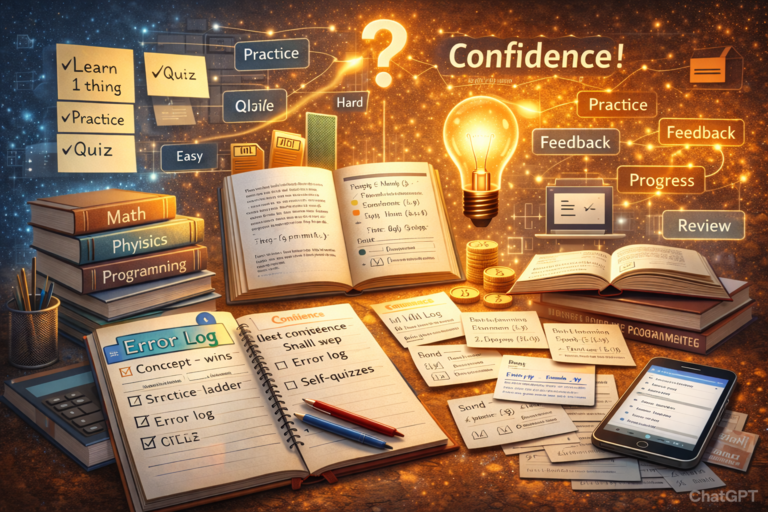
7) Keep an Error Log
Mistakes are valuable if treated as patterns you can correct:
-
Record type of mistake (concept, algebra, units, interpretation)
-
Note why it happened
-
Write the correction and a guiding rule
-
Solve 2–3 similar problems
Tracking patterns and correcting them generates visible progress and boosts confidence.
8) Use Built-In Feedback Loops
Confidence is solidified by performing without guidance:
-
Mini quizzes: 5 questions, timed, closed-book
-
24-hour recall: reproduce key formulas or steps from memory
Short, repeated checks reduce exam anxiety and reinforce mastery.
9) Build Consistency With a Weekly Study System
Confidence fades without rhythm. A sustainable weekly plan:
-
Session A: Learn new topic + guided examples
-
Session B: Practice set (Level 1–2)
-
Session C: Mixed practice + error log fixes
-
Session D: Review quiz + spaced repetition
-
Optional 10-min maintenance on off-day (flashcards or 5 review problems)
Consistency beats sporadic, high-effort cramming.
10) Use Spaced Repetition
Memory plays a role in confidence. Review:
-
Formulas and application conditions
-
Key definitions and distinctions
-
Step-by-step processes (derivatives, reactions, grammar rules)
Tools: index cards, a notebook, or a free SRS app. Review before you forget.
11) Handling Getting Stuck
Getting stuck is normal. Use a calm protocol:
-
Rewrite the problem in your own words
-
Label the topic
-
Try an easier or similar example
-
Peek at the next hint step if needed, not full solution
-
Redo the problem independently
This maintains control and prevents helplessness.
12) Build Exam Confidence
Train under real exam conditions:
-
Timed mixed sets
-
No notes allowed
-
Immediate review using error log
Use exam wrappers: after each practice test, identify weak areas, error types, and habits to improve.
13) Subject-Specific Quick Wins
Math/Science: redo solutions independently, check units, create formula sheets.
Writing/Grammar: imitate strong paragraphs, create checklists, seek feedback.
Programming: type code manually, build small projects, maintain a bug log.
14) Avoid Common Mistakes
-
Rereading instead of practicing
-
Studying too far above current level
-
No review system
-
Doing only hard problems
-
Ignoring analysis of mistakes
Confidence comes from knowing how to fix errors, not avoiding them.
Conclusion: Confidence Is a Skill
Self-study books are one of the most reliable ways to build confidence in difficult subjects. By combining structured explanations, active practice, micro-goals, error logs, spaced repetition, and consistent study habits, students can transform uncertainty into measurable progress and genuine self-assurance. Confidence is earned, and with the right approach, anyone can cultivate it in even the toughest subjects