
How to Improve Academic Vocabulary Using Free Online Books
Academic vocabulary is the language of textbooks, research articles, lectures, and formal essays. It includes general academic words like analyze, evaluate, and significant, as well as discipline-specific terms such as photosynthesis, capitalism, or phoneme. A strong academic vocabulary helps you read faster, understand complex arguments, write with precision, and perform better in exams especially in reading- and writing-intensive subjects.
The best part? You don’t need expensive apps or paid courses. With consistent reading and smart note-taking, free online books can become one of the most powerful tools for vocabulary growth.
1) Why Free Online Books Work So Well for Vocabulary Growth
Word lists alone rarely build lasting vocabulary. Books do because they provide:
Context-Rich Learning
You see words used in real explanations, arguments, and examples. This makes meaning easier to understand and remember.
Repeated Exposure
Textbooks and nonfiction naturally repeat key terms across chapters, reinforcing memory.
Level Control
You can choose materials that match your ability and gradually increase difficulty.
Organized Structure
Chapters, headings, glossaries, summaries, and indexes group words into meaningful clusters.
Easy Access
You can start immediately with a phone or laptop no purchase required.
Vocabulary grows best when you repeatedly encounter words in meaningful contexts. Books are built for that.
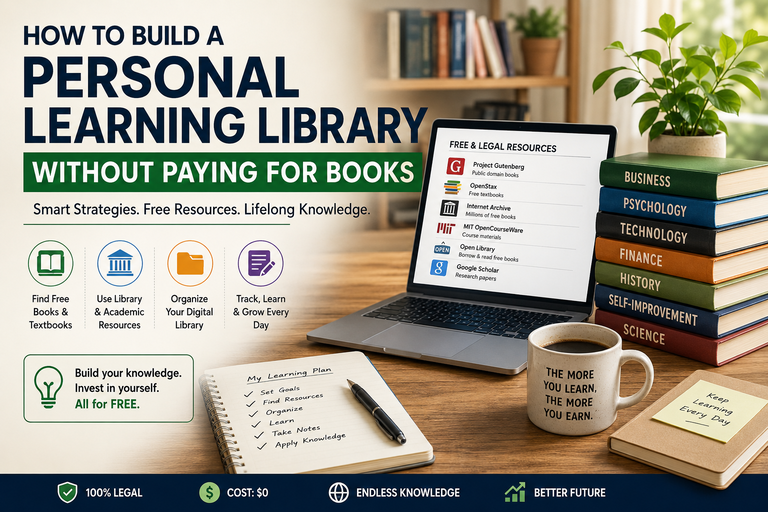
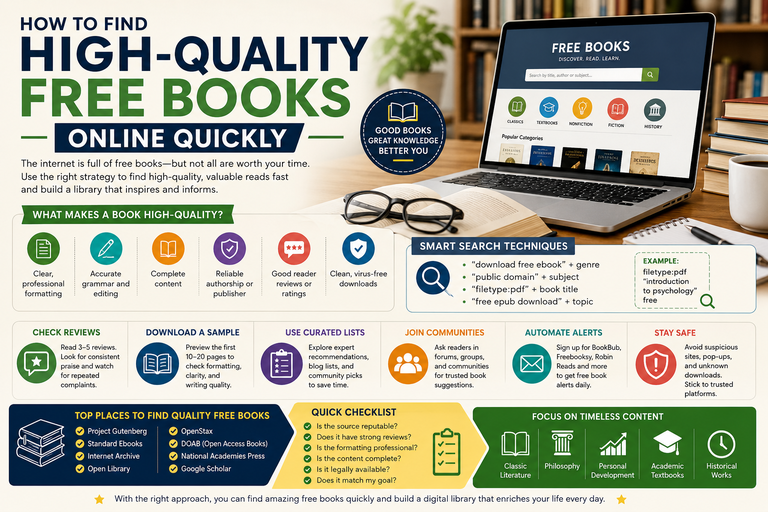
2) Where to Find Free Online Books (Legally)
There are many reliable platforms offering high-quality, legal content.
Public Domain Libraries
-
Project Gutenberg – Classic literature, essays, and nonfiction in the public domain
-
Internet Archive – Scanned books and borrowable texts
-
HathiTrust – Public domain and academic texts (access varies)
Free Textbooks and Open Educational Resources (OER)
-
OpenStax – Peer-reviewed college textbooks
-
MIT OpenCourseWare – Course materials, reading lists, lecture notes
-
OER Commons – Textbooks and materials across subjects
-
Open Textbook Library – Reviewed open textbooks
Academic and Reference Sources
-
University press open-access collections
-
Government and NGO reports (rich in academic vocabulary)
If your goal is structured vocabulary growth, free textbooks especially those from OpenStax are particularly effective because they define and repeat key terms clearly.
3) Choose the Right Books: The “One Level Harder” Rule
Efficient vocabulary learning requires the right difficulty level.
Choose books that are:
-
Readable but challenging
-
Slightly above your current level
-
Containing frequent but manageable new words
If every paragraph feels impossible, you won’t learn effectively because there isn’t enough context to infer meaning.
A useful target:
5–15 unfamiliar words per page (depending on your level). Enough to stretch you without overwhelming you.
4) Read Actively, Not Passively
Reading alone helps. Active reading transforms new words into long-term knowledge.
Step 1: Mark Important Words
Highlight or note words that:
-
Repeat frequently
-
Appear in headings or definitions
-
Seem central to the author’s argument
-
Show up in diagrams or summaries
Don’t collect every unknown word focus on the valuable ones.
Step 2: Guess the Meaning First
Before checking a dictionary:
-
Read surrounding sentences
-
Look for examples or synonyms
-
Identify tone (positive/negative)
-
Notice cause-and-effect clues
This builds exam-ready skills, where stopping for every word isn’t possible.
Step 3: Confirm with a Dictionary
Check:
-
Correct meaning in context
-
Pronunciation
-
Part of speech
-
Example sentence
This ensures accuracy and prevents misunderstanding.
5) Focus on High-Value Academic Words
Not all vocabulary is equally useful.
A) General Academic Vocabulary
These appear across disciplines and improve essays quickly:
analyze, interpret, theory, factor, significant, evidence, establish, indicate, consequence, derive, assume, context, method
A well-known guide is the Academic Word List (AWL), which is freely available online.
B) Discipline-Specific Vocabulary
Learn key terms from textbooks in your field:
-
Biology: cellular respiration, enzyme, ecosystem
-
Economics: inflation, marginal, elasticity
-
Literature: metaphor, narrative, theme
-
Psychology: cognition, stimulus, conditioning
Textbooks reinforce these through repetition, helping them stick naturally.
6) Build a Personal Vocabulary Notebook (Simple and Practical)
Your system should be easy to maintain.
Use this structure:
Word:
Meaning (in your own words):
Example from the book:
Your sentence (new context):
Related forms: (analyze → analysis → analytical)
Synonyms / contrasts:
Writing your own sentence is essential. Recognition is passive. Usage is mastery.
7) Learn Word Families, Not Single Words
Academic writing relies heavily on related word forms.
Examples:
-
consider → consideration → considerable → considerably
-
define → definition → definitive → redefine
-
conclude → conclusion → conclusive → inconclusive
-
economy → economic → economical → economics
When you look up a word, also check:
-
Noun form
-
Verb form
-
Adjective form
-
Adverb form
This multiplies your vocabulary efficiently.
8) Use Free Tools to Support Learning
You don’t need paid apps. Combine free books with free tools:
-
Google Dictionary (quick checks)
-
Cambridge Dictionary / Merriam-Webster (clear academic definitions)
-
Thesaurus.com (verify usage carefully)
-
YouGlish (hear real pronunciation in context)
-
Google Translate (useful for multilingual learners; double-check nuance)
-
Anki (free desktop spaced repetition tool)
-
Quizlet (free version available)
Spaced repetition reviewing words over time is one of the most effective memory strategies.
9) Turn Reading Into a Weekly Vocabulary Plan
Consistency beats intensity.
Daily (20–30 minutes)
-
Read 5–10 pages
-
Select 5–10 high-value words
-
Add short entries to your notebook
-
Review old words for 5 minutes
Weekly (30 minutes)
-
Choose 10–20 best words
-
Create flashcards
-
Write a short paragraph using 5–8 of them
That paragraph is critical. Academic vocabulary becomes powerful only when used in connected ideas.
10) Practice Through Writing (Not Just Memorizing)
You truly “own” a word when you can use it correctly.
Try:
-
One-sentence summaries: Use 2–3 new words
-
Compare/contrast paragraph: however, whereas, in contrast
-
Mini-argument: claim + evidence + therefore
This is especially useful for IELTS, TOEFL, and university coursework.
11) Avoid Common Mistakes
Collecting Too Many Words
Large lists create frustration. Focus on high-frequency, high-impact words.
Learning Only Definitions
Always keep an example sentence.
Misusing Synonyms
Words like assert, claim, and argue have subtle differences. Check usage examples.
Reading Books That Are Too Difficult
Comprehension comes first. Increase difficulty gradually.
12) Best Types of Free Books for Academic Vocabulary
For fast progress, try:
-
Introductory textbooks (structured definitions + repetition)
-
Essay collections (formal academic style)
-
Popular science writing (concept-rich but readable)
-
Classic nonfiction (formal tone, persuasive language)
A strong combination:
One textbook + one nonfiction book
This builds both technical and general academic vocabulary.
Conclusion
Improving academic vocabulary doesn’t require paid subscriptions or expensive materials. Free online books especially open textbooks and high-quality nonfiction offer exactly what vocabulary learners need: context, repetition, and exposure to authentic academic language.
The key is simple:
-
Read consistently
-
Choose books at the right level
-
Focus on high-value words
-
Learn word families
-
Review with spaced repetition
-
Practice through writing
Within weeks, you’ll notice reading becomes smoother, writing becomes clearer, and academic discussions feel far less intimidating.
Vocabulary growth isn’t about memorizing thousands of words.
It’s about meeting important words again and again—until they become part of how you think.