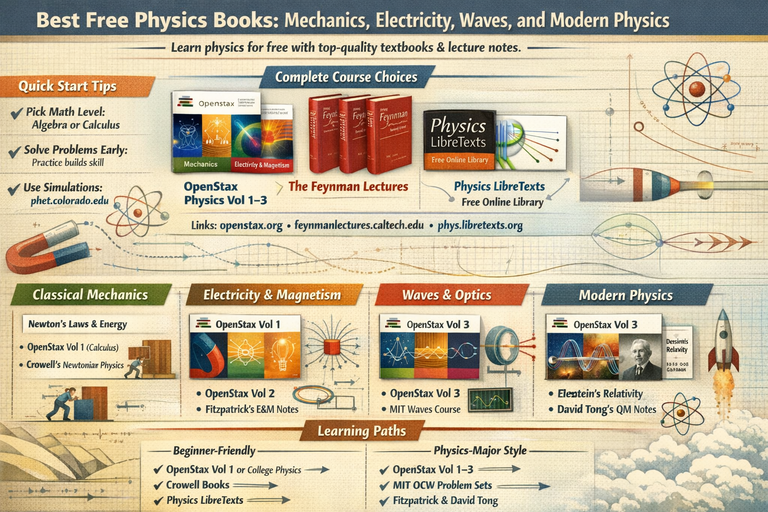
Best “Complete Course†Free Physics Textbooks (All-in-One)
1. OpenStax Physics (Best Overall Choice)
Why it’s great:
OpenStax textbooks are professionally edited, visually clear, and designed to match standard university syllabi. They include hundreds of worked examples, practice problems, and real-world applications.
OpenStax College Physics (Algebra-Based)
Covers: mechanics, fluids, thermal physics, electricity and magnetism, waves, optics, and modern physics
Best for: high school, pre-med, biology, and non-engineering students
OpenStax University Physics (Calculus-Based, Volumes 1–3)
Volume 1: Mechanics
Motion, forces, energy, momentum, rotation, gravitationVolume 2: Electricity and Magnetism
Electric fields, circuits, magnetism, inductionVolume 3: Waves, Optics, and Modern Physics
Oscillations, interference, diffraction, relativity, quantum basicsLink: https://openstax.org/subjects/science
(Look for University Physics Volumes 1–3)
Best for: Learners who want a single, consistent physics curriculum from start to finish.
2. The Feynman Lectures on Physics (Conceptual Classic)
Why it’s great:
Written by Nobel laureate Richard Feynman, this is one of the most famous physics texts ever. It focuses on why physics works, not just how to calculate answers.
Style: deep intuition, unconventional explanations
Best for: conceptual understanding alongside a standard textbook
Not ideal as a first or only problem-solving book
Link: https://www.feynmanlectures.caltech.edu/
3. Physics LibreTexts (Free, Searchable Physics Library)
Why it’s great:
Physics LibreTexts is a massive, open “living library†of physics chapters written by educators worldwide.
Strengths:
Multiple explanations of the same topic
Clear derivations and diagrams
Excellent for filling gaps or reviewing specific ideas
Link: https://phys.libretexts.org/
Best for: Quick refreshers, alternate explanations, and topic-by-topic study.
Best Free Physics Books by Topic
A. Classical Mechanics
(Motion, forces, energy, momentum, rotation)
1. OpenStax University Physics, Volume 1
Level: Calculus-based
Strengths:
Excellent structure for beginners
Clear free-body diagrams
Many worked examples and problems
Covers:
Kinematics
Newton’s laws
Work and energy
Momentum and collisions
Rotation and gravitation
Link: https://openstax.org/subjects/science (University Physics Vol 1)
2. Benjamin Crowell — Newtonian Physics
Style: very clear, conversational, intuition-focused
Strengths:
Connects math directly to physical meaning
Friendly tone for self-learners
Link: https://www.lightandmatter.com/
3. MIT OpenCourseWare — Classical Mechanics
Typical course: MIT 8.01
Strengths:
Full lecture notes
Challenging problem sets
Excellent supplement to textbooks
Link: https://ocw.mit.edu/ (search “8.01 Classical Mechanicsâ€)
4. Richard Fitzpatrick — Classical Mechanics
Style: more rigorous and mathematical
Strengths:
Bridges Newtonian mechanics to Lagrangian and Hamiltonian methods
Link: https://farside.ph.utexas.edu/teaching.html
Best for: Students transitioning beyond introductory mechanics.
B. Electricity and Magnetism (E&M)
1. OpenStax University Physics, Volume 2
Strengths:
Careful, step-by-step development
Strong field diagrams and circuit examples
Covers:
Electrostatics
Electric fields and potential
Capacitance and DC circuits
Magnetic fields
Faraday’s law and induction
Link: https://openstax.org/subjects/science (University Physics Vol 2)
2. Richard Fitzpatrick — Electricity and Magnetism
Strengths:
Clear field-theory approach
Excellent mathematical development
Link: https://farside.ph.utexas.edu/teaching.html
3. Benjamin Crowell — Electricity and Magnetism
Strengths:
Conceptual clarity
Very readable explanations
Link: https://www.lightandmatter.com/
4. MIT OpenCourseWare — Electricity & Magnetism
Typical course: MIT 8.02
Strengths:
Structured lectures and rigorous problem sets
Link: https://ocw.mit.edu/ (search “8.02 Electricity and Magnetismâ€)
C. Waves and Optics
(Oscillations, sound, interference, diffraction)
1. OpenStax University Physics, Volume 3
Strengths:
Excellent visuals
Logical progression from oscillations to optics
Covers:
Simple harmonic motion
Wave propagation
Standing waves
Interference and diffraction
Polarization and optical instruments
Link: https://openstax.org/subjects/science (University Physics Vol 3)
2. Benjamin Crowell — Waves
Strengths:
Superb intuition-building
Clear explanations of superposition and resonance
Link: https://www.lightandmatter.com/
3. MIT OpenCourseWare — Waves and Vibrations
Typical course: MIT 8.03
Strengths:
More advanced, physics-major-level treatment
Link: https://ocw.mit.edu/ (search “8.03 Waves and Vibrationsâ€)
4. Physics LibreTexts — Optics
Strengths:
Multiple explanations of geometric and physical optics
Link: https://phys.libretexts.org/ (search “Opticsâ€)
D. Introduction to Modern Physics
(Relativity, quantum physics, atoms, nuclei)
1. OpenStax University Physics, Volume 3 (Modern Physics Chapters)
Strengths:
Gentle introduction to abstract ideas
Strong visuals and examples
Covers:
Special relativity basics
Photons and wave-particle duality
Introductory quantum models
Atomic and nuclear physics
Link: https://openstax.org/subjects/science (University Physics Vol 3)
2. Albert Einstein — Relativity: The Special and the General Theory
Status: Public domain
Strengths:
Conceptual clarity
Minimal mathematics
Available via: https://www.gutenberg.org/ (search the title)
3. David Tong (Cambridge) — Free Lecture Notes
Style: physics-major level
Strengths:
Clear and rigorous explanations
Excellent first serious exposure to quantum mechanics
Link: https://www.damtp.cam.ac.uk/user/tong/lecture-notes/
4. MIT OpenCourseWare Quantum Physics
Courses:
MIT 8.04 Quantum Physics I
MIT 8.05 Quantum Physics II
Link: https://ocw.mit.edu/ (search “8.04 Quantum Physicsâ€)
Suggested Learning Paths
Path 1: Beginner-Friendly (Low Frustration)
OpenStax College Physics (algebra-based)
orOpenStax University Physics Vol 1 (calculus-based)
Add Benjamin Crowell for intuition
Use Physics LibreTexts when explanations don’t click
Path 2: Physics-Major Style (More Rigorous)
OpenStax University Physics Vol 1–3
Add MIT OCW problem sets
Add Fitzpatrick (mechanics & E&M)
Add Tong (quantum mechanics)
Tips for Learning Effectively from Free Physics Books
Solve problems early and often. Reading alone builds familiarity, not skill.
Redraw diagrams yourself. Forces, fields, rays, and wave patterns become clearer when sketched.
Use simulations. PhET simulations are excellent companions:
https://phet.colorado.edu/Keep a concept notebook. For each chapter, write:
Key definitions
Core equations
One real-world application
Quick Reference: Best Single Picks by Topic
Mechanics: OpenStax University Physics Vol 1
Electricity & Magnetism: OpenStax University Physics Vol 2
Waves & Optics: OpenStax University Physics Vol 3
Modern Physics (Intro):
OpenStax University Physics Vol 3 +
Einstein (conceptual) or Tong (more rigorous)
With these resources, you can learn college-level physics from motion and fields to quantum ideas without spending a single dollar. The key is consistency: choose one main text, add one conceptual supplement, and practice regularly