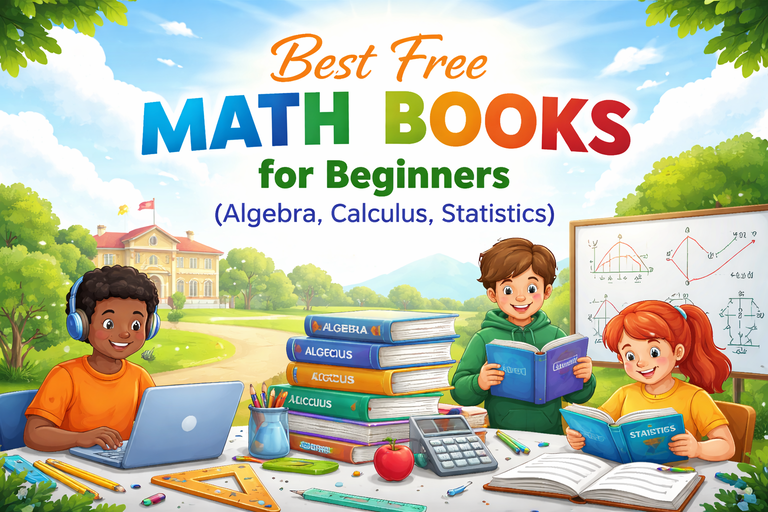
Best Free Math Books for Beginners (Algebra, Calculus, Statistics)
Math becomes far less intimidating when you have the right book one with clear explanations, step-by-step examples, diagrams, and plenty of practice problems. The good news is that you don’t need to spend money to get high-quality math education. Many excellent math textbooks are legally free, either because they are open educational resources (OER) or because universities and institutions provide them openly online.
This guide curates beginner-friendly, widely trusted free math books covering algebra, calculus, and statistics, and also includes recommended study paths to help you choose the right starting point based on your goals.
How to Choose the Right Free Math Book (Quick Checklist)
Before downloading any book, take a moment to clarify three things:
1. Your Current Level
Math builds step by step. Be honest about where you are:
Pre-algebra
Algebra I
Algebra II
Precalculus
Calculus
Starting too high often leads to frustration, not progress.
2. Your Goal
Ask yourself what you want to achieve:
Build strong fundamentals
Pass a school or college course
Prepare for university math
Learn statistics for research, business, or data analysis
3. Your Learning Style
Different books emphasize different approaches:
Concept-first: intuition, visuals, explanations
Practice-first: many worked examples and exercises
Balanced: explanations + practice
Pro tip: Choose one main textbook and use one supplementary resource for alternate explanations and extra practice.
Part 1: Best Free Algebra Books (Beginner to Intermediate)
Algebra is the foundation of almost all higher math. A strong start here makes everything else easier.
1. OpenStax — Prealgebra and Elementary Algebra
Why it’s great:
OpenStax textbooks are among the best free academic resources available. These books follow a modern textbook structure, use clear language, include worked examples, and provide large exercise sets with answer keys.
Topics covered:
Arithmetic fundamentals
Fractions and decimals
Ratios and proportions
Linear equations and inequalities
Introductory graphing
Links:
Prealgebra: https://openstax.org/details/books/prealgebra
Elementary Algebra: https://openstax.org/details/books/elementary-algebra
Best for:
True beginners
Adult learners returning to math
Self-study learners who want lots of practice
2. OpenStax — Intermediate Algebra
Why it’s great:
This book bridges the gap between basic algebra and precalculus, while still remaining accessible to learners.
Topics covered:
Functions and graphs
Polynomial and rational expressions
Exponents and logarithms
Quadratic functions
Systems of equations
Link:
https://openstax.org/details/books/intermediate-algebra
Best for:
Students preparing for precalculus or calculus.
3. CK-12 — FlexBooks for Algebra
Why it’s great:
CK-12 uses modular, bite-sized lessons that make it easy to review specific topics without reading an entire chapter.
Where to find:
https://www.ck12.org/student/
Best for:
Targeted practice
Review and reinforcement
Learners who prefer shorter lessons
4. Open Textbook Library — Algebra Options
Why it’s great:
The Open Textbook Library hosts multiple free algebra books, letting you compare styles and difficulty levels.
Link:
https://open.umn.edu/opentextbooks/
(Search “algebra” or “precalculus”)
Best for:
Learners who want to explore different explanations until one “clicks.”
Part 2: Best Free Calculus Books (Single-Variable & Intro Multivariable)
Calculus becomes manageable when algebra skills factoring, functions, exponents, and graph interpretation are solid.
1. OpenStax — Calculus, Volume 1–3 (Top Choice)
Why it’s great:
This is the gold standard for free calculus textbooks. It’s well-structured, thorough, and widely used in colleges.
Coverage:
Volume 1: Limits, derivatives, integrals
Volume 2: Integration techniques, sequences, series
Volume 3: Multivariable calculus and vector basics
Link:
https://openstax.org/subjects/math
Best for:
College-level self-study
Standard calculus courses
Learners who want lots of practice problems
2. Active Calculus (Concept-Focused and Beginner-Friendly)
Why it’s great:
Instead of heavy formulas upfront, this book emphasizes understanding through activities and guided discovery.
Link:
https://activecalculus.org/
Best for:
Learners who struggle with abstraction and want intuition before formulas.
3. MIT OpenCourseWare — Calculus Courses
Why it’s great:
MIT OCW provides full course materials, including assignments, exams, and sometimes solutions.
Links:
Single Variable Calculus (18.01): https://ocw.mit.edu/
Multivariable Calculus (18.02): https://ocw.mit.edu/
Best for:
Learners who want a real university course experience.
4. Paul’s Online Math Notes
Why it’s great:
Clear explanations, practical problem-solving steps, and lots of worked examples.
Link:
https://tutorial.math.lamar.edu/
Best for:
Exam preparation
Extra examples
Quick clarification of difficult topics
(Not a traditional textbook, but extremely effective.)
Part 3: Best Free Statistics Books (Beginner-Friendly)
Statistics is often the most accessible branch of math for beginners especially when taught with real-world data.
1. OpenStax — Introductory Statistics
Why it’s great:
Very approachable writing, real-life examples, and structured exercises.
Topics covered:
Descriptive statistics
Probability basics
Probability distributions
Confidence intervals
Hypothesis testing
Regression
Link:
https://openstax.org/details/books/introductory-statistics
Best for:
College intro statistics and self-learners.
2. OpenIntro Statistics
Why it’s great:
Focuses on statistical thinking and interpretation, not just calculations.
Link:
https://www.openintro.org/book/os/
Best for:
Learners interested in data analysis, research, or applied statistics.
3. NIST/SEMATECH e-Handbook of Statistical Methods
Why it’s great:
A deep, authoritative reference for practical statistical analysis.
Link:
https://www.itl.nist.gov/div898/handbook/
Best for:
Learners moving beyond basics into real-world data applications.
Best “All-in-One” Free Learning Platforms
While not traditional books, these platforms are incredibly effective for beginners:
Khan Academy: https://www.khanacademy.org/
(Algebra → Calculus → Statistics)Brilliant (partially free): https://brilliant.org/
(Interactive, concept-driven learning)Desmos Graphing Calculator: https://www.desmos.com/calculator
(Essential for algebra and calculus visualization)
Recommended Study Paths (Beginner-Friendly)
Path A: True Beginner → Calculus-Ready
OpenStax Prealgebra
OpenStax Elementary Algebra
OpenStax Intermediate Algebra
CK-12 or OpenStax Precalculus
OpenStax Calculus Volume 1
Tip: Most calculus struggles come from weak algebra, not calculus itself.
Path B: Learn Calculus with Strong Intuition
Active Calculus
OpenStax Calculus Volume 1 (for practice)
Paul’s Online Math Notes (for specific problem types)
Path C: Statistics with Minimal Prerequisites
OpenStax Introductory Statistics
OpenIntro Statistics
NIST Handbook (as a reference)
How to Study from a Math Book Effectively
Do the problems aim for 10–20 per section.
Keep an error log of mistakes and corrections.
Use spaced review (1 day, 1 week, 2 weeks).
Graph functions frequently using Desmos.
Master prerequisites early especially algebra for calculus.
Quick “Best Pick” Summary
If you want the simplest shortlist:
Algebra: OpenStax Elementary Algebra + Intermediate Algebra
Calculus: OpenStax Calculus Volume 1 (plus Active Calculus for intuition)
Statistics: OpenStax Introductory Statistics or OpenIntro Statistics