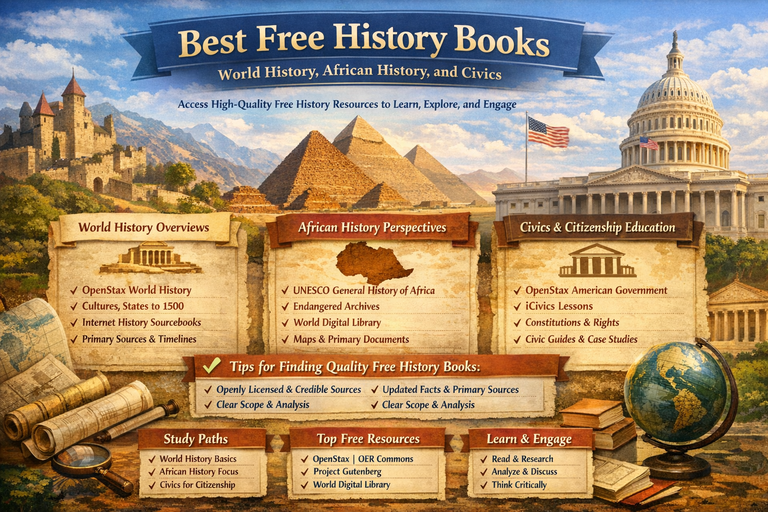
Best Free History Books: World History, African History, and Civics
History explains how societies form, change, and govern themselves. It connects people to enduring ideas migration, trade, empire, religion, science, resistance, and reform and reveals how today’s debates about identity, rights, and power grew out of earlier choices and conflicts. For students, teachers, and lifelong learners alike, history provides context for understanding the modern world.
Thanks to open licenses, public-domain works, and digitization by universities, libraries, and international organizations, many high-quality history texts are now legally available at no cost. These free history books and collections offer serious scholarship, primary sources, and teaching tools without the barrier of price.
This comprehensive guide highlights reputable, free-to-read or free-to-download history resources in three high-demand areas:
World history overviews
African history perspectives
Civics and citizenship education
It also explains what to look for in a credible free history book, how to study effectively, and where to find more open resources.
What to Look for in a High-Quality “Free History Bookâ€
Not all free materials are equal. When searching for history books online, prioritize resources that are:
Openly licensed (OER) under Creative Commons or in the public domain
Produced by reputable institutions (universities, academic presses, museums, archives, or international organizations)
Well-sourced and up-to-date, with citations, bibliographies, and primary sources
Clear about scope and perspective, whether political, social, economic, or global
Designed for learning, with maps, timelines, questions, and thematic structure
A good history book does more than list events. It explains cause and effect, compares interpretations, and teaches readers how historians evaluate evidence.
1) Best Free Books for World History (Big-Picture Overviews)
World history helps learners see connections across regions and centuries how agriculture and cities emerged, how trade routes moved goods and ideas, how empires formed, and how industrialization and colonialism reshaped the modern era.
OpenStax – World History (and Related Titles)
Best for: High school to early college; structured learning
Why it’s useful: OpenStax textbooks are designed for formal courses, with clear chapters, timelines, key terms, illustrations, and review questions. They are among the most widely used free textbooks in the world.
Free access: https://openstax.org/subjects/history
World History: Cultures, States, and Societies to 1500 (Open Textbook)
Best for: Early world history surveys; teachers building syllabi
Why it’s useful: This open textbook provides a strong overview of early civilizations, belief systems, trade networks, and political structures up to 1500 CE.
Free access (Open Textbook Library): https://open.umn.edu/opentextbooks/
Open U.S. History Texts and Primary Sources
If your focus includes U.S. history, pair an open textbook with original documents:
OpenStax U.S. History: https://openstax.org/details/books/us-history
U.S. National Archives: Founding documents, photographs, and records
https://www.archives.gov/
Internet History Sourcebooks (Fordham University)
Best for: Primary sources and discussion-based learning
Why it’s useful: Not a single book, but a vast, curated collection of translated and excerpted sources from ancient, medieval, and modern history. Ideal for reading history through original voices.
Free access: https://sourcebooks.fordham.edu/
How to Study World History Effectively
Use an open textbook as the main narrative framework
Add 2–3 primary sources per unit (laws, letters, speeches, travel accounts)
Build a timeline tracking technology, state power, trade, and belief systems
2) Best Free Books and Collections for African History
(Voices, Perspectives, and Depth)
African history is central to world history. The continent is home to early human societies, complex states and trade networks, powerful empires, and rich intellectual traditions. Modern African history also reflects profound transformations shaped by slavery, colonialism, resistance, and independence movements.
Strong African history resources emphasize regional diversity and avoid treating Africa as a single, uniform story.
UNESCO – General History of Africa (Multi-Volume Series)
Best for: Comprehensive African history; educators; serious readers
Why it’s useful: One of the most important scholarly history projects ever produced on Africa. Written by experts from across the continent and beyond, it deliberately centers African perspectives.
Free access: https://www.unesco.org/ (search “General History of Africaâ€)
British Library – Endangered Archives & African Collections
Best for: Advanced study, local history, original documents
Why it’s useful: Digitized manuscripts, photographs, newspapers, and recordings that support regional and community-level research.
Start here: https://eap.bl.uk/
World Digital Library
Best for: Visual history and inquiry-based learning
Why it’s useful: Curated maps, manuscripts, rare books, and cultural materials from libraries worldwide, including many African collections.
Free access: https://www.wdl.org/
Library of Congress – African & Middle East Reading Room
Best for: Research guidance and curated sources
Why it’s useful: Country studies, bibliographies, and digitized materials helpful for essays and deeper exploration.
Free access: https://www.loc.gov/rr/amed/
How to Approach African History Without Oversimplifying
Study by regions and networks (Sahel trade routes, Swahili coast, forest kingdoms, Nile corridor, southern Africa)
Use UNESCO’s volumes for scholarly depth and framing
Anchor topics with maps and primary sources (trade routes, city-states, colonial borders, independence movements)
3) Best Free Books for Civics and Citizenship Education
(Rights, Government, and Participation)
Civics explains how governance works constitutions, institutions, elections, rights, responsibilities, and the role of citizens. Strong civics education builds practical skills: evaluating information, understanding law and policy, and participating constructively in public life.
OpenStax – American Government (and Related Civics Texts)
Best for: Structured civics learning; introductory political science
Why it’s useful: Clear explanations of institutions, civil liberties, federalism, public opinion, and participation, supported by review questions and examples.
Free access: https://openstax.org/subjects/social-sciences
iCivics (Lesson-Based Civics Learning)
Best for: Middle school to early high school
Why it’s useful: Engaging, accurate civics content with interactive lessons and activitiesexcellent for foundational citizenship education.
Free access: https://www.icivics.org/
Constitutions and Civic Documents (Primary Sources)
Best for: Learning civics “from the sourceâ€
Why it’s useful: Foundational documents help learners understand how rights and institutions are defined and debated.
Constitute Project (global constitutions): https://www.constituteproject.org/
Universal Declaration of Human Rights (UN):
https://www.un.org/en/about-us/universal-declaration-of-human-rights
National Civic Education Resources
Many countries’ education ministries and election commissions publish free voter guides and citizenship booklets. These are especially valuable because they reflect local laws and systems.
How to Learn Civics in a Way That Builds Real-World Skill
Start with institutions (executive, legislature, courts; national and local government)
Learn rights and responsibilities
Practice media literacy (fact vs. opinion vs. misinformation)
Use case studies: elections, court rulings, budgets, community organizing
Suggested Reading Paths
Path A: Quick Foundation (2–4 Weeks)
One open world history textbook (survey chapters)
A primary source set (Fordham Sourcebooks or national archives)
A civics primer (OpenStax or a local civic guide)
Path B: Africa-Focused Study (4–8 Weeks)
General History of Africa (selected chapters by era/region)
Primary sources (World Digital Library or Endangered Archives)
Map-based study of trade routes, empires, colonial borders, and independence timelines
Path C: Civics for Informed Citizenship (Ongoing)
One structured civics text
Constitution and rights documents
Weekly practice: follow one policy issue using multiple sources and summarize arguments and evidence
Where to Find More Free, Legal History Books
OpenStax (History & Social Science): https://openstax.org/
Open Textbook Library: https://open.umn.edu/opentextbooks/
OER Commons: https://www.oercommons.org/
Project Gutenberg (public domain classics): https://www.gutenberg.org/
Internet Archive / Open Library: https://archive.org/ | https://openlibrary.org/
UNESCO Digital Library: https://unesdoc.unesco.org/
World Digital Library: https://www.wdl.org/
National archives and libraries: Primary sources, images, letters, and government records
Why Free History Books Matter
Free history books do more than reduce costs. They:
Expand access for learners without strong library or textbook funding
Help teachers build complete, legal course packs
Encourage reading across multiple viewpoints and sources
Support informed citizenship by strengthening historical thinking and civic understanding
History is not only about remembering what happened. It is about learning how to interpret evidence, understand context, and make sense of the present. With today’s wealth of open resources, high-quality history education is more accessible than ever