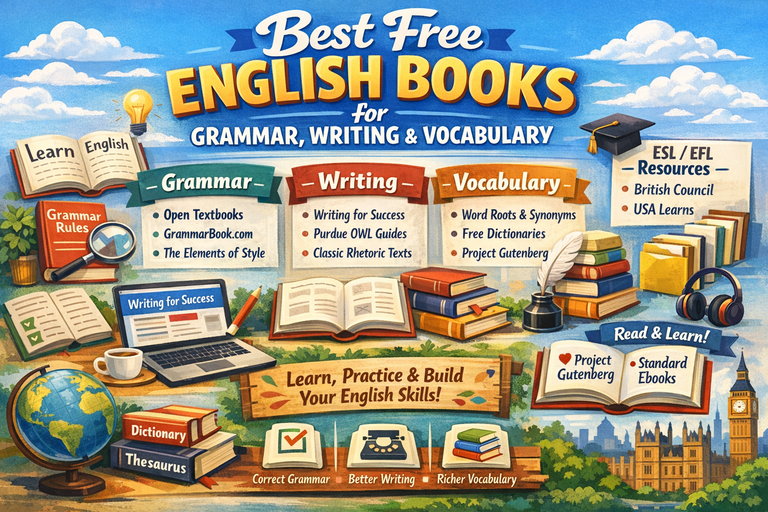
Best Free English Books for Grammar, Writing, and Vocabulary
Learning English well takes more than memorizing rules. Real progress comes from clear explanations, real examples, and consistent practice. The good news? You don’t need expensive textbooks. Many excellent English books are legally free either because they’re open educational resources (OER) or public-domain classics.
This guide curates the best free English books and book-length resources for grammar, writing, and vocabulary, explains who each resource is best for, and shows where to find them. Whether you’re an ESL learner, a student, or a professional polishing your writing, there’s something here for you.
How to Choose the Right Free English Book
Before downloading anything, get clear on three things:
1) Your level
Beginner – basic sentence structure, common tenses, everyday vocabulary
Intermediate – accuracy, paragraph writing, idioms, collocations
Advanced / Academic – style, argument, clarity, formal vocabulary
2) Your goal
Correct grammar and fewer mistakes
Better essays and reports
Stronger emails and professional writing
Richer vocabulary and more natural expressions
3) Your learning style
Rule-based – grammar charts and explanations
Example-based – models you can imitate
Practice-heavy – exercises and guided writing
Best strategy:
Use three complementary resources:
One grammar book (rules + practice)
One writing book (structure + style)
One vocabulary resource (word building + usage)
Best Free English Grammar Books
1) Open English Grammar Textbooks (OER)
Why they’re useful:
Open textbooks are modern, structured like university courses, and often include exercises, summaries, and activities.
Where to find them:
Open Textbook Library: https://open.umn.edu/opentextbooks/
(Search: “English grammar,†“writing,†or “compositionâ€)
Best for:
Students, self-learners who want a textbook-style approach, and classroom use.
2) The Blue Book of Grammar and Punctuation (Free Online)
Why it’s great:
Clear rules, simple explanations, lots of examples, and quizzes. It’s especially good for common mistakes (commas, verb agreement, capitalization).
Where to find:
https://www.grammarbook.com/
Best for:
Self-learners who want quick answers, practical rules, and regular practice.
3) The Elements of Style (Public Domain Edition)
Why it’s helpful:
Short, memorable rules focused on clarity, conciseness, and correctness. Some advice is debated today, but it’s still powerful for tightening sentences.
Where to find:
Project Gutenberg – https://www.gutenberg.org/
(Search: The Elements of Style)
Best for:
Intermediate and advanced learners refining sentence clarity and style.
4) Classic Reference Grammars (Public Domain)
Older grammar books can be extremely detailed and precise, though the examples may feel formal or old-fashioned.
Where to find:
Project Gutenberg – https://www.gutenberg.org/
(Search: “English grammarâ€)
Best for:
Learners who like formal rule explanations and don’t mind traditional language.
Best Free English Writing Books (Essays, Academic Writing, Style)
1) Writing for Success (Open Textbook)
Why it’s excellent:
One of the best free modern writing textbooks. It covers:
The writing process (planning → drafting → revising)
Paragraphs and essays
Grammar in context
Editing and proofreading
Where to find:
Open Textbook Library – https://open.umn.edu/opentextbooks/
(Search: Writing for Success)
Best for:
High school and college students, ESL learners building strong foundations.
2) Free Composition & Rhetoric OER Textbooks
These books teach argument, research, organization, and academic writing, similar to expensive college textbooks.
Where to find reliable collections:
OpenStax: https://openstax.org/subjects
Open Textbook Library: https://open.umn.edu/opentextbooks/
LibreTexts (Writing & English): https://libretexts.org/
Best for:
Academic writing, research papers, and structured learning.
3) Classic Composition & Rhetoric Texts (Public Domain)
Older writing books often focus deeply on logic, structure, persuasion, and clarity.
Where to find:
Project Gutenberg – https://www.gutenberg.org/
Best for:
Advanced learners who want to master formal writing techniques.
4) University Writing Handbooks (Free, Book-Like Guides)
Many universities publish outstanding free writing guides that function like mini-books.
Top resources:
Purdue OWL: https://owl.purdue.edu/
Harvard College Writing Center: https://writingcenter.fas.harvard.edu/
Best for:
Essays, research papers, citations, grammar in context.
Best Free Vocabulary Books and Resources
1) Public Domain Vocabulary Builders
Classic vocabulary books often focus on precise meanings, synonyms, and usage, helping learners avoid confusion between similar words.
Where to find:
Project Gutenberg – https://www.gutenberg.org/
Search terms:
“synonyms and antonymsâ€
“word studyâ€
“vocabularyâ€
Best for:
Careful vocabulary expansion and formal English.
2) Word Roots and Morphology Resources
Learning prefixes, suffixes, and roots (Latin and Greek) is one of the fastest ways to grow vocabulary.
Where to find:
Open Textbook Library: https://open.umn.edu/opentextbooks/
LibreTexts: https://libretexts.org/
Best for:
Intermediate learners who want to unlock thousands of words efficiently.
3) Free Dictionaries and Thesauruses (Essential Tools)
Not traditional books, but absolutely essential:
Merriam-Webster: https://www.merriam-webster.com/
Cambridge Dictionary: https://dictionary.cambridge.org/
Oxford Learner’s Dictionaries: https://www.oxfordlearnersdictionaries.com/
Best for:
Pronunciation, example sentences, collocations, and word usage.
Best Free Resources for ESL / EFL Learners
1) British Council – LearnEnglish
Why it’s good:
Clear explanations, graded lessons, grammar practice, and vocabulary support.
Where to find:
https://learnenglish.britishcouncil.org/
Best for:
Beginner to intermediate ESL learners.
2) USA Learns
Free, structured courses that work like a guided textbook.
Where to find:
https://www.usalearns.org/
Best for:
Beginners who want step-by-step instruction.
Bonus: Free Literature Books to Build Vocabulary Naturally
Reading real books improves grammar intuition, sentence rhythm, and vocabulary in context.
Where to find:
Project Gutenberg: https://www.gutenberg.org/
Standard Ebooks (beautiful formatting): https://standardebooks.org/
Best for:
Learning natural English through stories and essays.
Recommended 3-Book Study Plans
Plan A: Grammar + Everyday Writing
The Blue Book of Grammar and Punctuation
Writing for Success
One classic novel from Standard Ebooks
Plan B: Academic Writing (College / IELTS-style)
Writing for Success
Purdue OWL
Dictionary + vocabulary notebook
Plan C: Fast Vocabulary Growth (Intermediate+)
Word roots resource (OER / LibreTexts)
Dictionary + thesaurus practice
Daily reading from public-domain literature
Tips to Learn Faster with Free English Books
Don’t just read practice. Write sentences and short paragraphs.
Track your errors. Keep a personal mistake list (articles, tenses, prepositions).
Use spaced repetition. Review vocabulary after 1, 3, 7, and 14 days.
Learn collocations. “Make a decision,†“heavy rain,†“strong coffee.â€
Imitate good writing. Rewrite strong paragraphs with your own topics.
Summary: Best Free Picks (Quick List)
Grammar: The Blue Book of Grammar and Punctuation (GrammarBook.com)
Writing: Writing for Success (Open Textbook Library)
Vocabulary: Free dictionaries + public-domain vocabulary books + classic literature
With these free resources and consistent practice you can build accurate grammar, confident writing, and a rich, natural vocabulary without spending a cent