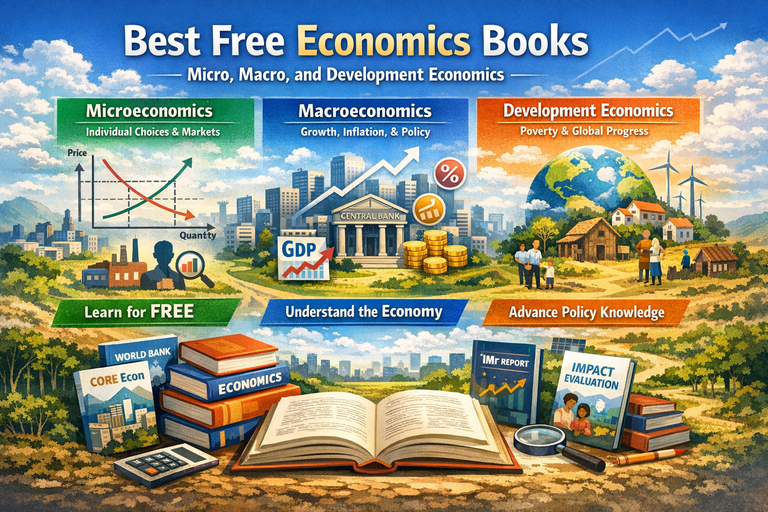
Best Free Economics Books: Micro, Macro, and Development Economics
Economics explains how people, firms, and governments make choices under scarcity and how those choices shape markets, inflation, unemployment, inequality, and long-run development. From why prices rise to how policies reduce poverty, economics provides tools to understand everyday decisions and global outcomes alike.
For many learners, however, the biggest barrier is cost. Standard economics textbooks are often expensive and frequently updated. The good news is that a growing ecosystem of legally free, high-quality economics books now offers structured learning without financial barriers often written and reviewed by leading academics and institutions.
This guide highlights some of the best free economics books across three core pillars:
-
Microeconomics: individual decision-making, firms, markets, and welfare
-
Macroeconomics: growth, inflation, unemployment, money, and economic policy
-
Development & public economics: poverty, institutions, public goods, taxation, and policy evaluation
Where possible, the recommendations focus on complete textbooks or book-length resources, not just lecture notes, and on publishers and institutions known for reliability and academic rigor.
How to Choose the Right Free Economics Book
Before downloading anything, match the book to your goals, level, and learning style.
1) Your Level
-
Principles (Beginner)
Minimal math, intuitive graphs, broad coverage. Ideal for first-time learners. -
Intermediate
More formal models, sometimes calculus, deeper theoretical structure. -
Applied / Policy-focused
Emphasis on real-world data, institutions, and evaluation methods.
2) Your Learning Style
Ask yourself:
-
Do you want lots of practice problems and exercises?
-
Do you prefer case studies and data over abstract modeling?
-
Do you learn best through visual graphs, stories, or equations?
3) Your Context
-
Macroeconomic policy details vary by country, but core ideas transfer globally.
-
Development economics often emphasizes institutions, field evidence, and implementation challenges.
1) Best Free Books for Microeconomics
Microeconomics forms the foundation of economic thinking. It explains how individuals make choices, how firms produce and price goods, how markets allocate resources, and when markets fail.
A. OpenStax — Microeconomics
Level: Principles (beginner to early intermediate)
Best for: Students, self-learners, entrepreneurs
Why it stands out:
OpenStax provides one of the most widely used free economics textbooks in the world. It combines clear explanations, strong visual intuition, chapter summaries, and end-of-chapter exercises. Coverage mirrors a full university “Microeconomics 101” course.
Core topics you’ll master
-
Supply and demand; elasticity
-
Consumer choice and welfare analysis
-
Firm behavior, production, and costs
-
Market structures: competition, monopoly, oligopoly
-
Market failures: externalities, public goods, information problems
-
Government intervention: taxes, subsidies, and regulation
Use it for: A complete, structured introduction to microeconomics.
B. CORE Econ — The Economy
Level: Principles, with modern and interdisciplinary emphasis
Best for: Learners who want economics tied to real institutions and history
Why it stands out:
CORE Econ rethinks how economics is taught. Instead of starting with abstract markets, it begins with real problems inequality, climate change, innovation, power, and labor markets and builds theory around them. Data and empirical evidence appear early and often.
Use it for: A context-rich principles sequence that blends micro, macro, and social relevance.
C. Microeconomics: Theory Through Applications (Open textbook / Saylor-style)
Level: Principles to intermediate bridge
Best for: Learners who want more formal modeling without jumping straight into heavy math
Why it stands out:
This style of open textbook emphasizes applying microeconomic models to policy and real-world scenarios. It’s ideal after (or alongside) an introductory text.
Use it for: Strengthening analytical skills and applying theory to practical questions.
D. Open Textbook Libraries (Specialized Micro Topics)
If you want to go beyond principles into game theory, industrial organization, behavioral economics, or welfare analysis search trusted repositories such as:
-
Open Textbook Library
-
BCcampus Open Education
-
LibreTexts (Economics)
Tip: For microeconomics, prioritize books with problem sets, worked examples, and graph practice. Drawing and interpreting diagrams is where micro really “clicks.”
2) Best Free Books for Macroeconomics
Macroeconomics connects individual decisions to economy-wide outcomes: output, employment, inflation, interest rates, and long-run growth. It also explains the roles of central banks and government budgets.
A. OpenStax — Macroeconomics
Level: Principles (beginner to early intermediate)
Best for: A full, structured macro introduction
Why it stands out:
The book follows a clear progression from measuring GDP to understanding business cycles, inflation, monetary policy, fiscal policy, and international macroeconomics. Learning objectives and practice questions make it ideal for self-study.
Core topics you’ll master
-
GDP and national income accounting
-
Business cycles and unemployment
-
Inflation, money, and banking
-
Fiscal and monetary policy
-
Long-run growth and productivity
-
Exchange rates and international finance basics
Use it for: A standard “Macro 101” equivalent.
B. CORE Econ — The Economy (Macroeconomic Modules)
Level: Principles with institutional focus
Best for: Learners who want macro tied to real events
Why it stands out:
CORE emphasizes how macro outcomes emerge from firm behavior, labor relations, policy regimes, and institutions making it easier to connect theory with current economic news.
C. Macroeconomics: Theory Through Applications (Open textbook)
Level: Principles to intermediate
Best for: Learners who want a slightly more model-forward approach
Why it stands out:
This type of open macro text helps learners turn intuition into structured frameworks for analyzing shocks, policy tradeoffs, and adjustments over time.
D. IMF and Central Bank Book-Length Resources
Level: Intermediate to advanced (policy-focused)
Best for: Understanding how macro policy works in practice
Why it stands out:
Although not always labeled “textbooks,” institutional publications often provide some of the clearest explanations of real-world macroeconomic frameworks especially inflation targeting, fiscal sustainability, and financial stability.
Use it for: Moving beyond theory into real policy discussions.
3) Best Free Books for Development and Public Economics
Development economics studies how living standards improve over time focusing on productivity, health, education, institutions, infrastructure, finance, and governance. Public economics examines how governments raise and spend resources and how policies affect welfare.
Because these fields rely heavily on empirical evidence, many of the best free resources come from global institutions.
A. World Bank — World Development Report (Annual Series)
Level: Beginner to advanced (varies by edition)
Best for: Evidence-based development policy analysis
Why it stands out:
Each report focuses on a major theme jobs, gender, governance, risk, digital development, climate combining research, case studies, and policy lessons.
Use it for: Topic-driven learning and understanding development challenges in practice.
B. World Bank — Impact Evaluation in Practice
Level: Beginner to intermediate (applied)
Best for: Learning how “what works” is measured
Why it stands out:
This book offers one of the clearest introductions to causal inference in development and public policy.
What you’ll learn
-
Why correlation is not causation
-
Randomized controlled trials and quasi-experiments
-
Difference-in-differences, regression discontinuity, matching
-
How to interpret results and avoid common pitfalls
Use it for: Understanding how policies are evaluated, not just designed.
C. UNDP — Human Development Reports
Level: Beginner to intermediate
Best for: A broader view of development beyond GDP
Why it stands out:
UNDP emphasizes capabilities, inequality, vulnerability, and human welfare connecting economics with social outcomes.
D. Public Economics Foundations in OpenStax and CORE Econ
Level: Principles
Best for: Public goods, taxation basics, welfare analysis
Why it stands out:
You get the essential building blocks of public economics market failures, redistribution, and policy tradeoffs without needing a specialized paid text.
E. IMF Fiscal and Government Finance Resources
Level: Intermediate to advanced
Best for: Budgets, deficits, debt, and fiscal transparency
Why it stands out:
More technical than standard textbooks, these resources are ideal for learners interested in public financial management and fiscal institutions.
Suggested Reading Paths (Structured Self-Study)
Path 1: Beginner “Principles” Track (4–8 weeks)
-
CORE Econ — The Economy
-
OpenStax — Microeconomics
-
OpenStax — Macroeconomics
Outcome: Comfort with graphs, indicators, and basic policy debates.
Path 2: Exam-Oriented Track (3–6 weeks)
-
OpenStax Microeconomics (chapters + problems)
-
OpenStax Macroeconomics (chapters + problems)
-
One development report (World Development Report or Human Development Report)
Outcome: Strong preparation for intro university courses and exams.
Path 3: Development & Policy Track (6–10 weeks)
-
Principles foundation (OpenStax or CORE)
-
World Development Report (chosen theme)
-
Impact Evaluation in Practice
-
Supplement with regional or sector-specific reports
Outcome: Understanding of both development theory and evidence-based policy.
How to Study Economics Effectively (Especially with Free Books)
-
Draw the graphs yourself. Economics becomes clear when you can recreate diagrams from memory.
-
Treat end-of-chapter problems as mandatory. Reading builds familiarity; problems build skill.
-
Connect models to real data. Inflation rates, GDP growth, poverty measures make the numbers real.
-
Write one-page summaries. Focus on assumptions, mechanisms, predictions, and policy implications.
Quick Picks: Best Free Economics Books by Topic
-
Best overall free micro textbook: OpenStax Microeconomics
-
Best overall free macro textbook: OpenStax Macroeconomics
-
Best modern, real-world principles book: CORE Econ The Economy
-
Best development policy series: World Bank World Development Report
-
Best policy evaluation book: World Bank Impact Evaluation in Practice
Free economics books have matured into a powerful alternative to costly textbooks. With the right selection and a structured approach, you can build a solid economics foundation or even advanced policy insight without spending a single dollar