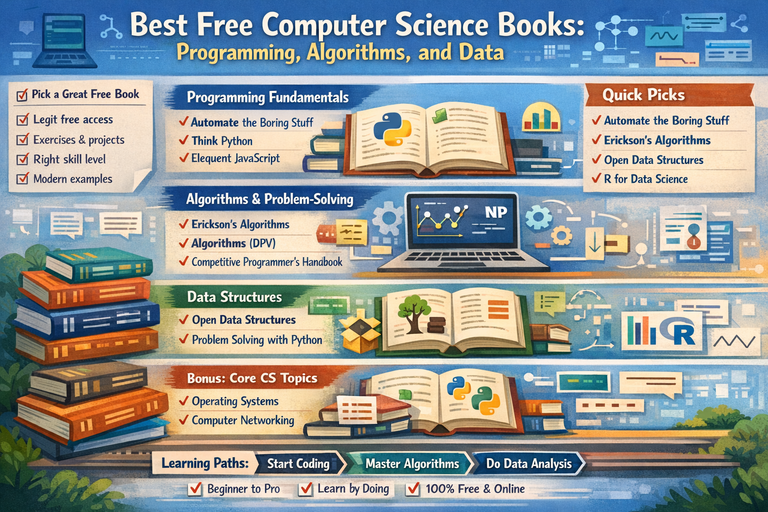
Best Free Computer Science Books: Programming, Algorithms, and Data
Computer science is no longer a niche discipline reserved for software engineers. Skills like programming, algorithmic thinking, and data analysis are now essential across business, healthcare, finance, science, design, education, and entrepreneurship. Whether you’re automating workflows, analyzing data, building products, or preparing for technical interviews, computer science literacy gives you a powerful advantage.
The challenge for many learners especially students and self-taught developers is cost. Traditional CS textbooks can be expensive, often running into hundreds of dollars per semester. The good news is that many world-class computer science books are legally available online for free, written by respected professors, researchers, and industry practitioners.
This guide curates the best free computer science books across:
Programming fundamentals
Algorithms and problem-solving
Data structures
Data analysis and data science
Core systems knowledge (operating systems, networking)
Each recommendation includes who the book is for, what you’ll learn, and why it’s worth your time, so you can choose confidently and avoid low-quality or outdated material.
How to Choose a Free Computer Science Book (Quick Checklist)
Not all free resources are equally valuable. Before committing your time, look for these qualities:
Legitimate free access
Author-hosted websites, open-license books, or officially free web editions.Exercises and projects
Computer science is learned by doing, not just reading.A clear target level
Beginner, intermediate, or advanced avoid books that don’t match your background.Modern workflows
Current language versions, realistic tooling, and practical examples.Conceptual depth
Good CS books explain why things work, not just how.
At-a-Glance Recommendations (Fast Picks)
If you want just a few high-impact choices:
Programming (absolute beginner): Automate the Boring Stuff with Python
Programming (CS foundations): How to Design Programs or SICP
Data structures: Open Data Structures
Algorithms (core theory): Algorithms by Jeff Erickson
Data analysis: R for Data Science or Python Data Science Handbook
Systems depth: Operating Systems: Three Easy Pieces
1) Programming Fundamentals (Best Free Books)
Automate the Boring Stuff with Python Al Sweigart
Best for: Absolute beginners who want quick, practical results
What you learn: Python basics, file handling, spreadsheets, web scraping, automation
Free: https://automatetheboringstuff.com/
Why it’s great:
This book is famous for turning beginners into confident programmers fast. Instead of abstract exercises, you write scripts that solve real problems renaming files, scraping websites, automating emails, and more. It’s ideal for students, office workers, and entrepreneurs who want immediate value.
Think Python (2nd Edition) Allen B. Downey
Best for: Beginners who want strong conceptual foundations
What you learn: Variables, functions, recursion, data structures, OOP
Free: https://greenteapress.com/wp/think-python-2e/
Why it’s great:
Think Python focuses on thinking like a computer scientist. The explanations are clear, the pacing is thoughtful, and the exercises reinforce core ideas that transfer to other languages.
Python for Everybody Charles Severance
Best for: Beginners interested in programming plus data concepts
What you learn: Python basics, files, web data, APIs, databases
Free: https://www.py4e.com/book
Why it’s great:
Designed for non-CS majors, this book gently introduces programming while naturally leading into data analysis and real-world applications.
Eloquent JavaScript (3rd Edition) Marijn Haverbeke
Best for: Beginners to intermediate learners using JavaScript
What you learn: JavaScript fundamentals, functional programming, async code, browser APIs
Free: https://eloquentjavascript.net/
Why it’s great:
Beautifully written and intellectually engaging, this book helps you understand JavaScript deeply rather than memorizing syntax.
You Don’t Know JS Yet (Series) Kyle Simpson
Best for: Intermediate JavaScript developers
What you learn: Scope, closures, types, async behavior, language internals
Free: https://github.com/getify/You-Dont-Know-JS
Why it’s great:
Many JS developers struggle because they never fully understand the language. This series fills that gap and dramatically improves code quality.
Structure and Interpretation of Computer Programs (SICP) Abelson & Sussman
Best for: Learners who want deep computer science thinking
What you learn: Abstraction, recursion, interpreters, functional programming ideas
Free: https://sarabander.github.io/sicp/
Why it’s great:
Often called the classic CS book, SICP changes how you think about computation. It’s challenging but incredibly rewarding.
How to Design Programs (2nd Edition) Felleisen et al.
Best for: Beginners who want a systematic approach to problem-solving
What you learn: Program design recipes, testing, recursion, data-driven design
Free: https://htdp.org/
Why it’s great:
Instead of trial-and-error coding, this book teaches a disciplined method for building correct programs.
Crafting Interpreters Bob Nystrom
Best for: Intermediate programmers curious about how languages work
What you learn: Parsing, abstract syntax trees, bytecode, interpreters, VMs
Free: https://craftinginterpreters.com/
Why it’s great:
You build real interpreters step by step, gaining insight into compilers, language design, and runtime systems.
2) Algorithms & Problem-Solving (Best Free Books)
Algorithms Jeff Erickson
Best for: Serious learners seeking a full algorithms course
What you learn: Proofs, graphs, dynamic programming, NP-completeness
Free: https://jeffe.cs.illinois.edu/teaching/algorithms/
Why it’s great:
Rigorous yet readable, this book emphasizes why algorithms work, not just how to code them.
Algorithms Dasgupta, Papadimitriou, Vazirani
Best for: Clean conceptual introduction to algorithms
What you learn: Divide-and-conquer, greedy algorithms, graphs, complexity
Free: https://people.eecs.berkeley.edu/~vazirani/algorithms.html
Why it’s great:
Concise and elegant, often used in top universities worldwide.
Competitive Programmer’s Handbook Antti Laaksonen
Best for: Learning algorithms through implementation
What you learn: Sorting, searching, graphs, DP, math techniques
Free: https://cses.fi/book/book.pdf
Why it’s great:
Excellent for coding interviews and contest-style problem-solving.
The Little Book of Semaphores Allen B. Downey
Best for: Understanding concurrency and synchronization
What you learn: Threads, locks, classic concurrency problems
Free: https://greenteapress.com/wp/the-little-book-of-semaphores/
Why it’s great:
Concurrency is notoriously hard this book makes it approachable.
3) Data Structures (And Coding with Them)
Open Data Structures Pat Morin
Best for: Learners seeking depth with clarity
What you learn: Arrays, lists, stacks, queues, trees, hashing, graphs
Free: https://opendatastructures.org/
Why it’s great:
Balances theoretical rigor with practical implementation insights.
Problem Solving with Algorithms and Data Structures (Python) Miller & Ranum
Best for: Beginners to intermediate Python programmers
What you learn: Data structures, algorithmic thinking, Python implementations
Free: https://runestone.academy/ns/books/published/pythonds3/index.html
Why it’s great:
Interactive and beginner-friendly, ideal for self-study.
4) Data Analysis, Data Science, and “Data Thinking”
R for Data Science (2nd Edition) Wickham et al.
Best for: Practical, end-to-end data analysis
What you learn: Data wrangling, visualization, modeling, reproducibility
Free: https://r4ds.hadley.nz/
Why it’s great:
A gold standard for learning modern data workflows.
Python Data Science Handbook Jake VanderPlas
Best for: Python-based data analysis
What you learn: NumPy, Pandas, Matplotlib, Scikit-learn
Free: https://jakevdp.github.io/PythonDataScienceHandbook/
Why it’s great:
Hands-on and tool-focused, perfect for applied work.
Think Stats (2nd Edition) Allen B. Downey
Best for: Developers learning statistics through code
What you learn: Probability, inference, regression
Free: https://greenteapress.com/wp/think-stats-2e/
Why it’s great:
Bridges the gap between programming and statistics.
An Introduction to Statistical Learning (ISLR)
Best for: Beginners to machine learning
What you learn: Regression, classification, trees, SVMs, clustering
Free: https://www.statlearning.com/
Why it’s great:
More intuitive and accessible than many ML textbooks.
Mining of Massive Datasets Leskovec et al.
Best for: Big-data and large-scale systems thinking
What you learn: MapReduce, similarity search, graph mining, recommenders
Free: http://www.mmds.org/
Why it’s great:
Explains the ideas behind modern data platforms.
5) Bonus: Foundational CS Areas (High-Value Reads)
These books deepen your understanding beyond coding:
Operating Systems: Three Easy Pieces (OSTEP)
https://pages.cs.wisc.edu/~remzi/OSTEP/
Covers processes, threads, memory, and file systems.Computer Networking: Principles, Protocols and Practice
https://cnp3book.info.ucl.ac.be/
Covers Internet architecture, TCP/IP, routing, congestion control.
Suggested Learning Paths (So You Don’t Get Stuck)
Path A: “I’m Brand New to Programming”
Automate the Boring Stuff with Python
Think Python
Problem Solving with Algorithms and Data Structures (Python)
Path B: “I Can Code Now I Want Algorithms”
Open Data Structures
Algorithms (Dasgupta–Papadimitriou–Vazirani)
Erickson’s Algorithms
Competitive Programmer’s Handbook
Path C: “I Want to Do Data Analysis”
R for Data Science or Python Data Science Handbook
Think Stats
ISLR
Tips for Using Free CS Books Effectively
Code every concept don’t just read.
Solve exercises consistently, even a few per chapter.
Build mini-projects every few chapters.
Keep reusable notes: patterns, pitfalls, examples.
Revisit hard chapters depth matters more than speed.
Want a Personalized Book List?
If you share:
your current level (new / some coding / intermediate),
your preferred language (Python, JavaScript, Java, C++, R),
and your goal (job switch, academics, interviews, data analysis)