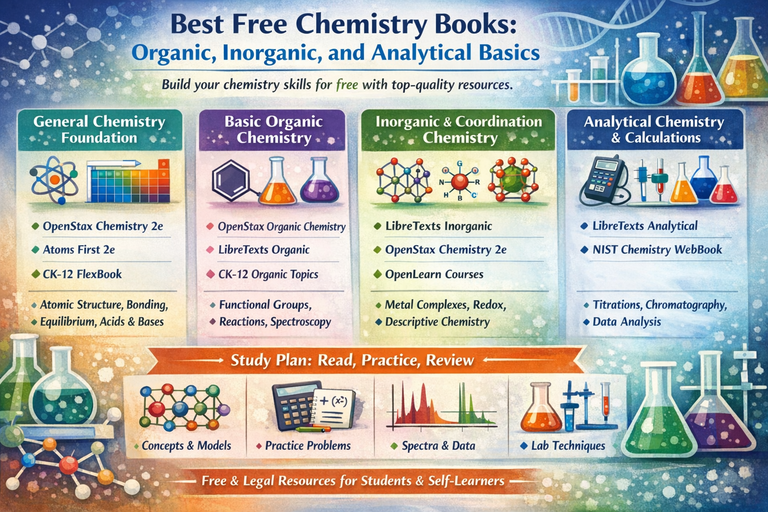
Best Free Chemistry Books: Organic, Inorganic, and Analytical Basics
Chemistry becomes much easier and far more enjoyable when you build ideas step by step and practice them often. Unfortunately, many standard chemistry textbooks are expensive, especially for students studying independently, revising for exams, or refreshing concepts outside a formal course.
The good news is that high-quality free chemistry books and open textbooks now cover the same foundations as paid texts: atomic structure, bonding, reaction types, stoichiometry, equilibrium, organic functional groups, and analytical calculations. Most of these resources are legally available through Open Educational Resources (OER) platforms and can be read online or downloaded at no cost.
This guide highlights reliable free resources across three essential areas of chemistry:
Basic organic chemistry
Inorganic reactions and bonding
Analytical techniques and calculations
These books are suitable for high school students, undergraduates, and self-learners, and they can be combined to create a complete, university-level chemistry foundation.
What to Look for in a Free Chemistry Book
Not all free textbooks are equal. A strong chemistry resource should include:
Conceptual clarity – explanations that link atomic and molecular models to observable behavior such as reactivity, color, acidity, and solubility.
Worked examples – step-by-step solutions for stoichiometry, equilibrium, pH, kinetics, and spectroscopy.
Practice problems – chemistry is learned by doing, not just reading.
Visuals and tables – structures, reaction mechanisms, periodic trends, common ions, and solubility rules.
Modern relevance – updated safety guidance and contemporary analytical techniques.
A highly effective strategy is to combine:
One general chemistry book (for fundamentals),
One organic chemistry book (for structure and reactions), and
One analytical resource (for calculations, measurement, and lab concepts).
1) Best Free Chemistry Books for a General Foundation
(Recommended Starting Point)
Even if your main interest is organic or analytical chemistry, progress is much faster with a solid grounding in general chemistry: atomic structure, periodic trends, bonding, thermochemistry, equilibrium, acids and bases, and redox reactions.
OpenStax: Chemistry 2e (Best all-around free textbook)
Level: Advanced high school → undergraduate
Why it stands out: Clear explanations, excellent diagrams, strong problem sets, and a progression that closely matches standard university curricula.
Best for learning:
Stoichiometry and limiting reagents
Atomic structure and periodic trends
Ionic and covalent bonding, VSEPR, molecular geometry
Thermochemistry, kinetics, and equilibrium
Acid–base chemistry and electrochemistry
Link: https://openstax.org/details/books/chemistry-2e
OpenStax: Chemistry – Atoms First 2e
Level: High school → undergraduate
Why it’s useful: Some courses begin with atomic theory and bonding before stoichiometry. This edition follows that sequence.
Link: https://openstax.org/details/books/chemistry-atoms-first-2e
CK-12: Chemistry FlexBook (Best for quick review and gentle explanations)
Level: Middle school → high school (also useful for refreshers)
Why it’s useful: Short, modular sections make it ideal for brushing up on fundamentals before moving to a full general chemistry text.
Link: https://www.ck12.org/chemistry/
2) Best Free Books for Basic Organic Chemistry
Organic chemistry is often described as “memorization-heavy,†but the most effective approach is pattern-based learning:
Identify functional groups
Understand electron movement
Learn common reaction mechanisms
Practice drawing structures and interpreting spectra
OpenStax: Organic Chemistry (Best free modern organic textbook)
Level: Undergraduate (accessible to motivated high school students)
Why it stands out: Comprehensive coverage, clear structure, and abundant practice problems.
Best for learning:
Functional groups and IUPAC nomenclature
Conformations and stereochemistry
Substitution and elimination reactions (SN1, SN2, E1, E2)
Alkene and alkyne addition reactions
Carbonyl chemistry fundamentals
Introductory IR, NMR, and mass spectrometry
Link: https://openstax.org/details/books/organic-chemistry
Organic Chemistry on LibreTexts (Best companion and alternative explanations)
Level: Advanced high school → undergraduate
Why it’s useful: If a mechanism or concept doesn’t “click,†LibreTexts often provides another explanation, extra examples, and additional problem sets.
Link: https://chem.libretexts.org
(Navigate to Organic Chemistry)
Note: LibreTexts functions more like a digital library than a single linear book, making it ideal for targeted review and supplementation.
CK-12: Organic Chemistry Topics (Best for first exposure)
Level: High school
Why it’s useful: Excellent for learning basic functional groups and reaction ideas before tackling full, mechanism-heavy organic chemistry.
Link: https://www.ck12.org/chemistry/
(Search within CK-12 for organic chemistry topics)
3) Best Free Books for Inorganic Chemistry
(Bonding, Reactions, and Coordination)
At the introductory level, inorganic chemistry typically focuses on:
Bonding models (ionic, covalent, metallic)
Periodic trends and reactivity
Acid–base and redox chemistry
Coordination compounds and metal complexes
Descriptive chemistry of main-group and transition elements
OpenStax: Chemistry 2e (Best inorganic foundation for most learners)
Level: Advanced high school → undergraduate
Why it works: Chapters on bonding, intermolecular forces, equilibrium, acids and bases, and redox chemistry form the backbone of inorganic chemistry.
Link: https://openstax.org/details/books/chemistry-2e
Inorganic Chemistry on LibreTexts (Best free deepening resource)
Level: Undergraduate
Why it’s useful: Helpful for coordination chemistry, crystal field concepts (introductory level), descriptive chemistry, and expanded bonding models.
Link: https://chem.libretexts.org
(Navigate to Inorganic Chemistry)
OpenLearn / Open University Chemistry Units (Best structured short courses)
Level: Introductory → intermediate
Why it’s useful: Designed for independent learners, with strong explanations of bonding, reactivity, and chemical principles.
Link: https://www.open.edu/openlearn/
(Search for “chemistry bonding,†“acids and bases,†“reaction rates,†etc.)
4) Best Free Books for Analytical Chemistry
(Techniques and Calculations)
Analytical chemistry is where chemistry meets measurement. Core skills include:
Units, significant figures, and error analysis
Concentration and equilibrium calculations
Acid–base, complexation, and solubility equilibria
Titrations and calibration curves
Spectroscopy and chromatography basics
OpenStax: Chemistry 2e (Best for analytical calculations)
Level: Advanced high school → undergraduate
Why it’s relevant: Stoichiometry, buffers, solubility, kinetics, and electrochemistry are central to analytical chemistry.
Link: https://openstax.org/details/books/chemistry-2e
Analytical Chemistry on LibreTexts (Best free analytical reference)
Level: Undergraduate
Why it’s useful: Coverage often includes:
Gravimetric analysis concepts
Titration curves and buffer calculations
UV–Vis and IR spectroscopy
Chromatography fundamentals
Statistics (mean, standard deviation, confidence intervals)
Link: https://chem.libretexts.org
(Navigate to Analytical Chemistry)
NIST Chemistry WebBook (Best free reference data)
Level: High school → professional reference
Why it’s useful: Trusted physical constants, spectra, and reference data essential for analytical work.
Link: https://webbook.nist.gov/chemistry/
Quick Recommendations by Learner Type
If you’re in high school or starting from scratch
CK-12 Chemistry for approachable foundations
OpenStax Chemistry 2e once basics feel comfortable
LibreTexts for extra practice and clarification
If you’re an undergraduate or preparing for college chemistry
OpenStax Chemistry 2e (core text)
OpenStax Organic Chemistry (organic sequence)
LibreTexts for inorganic and analytical depth
If you’re self-learning (fast, practical pathway)
OpenStax Chemistry 2e (stoichiometry → bonding → equilibrium → acids/bases)
OpenStax Organic Chemistry (functional groups and mechanisms)
LibreTexts for analytical topics (titrations, calibration, spectroscopy)
A Simple Study Plan: Concept + Practice
Chemistry improves fastest when reading and problem-solving are tightly linked:
Read a short section (10–20 minutes)
Solve 5–10 problems immediately
Check errors and rework problems without the solution
Review key formulas weekly (equilibrium expressions, pH relations, reaction patterns)
High-impact skills to practice early:
Dimensional analysis and unit conversions
Balancing equations and stoichiometry
Acid–base pH and buffer problems
Recognizing functional groups and predicting reactions
Interpreting graphs (titration curves, calibration curves)
Best Free Chemistry Books: Top Picks Summary
If you only choose a few resources, these cover most learning needs:
Best overall general chemistry: OpenStax Chemistry 2e
Best organic chemistry textbook: OpenStax Organic Chemistry
Best supplementary library: Chemistry LibreTexts
Best beginner ramp-up: CK-12 Chemistry
Best analytical reference data: NIST Chemistry WebBook
With these free, legal resources, you can build a complete chemistry foundation from atoms to reactions to measurements without spending anything on textbooks.