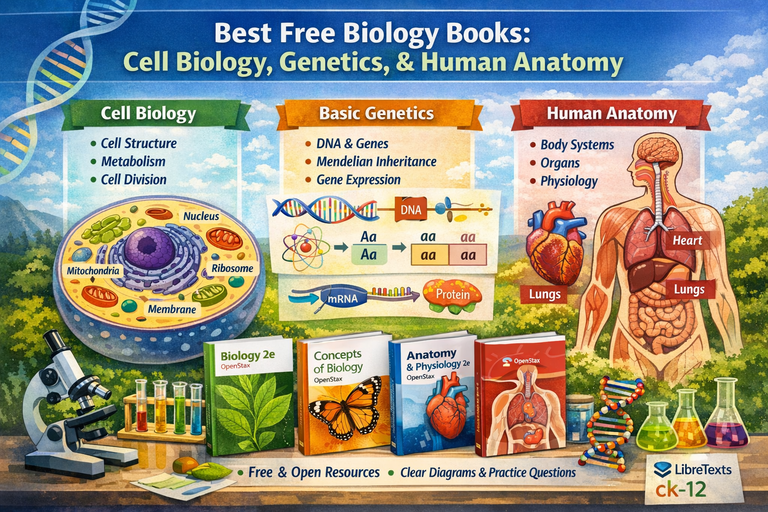
Best Free Biology Books: Cell Biology, Genetics, and Human Anatomy
Biology explains how living systems work from how a single cell produces energy, to how traits are passed from parents to offspring, to how the human body maintains balance across organs and tissues. Whether you’re studying for secondary school or university exams, preparing for a health-related program, or learning purely out of curiosity, free biology books especially open textbooks can give you clear explanations, diagrams, and practice questions without the high cost of traditional textbooks.
This guide focuses on beginner-friendly, legally available resources in three foundational areas:
Cell biology (cell structure, membranes, metabolism, division)
Basic genetics (DNA, genes, inheritance, gene expression)
Human anatomy and physiology (body systems and how they function together)
Most of the books listed are Open Educational Resources (OER) with Creative Commons licenses, meaning you can read them online and often download them for free.
What Makes a Free Biology Book “Good†for Beginners?
When you’re just starting out, the best biology resources tend to share a few important qualities:
Strong visuals: Clear, labeled diagrams and step-by-step illustrations of processes
Simple language: Minimal jargon, with key terms defined as they appear
Logical structure: Short sections, summaries, and review questions
Up-to-date content: Especially important in genetics and physiology
Practice opportunities: Concept checks, end-of-chapter questions, or examples
A practical strategy is to use one broad textbook for coverage and one focused resource for extra depth in cell biology, genetics, or anatomy.
1) Best Free Books for Cell Biology (Structure & Function)
OpenStax: Biology 2e (Best all-around starter)
Level: High school → early college
Why it’s great: Clear diagrams, strong explanations, learning objectives, and end-of-chapter questions. It’s one of the most widely used free biology textbooks.
Best for learning:
Cell structure and organelles
Membranes, transport, and enzymes
Cellular respiration and photosynthesis
Cell cycle, mitosis, and meiosis
Link: https://openstax.org/details/books/biology-2e
Tip: If this feels dense at first, start with Concepts of Biology below and come back to Biology 2e later.
OpenStax: Concepts of Biology (Best gentle introduction)
Level: Beginner / non-majors
Why it’s great: Shorter chapters and simpler explanations make it ideal if you’re new to biology or returning after a long break.
Best for learning:
What cells are and how they function
Basic metabolism and homeostasis
Introductory genetics concepts
Link: https://openstax.org/details/books/concepts-biology
NCBI Bookshelf: The Cell: A Molecular Approach (Cooper & Hausman)
(Best free deep dive)
Level: Early college → intermediate
Why it’s great: A classic cell biology text with strong conceptual explanations of how molecular processes drive cell behavior.
Best for learning:
Membrane transport and signaling
Gene expression from a cellular perspective
Cytoskeleton, organelles, and cell communication
Link (NCBI Bookshelf): https://www.ncbi.nlm.nih.gov/books/
(Search for “The Cell: A Molecular Approachâ€)
CK-12: Biology FlexBook 2.0 (Best for quick, visual learning)
Level: Middle school → high school
Why it’s great: Modular, visual, and easy to read. Excellent for review or filling knowledge gaps.
Best for learning:
Cell membranes, diffusion, and osmosis
Basic biochemistry and energy
Concise explanations for exam prep
Link: https://www.ck12.org/book/ck-12-biology-flexbook-2.0/
2) Best Free Books for Basic Genetics
Genetics is often easiest when learned in this order:
DNA structure and replication
Gene expression (transcription and translation)
Mendelian inheritance
Chromosomes, meiosis, and variation
Modern genetics (mutations, regulation, genomics basics)
OpenStax: Biology 2e (Best single free genetics foundation)
Level: High school → early college
Why it’s great: Covers both classical Mendelian genetics and modern molecular genetics, with practice questions.
You’ll learn:
DNA replication, transcription, and translation
Punnett squares and inheritance patterns
Chromosomes, linkage, and nondisjunction
Mutations and gene regulation fundamentals
Link: https://openstax.org/details/books/biology-2e
OpenStax: Concepts of Biology (Best for first-time learners)
Level: Beginner
Why it’s great: Explains core genetics terms allele, genotype, phenotype, codon without overwhelming detail.
Link: https://openstax.org/details/books/concepts-biology
CK-12: Biology (Genetics sections)
Level: Middle school → high school
Why it’s great: Genetics is skill-based, especially inheritance problems. CK-12 breaks concepts into manageable steps.
Link: https://www.ck12.org/book/ck-12-biology-flexbook-2.0/
Biology LibreTexts (Free online chapters)
Level: High school → college
Why it’s great: Offers alternative explanations and extra diagrams if a concept doesn’t click the first time.
Best for learning:
Mendelian genetics practice
Molecular genetics pathways
Introductory population genetics
Link: https://bio.libretexts.org
Note: LibreTexts is organized like a library rather than a single linear book, making it ideal as a companion resource.
3) Best Free Books for Human Anatomy and Physiology
If you’re interested in health sciences, nursing, fitness, or pre-med studies, you’ll want anatomy (structures) and physiology (functions) taught together.
OpenStax: Anatomy & Physiology 2e (Best overall free A&P textbook)
Level: Advanced high school → college
Why it’s great: Comprehensive, well-illustrated, and organized by body systems with learning objectives and review questions.
Covers:
Anatomical terminology and body organization
Nervous and endocrine regulation
Cardiovascular and respiratory systems
Digestive, urinary, immune, and reproductive systems
Homeostasis and system integration
Link: https://openstax.org/details/books/anatomy-and-physiology-2e
Wikibooks: Human Anatomy / Anatomy & Physiology (Best quick reference)
Level: Beginner → intermediate
Why it’s useful: Free, searchable, and often simplified. Best used alongside a structured textbook.
Link: https://en.wikibooks.org
(Search for “Human Anatomy†or “Anatomy and Physiologyâ€)
Project Gutenberg: Gray’s Anatomy (Public domain editions)
Level: Reference / advanced
Why it’s useful: Classic anatomical illustrations and detailed descriptions.
Important caution: Public domain editions are very old. Terminology and medical context may be outdated. Use for illustrations and reference not as your primary anatomy source.
Link: https://www.gutenberg.org
(Search “Gray’s Anatomyâ€)
Recommended Learning Path (Beginner → Confident)
Start easy (2–3 weeks):
OpenStax Concepts of Biology (cells + intro genetics)
Build a strong foundation (6–10 weeks):
OpenStax Biology 2e (cells and genetics in more detail)
Add human body systems (6–12 weeks):
OpenStax Anatomy & Physiology 2e
Go deeper as needed:
The Cell: A Molecular Approach (NCBI Bookshelf)
Biology LibreTexts for alternative explanations and practice
How to Study Effectively with Free Biology Books
Redraw diagrams (cell membranes, mitosis, nephron, heart blood flow). If you can draw it from memory, you understand it.
Turn headings into questions:
“Stages of mitosis†→ “What happens in prophase vs. metaphase?â€Practice genetics problems regularly. Inheritance patterns only become clear through repetition.
Use spaced review: Revisit key topics (cell cycle, transcription/translation, major organs) over several days.
Quick Picks (If You Only Choose Three)
Cell biology + genetics (all-in-one): OpenStax Biology 2e
Human anatomy & physiology: OpenStax Anatomy & Physiology 2e
Extra beginner support: CK-12 Biology FlexBook 2.0
With these free resources, you can build a solid biology foundation from cells to systems without spending anything on textbooks