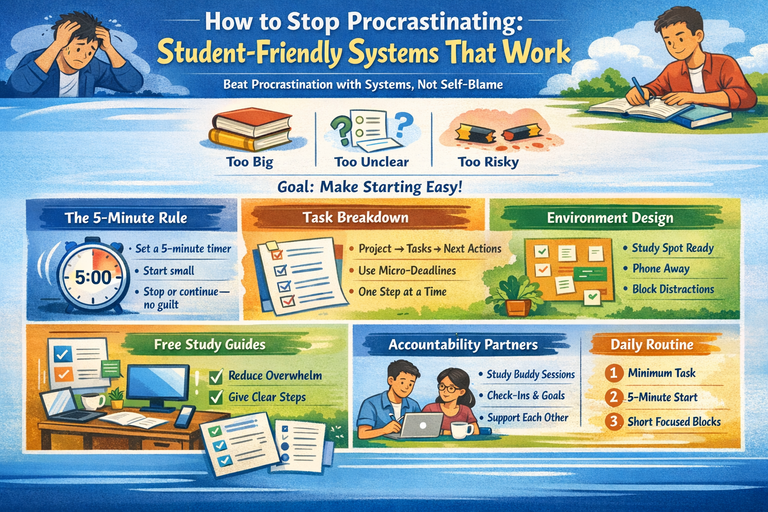
How to Stop Procrastinating: Student-Friendly Systems That Work
Procrastination isn’t usually a character flaw or laziness. For students, it’s most often a response to fear (of failing, of not doing it perfectly, of finding it hard) and overwhelm (too much to do, unclear steps, too little time, too many distractions). When studying feels emotionally uncomfortable, your brain tries to protect you by delaying the task and chasing short-term relief scrolling, gaming, tidying, “researching,” or waiting for motivation.
The solution is not trying harder. The solution is building systems that make starting easy, reduce uncertainty, and keep you moving even when you don’t feel like it.
This guide walks you through student-friendly systems that actually work in real life: the 5-minute rule, task breakdown, environment design, accountability partners, and how free study guides can reduce overwhelm and help you start.
1) Why Students Procrastinate (So You Can Fix the Real Problem)
Common procrastination triggers
Most procrastination happens when a task feels:
-
Too big – “I have to learn the whole chapter.”
-
Too unclear – “I don’t know what to do first.”
-
Too risky – “What if I try and still fail?”
-
Too boring – “This feels pointless.”
-
Too uncomfortable – “This topic makes me feel behind.”
When any of these show up, your brain chooses short-term mood improvement over long-term goals. Avoidance feels safer than facing the discomfort.
The key mindset shift
You don’t procrastinate because you don’t care.
You procrastinate because starting feels stressful.
So the real goal isn’t more discipline it’s to make starting feel safe, simple, and specific.
2) System #1: The 5-Minute Rule (Start Small, Beat Resistance)
What it is
Commit to working for just five minutes. That’s it. You’re not promising a full study session—only the first step.
Why it works
-
Lowers the “activation energy” needed to begin
-
Breaks the mental barrier of starting
-
Momentum often carries you past five minutes
-
Even if you stop, you’ve still built the habit
How to use it (student version)
-
Pick a task that matters (e.g., revise biology, write an intro paragraph).
-
Set a 5-minute timer.
-
Do the smallest real action possible:
-
open your notes
-
write the first two sentences
-
solve one question
-
make three flashcards
-
When the timer ends:
-
Continue if you can, or
-
Stop without guilt and schedule the next 5 minutes later.
One important rule
The 5-minute rule is not a trick to force hours of work. It’s a system to reduce fear and build consistency.
3) System #2: Task Breakdown (Turn “Study” Into Clear Steps)
A vague task creates overwhelm. A defined task creates action.
The “Too Big / Too Vague” test
If you can’t answer “What exactly do I do next?” in one sentence, the task is too vague.
-
Vague: “Study chemistry.”
-
Clear: “Do questions 1–10 on acids and bases and check answers.”
The 3-layer breakdown method
Break work into Project → Tasks → Next Actions.
Project: Prepare for History exam
Tasks (30–60 minutes):
-
Review causes of World War I
-
Learn key dates and figures
-
Write one timed paragraph
Next actions (2–10 minutes):
-
Open notes and highlight five causes
-
Make ten flashcards
-
Write a five-sentence outline
When you procrastinate, you usually don’t need motivation you need a next action.
Use micro-deadlines
Instead of “finish the chapter by Friday,” try:
-
“Read three pages by 5:15”
-
“Complete five questions by 6:00”
Micro-deadlines shrink overwhelm and increase follow-through.
4) System #3: Environment Design (Make Focus Easier Than Distraction)
Willpower loses against a distracting environment especially when you’re anxious or tired. Environment design means making the right choice the easiest choice.
The friction principle
-
Reduce friction for studying
-
Increase friction for distractions
Practical environment upgrades that work
Reduce friction for studying
-
Keep materials visible and ready (book, laptop, calculator)
-
Use a dedicated study spot
-
Maintain a running list titled “Next Actions”
-
Start with a warm-up task (flashcards, quick quiz)
Increase friction for distractions
-
Put your phone in another room or drawer
-
Use Focus Mode or Do Not Disturb
-
Block distracting sites during study blocks
-
Keep only one tab open
The 10-minute reset rule
If you’re drifting:
-
Stand up
-
Tidy your desk for two minutes
-
Open exactly what you need
-
Set a 10-minute timer
Often, that’s enough to restart momentum.
5) System #4: Accountability Partners (External Structure Beats Internal Struggle)
When fear and overwhelm are high, external structure helps more than internal pressure.
What accountability provides
-
Helps you start when you don’t feel like it
-
Makes intentions feel real
-
Adds gentle pressure and routine
-
Reduces isolation (a major procrastination trigger)
Best accountability formats for students
-
Study buddy sessions: 45–90 minutes of quiet work
-
Check-in messages: “My goal: 20 math questions by 7:30”
-
Weekly planning calls: set goals, review, adjust
-
Group study rooms: shared timer, silent work
Accountability rules (so it stays supportive)
-
Report effort and process, not perfection
-
Keep goals small and measurable
-
If you miss a target, review quickly:
-
What made it hard?
-
What’s the next tiny step?
-
What will I change tomorrow?
-
Accountability is support, not punishment.
6) How Free Study Guides Reduce Overwhelm (And Make Starting Easier)
One major reason students procrastinate is uncertainty: What do I need to know? Where do I start? How do I revise?
Free study guides reduce that uncertainty by providing structure.
How study guides help with procrastination
-
Clear scope: shows what’s included (and what isn’t)
-
Checklists: make progress visible
-
Summaries and examples: lower the effort to begin
-
Practice questions: turn vague studying into concrete tasks
How to use free study guides effectively
-
Choose one aligned to your syllabus or exam board
-
Turn headings into a checklist:
-
Not started / In progress / Confident
-
-
Combine with the 5-minute rule:
-
“I’ll answer three questions from this section”
-
-
Create next actions from the guide:
-
“Make eight flashcards from this page”
-
“Do the end-of-topic quiz”
-
Where to find high-quality free guides
-
School portals and teacher-shared resources
-
Public library digital collections
-
Open Educational Resources (OER)
-
Reputable education websites and past-paper banks
Always check that the guide matches your curriculum.
7) A Simple Anti-Procrastination Routine (Daily System)
Here’s a system you can run almost anywhere.
Step 1: Decide your minimum
Choose one daily minimum:
-
10 flashcards
-
1 paragraph plan
-
5 practice questions
-
15 minutes of focused review
Step 2: Pick one next action
Write one sentence:
“Next, I will ______ for 10 minutes.”
Step 3: Start with five minutes
Set a timer. Begin. No negotiation.
Step 4: Continue in short blocks
If you can, do:
-
25 minutes + 5-minute break, or
-
Two 15-minute blocks
Step 5: End with a quick plan
Write:
-
What you finished
-
The next action for tomorrow
This removes startup pain next time.
8) Common Traps (And What to Do Instead)
Trap: “I need motivation first.”
Instead: Start with five minutes. Motivation often follows action.
Trap: “I must do it perfectly or not at all.”
Instead: Aim for a rough first pass. You can improve later.
Trap: “I don’t have enough time.”
Instead: Do a small, high-value task practice questions, active recall, reviewing mistakes.
Trap: “I keep failing, so why start?”
Instead: Redefine success as showing up and completing the next action. Consistency rebuilds confidence.
Conclusion: Beat Procrastination with Systems, Not Self-Blame
Procrastination isn’t laziness it’s usually fear and overwhelm. The fix is to reduce the emotional weight of starting and replace willpower with simple systems:
-
The 5-minute rule to begin even when you don’t feel ready
-
Task breakdown to make work clear and manageable
-
Environment design to make focus easier than distraction
-
Accountability partners to add structure and follow-through
-
Free study guides to reduce uncertainty and make the first step obvious
You don’t need to feel motivated to start.
You just need a system that makes starting easy and lets momentum do the rest