
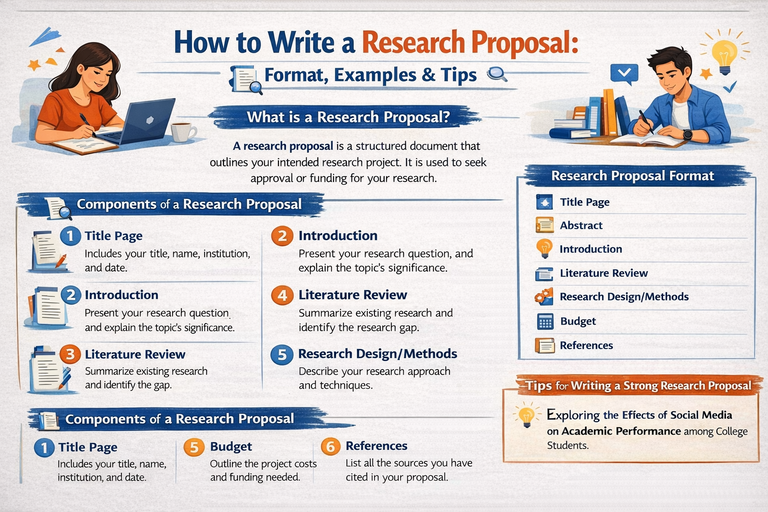
How to Write a Research Proposal: Format, Examples & Tips
A research proposal is a formal document that outlines what you intend to study, why the study is important, and how you plan to carry it out. It serves as a blueprint for your research project and is commonly required for:
-
undergraduate and postgraduate research projects,
-
thesis or dissertation approval,
-
grant and funding applications,
-
research internships and academic fellowships.
A well-written research proposal demonstrates that your topic is clear, relevant, feasible, and methodologically sound. More importantly, it convinces supervisors, committees, or funding bodies that your study is worth approving and supporting.
This guide explains the standard research proposal format, with clear examples and practical writing tips to help you produce a strong, credible proposal.
What a Research Proposal Should Do
An effective research proposal should persuade the reader that:
-
the topic is important and relevant, either academically, practically, or both;
-
there is a clear research problem, such as a knowledge gap, unresolved debate, or real-world issue;
-
the objectives and research questions are specific, focused, and achievable;
-
the chosen methodology is appropriate, ethical, and rigorous;
-
the project is feasible within the available time, resources, and data access.
In short, a proposal answers three core questions:
What will you study? Why does it matter? How will you do it?
Standard Research Proposal Format (With What to Include)
1) Title
The title is the first thing reviewers see, and it should clearly reflect the focus of your study.
A strong research title is:
-
specific rather than broad,
-
aligned with your main variables or concepts,
-
clear about the population or context being studied.
Good titles often include:
-
key concepts or variables,
-
the target group or setting,
-
sometimes the research method or timeframe.
Examples
-
“The Impact of Social Media Use on Study Habits among First-Year University Students in [City/Country]”
-
“Determinants of Customer Satisfaction in Mobile Banking: A Survey of Users in [Region]”
-
“Teachers’ Perceptions of AI Tools in Lesson Planning: A Qualitative Study in Public Secondary Schools”
Tip:
Avoid vague titles such as “A Study of Education” or overly long titles filled with unnecessary technical terms. Aim for clarity, not complexity.
2) Introduction / Background
The introduction (or background) sets the context for your study and explains why the topic deserves attention.
This section should include:
-
a brief overview of the research topic,
-
key concepts or definitions (only if necessary),
-
what existing research generally shows,
-
what is missing, unclear, or under-researched (the research gap).
The background should gradually move from general information to a specific problem, leading naturally to your problem statement.
Mini-Example (Background)
Student procrastination is widely associated with lower academic performance, increased stress, and reduced academic satisfaction. Recent studies suggest that smartphone use may exacerbate procrastination by disrupting sustained attention and encouraging frequent task switching. While global research has explored the relationship between smartphone use and academic behavior, limited attention has been given to how specific smartphone behaviors such as late-night usage and social media scrolling affect procrastination patterns among first-year university students in [context]. This study seeks to address this gap.
Tip:
Do not turn the background into a full literature review. Be selective and focused, and ensure every paragraph contributes to justifying your research.
3) Research Problem (Problem Statement)
The research problem is the core issue your study aims to address. It clearly states what is wrong, missing, or unknown and why that matters.
A strong problem statement explains:
-
what the problem is,
-
who or what it affects,
-
what evidence suggests it exists,
-
why it needs investigation now.
Example (Problem Statement)
Despite the widespread use of smartphones among university students, there is insufficient institution-specific evidence on how smartphone-related behaviors influence academic procrastination among first-year students at [Institution]. In the absence of such data, student-support initiatives may rely on assumptions rather than targeted, evidence-based interventions. This study will examine the relationship between smartphone usage patterns and academic procrastination to inform effective student guidance strategies.
Tip:
The problem statement is not a topic description. It must highlight a specific gap your research will fill.
4) Objectives
Research objectives translate the problem into clear, actionable research aims.
There are usually two types:
-
General objective: the overall purpose of the study (one statement).
-
Specific objectives: 3–6 focused steps that guide data collection and analysis.
Example
General Objective:
To examine the relationship between smartphone use patterns and academic procrastination among first-year university students.
Specific Objectives:
-
To measure the prevalence of late-night smartphone use among first-year students.
-
To assess levels of academic procrastination using a validated scale.
-
To determine whether late-night smartphone use predicts academic procrastination.
-
To explore whether study habits mediate the relationship between smartphone use and procrastination.
Tip:
Begin specific objectives with action verbs such as assess, examine, compare, determine, test, explore, or describe.
5) Research Questions or Hypotheses
Choose between research questions and hypotheses based on your research design.
-
Use research questions for exploratory, descriptive, or qualitative studies.
-
Use hypotheses for quantitative studies that test predicted relationships.
A. Research Questions (Examples)
-
What smartphone use behaviors are most common among first-year university students?
-
How does late-night smartphone use relate to academic procrastination?
-
What reasons do students report for smartphone-related distraction during study time?
B. Hypotheses (Examples)
-
H₁: Late-night smartphone use is positively associated with academic procrastination.
-
H₀ (Null): There is no significant relationship between late-night smartphone use and academic procrastination.
Tip:
Each research question or hypothesis must directly align with at least one objective.
6) Methodology
The methodology section is often the most heavily evaluated part of a research proposal. It demonstrates that your study is realistic, systematic, and scientifically credible.
A strong methodology usually includes the following sub-sections:
a) Research Design
Describe the overall approach and justify your choice.
-
Quantitative: survey, correlational, experimental, quasi-experimental
-
Qualitative: interviews, focus groups, case study, ethnography
-
Mixed methods: combination of both, with sequence explained
Example:
This study will adopt a cross-sectional correlational survey design to examine associations between smartphone use behaviors and academic procrastination.
b) Study Area / Setting
Explain where the research will take place (institution, community, online platform).
c) Population and Sampling
Include:
-
target population,
-
sample size and justification,
-
sampling technique,
-
inclusion and exclusion criteria.
Example:
The study population comprises all first-year students at [University]. A sample of 250 students will be selected using stratified random sampling across faculties to ensure representation.
d) Data Collection Methods and Instruments
Describe what tools you will use and how data will be collected.
Example:
Data will be collected using a structured questionnaire consisting of smartphone-use frequency items and the Procrastination Assessment Scale for Students (PASS). A pilot test involving 20 students will be conducted to assess clarity and reliability.
e) Data Analysis Plan
Explain how data will be analyzed.
-
Quantitative: descriptive statistics, correlation, regression, t-tests, ANOVA
-
Qualitative: coding, thematic analysis, content analysis
Mention software if required.
Example:
Descriptive statistics will summarize smartphone-use patterns. Pearson correlation and multiple regression analyses will test whether late-night smartphone use predicts procrastination levels, with significance set at p < 0.05.
f) Validity, Reliability, or Trustworthiness
Explain how you ensure accuracy and credibility.
g) Ethical Considerations
Include informed consent, confidentiality, voluntary participation, data security, and approvals.
h) Timeline
Provide a clear schedule of research activities.
i) Budget (if required)
List expected research costs.
Tip:
Your methodology should be detailed enough that another researcher could replicate the study.
7) Expected Outcomes / Significance of the Study
This section explains the value and contribution of your research.
Include:
-
expected findings (carefully worded),
-
academic contribution,
-
practical or policy relevance,
-
intended beneficiaries.
Example:
The study is expected to identify specific smartphone behaviors that significantly predict academic procrastination among first-year students. Findings may contribute to academic literature on digital distraction and inform student support programs focused on time management and healthy technology use.
8) References
List all cited sources using the required referencing style (APA, MLA, Harvard, Chicago, etc.). Ensure accuracy and consistency.
Tip:
Prioritize peer-reviewed journals, academic books, and reputable institutional sources.
Short Research Proposal Example (Mini-Template)
(You can adapt this structure to your own topic.)
Title: The Relationship Between Late-Night Smartphone Use and Academic Procrastination Among First-Year Students at [University]
Background: Smartphone use is widespread and may disrupt study routines through distraction and reduced sleep. While international studies suggest a link between smartphone use and procrastination, local evidence among first-year students remains limited.
Problem Statement: There is insufficient institution-specific data on how late-night smartphone use influences academic procrastination, limiting the effectiveness of targeted student-support interventions.
Objective: To determine whether late-night smartphone use predicts academic procrastination among first-year students.
Research Question: To what extent does late-night smartphone use predict academic procrastination?
Methodology: A cross-sectional survey of 250 first-year students using stratified random sampling. Data will be collected via a structured questionnaire and a validated procrastination scale. Analysis will include descriptive statistics, correlation, and regression.
Expected Outcomes: Identification of problematic smartphone-use patterns and evidence-based recommendations for student wellbeing programs.
Writing Tips for a Strong Research Proposal
1) Keep Your Topic Focused
Narrow your study by specifying:
-
one main problem,
-
a defined population,
-
a clear context,
-
a manageable timeframe.
2) Use Clear, Academic Language
Avoid unnecessary jargon. Write precisely and cautiously.
3) Justify the Importance of Your Study
Clearly explain who benefits, how the gap is filled, and why the research matters.
4) Follow Institutional Guidelines Strictly
Formatting errors can lead to rejection even if the content is strong.
5) Align Methods with Questions
Let your research questions guide your methodology not the other way around.
6) Use Credible Research Guides
University library guides and methodology textbooks are invaluable for beginners.
Final Checklist (Before Submission)
-
Title reflects variables, population, and context
-
Problem statement clearly identifies a research gap
-
Objectives align with research questions or hypotheses
-
Methodology is feasible, ethical, and well explained
-
Expected outcomes are realistic and meaningful
-
References are accurate and correctly formatted
-
Formatting matches institutional requirements exactly