
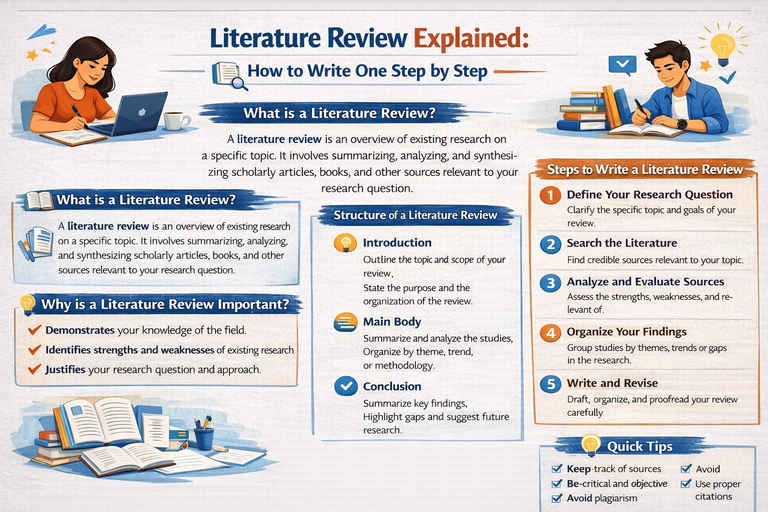
Literature Review Explained: How to Write One Step by Step
A literature review is one of the most important parts of academic writing yet it is also one of the most misunderstood. Many students assume that a literature review is simply a long summary of books and journal articles related to a topic. In reality, it is much more than that. A literature review is a critical, analytical discussion of existing research that shows how knowledge in a field has developed, where scholars agree or disagree, and what questions remain unanswered.
Rather than reporting what each author said in isolation, a strong literature review connects studies to one another, evaluates their quality, and explains how they collectively shape our understanding of a topic. Most importantly, it shows why your own research or argument is necessary.
A well-written literature review helps readers understand:
-
what is already known about your topic,
-
what key debates, trends, or patterns exist in the research,
-
what theories and research methods have been used,
-
and where gaps or limitations remain in the existing literature.
By doing this, the literature review positions your work within the academic conversation and demonstrates your credibility as a researcher or writer.
What a Literature Review Is (and Isn’t)
Understanding what a literature review should and should not be is the first step toward writing one effectively.
A Literature Review Is:
-
A synthesized overview of relevant research
This means bringing multiple sources together and discussing them collectively, rather than one at a time. -
A critical evaluation of the literature
You assess strengths, weaknesses, contradictions, and limitations in previous studies. -
A map of the research field
You identify key themes, debates, theoretical approaches, methods, and trends. -
A foundation for identifying research gaps
You explain what has not been studied enough and how your work addresses that gap.
A Literature Review Is Not:
-
A paragraph-by-paragraph summary of individual articles
-
A list of citations with brief descriptions
-
A collection of quotations without explanation
-
A report of “what the authors said” without your own analysis or connections
If your literature review reads like a series of summaries, it likely needs more synthesis and critical engagement.
When You Write a Literature Review
A literature review can appear in several academic contexts, including:
-
a section of a research proposal,
-
a chapter in a thesis or dissertation,
-
part of an academic essay,
-
or a standalone article known as a review paper.
Although the length, depth, and format may vary depending on the context and discipline, the core purpose remains the same: to present the current state of knowledge and clearly position your own work within it.
How to Write a Literature Review (Step by Step)
Step 1: Identify Relevant Studies and Books
Begin with a clear research topic or research question. This will guide your search and help you avoid collecting irrelevant sources.
Where to Look for Sources:
-
Academic databases (e.g., Google Scholar, PubMed, JSTOR, Scopus—depending on your field)
-
University library catalogs (for books and ebooks)
-
Course textbooks and recommended reading lists
-
Reference lists of key articles
-
Recent review articles (especially useful for identifying major themes and authors quickly)
How to Choose Strong Sources:
Prioritize:
-
peer-reviewed journal articles,
-
reputable academic books or edited volumes,
-
recent research (typically from the last 5–10 years, unless foundational theories are required),
-
highly cited or influential studies in your field.
Tip: Record full citation details as soon as you find a source (author, year, title, journal, pages, DOI or URL). This saves time and prevents referencing errors later.
Step 2: Read Strategically (Not All Reading Is Equal)
You do not need to read every source word for word. Instead, read with a purpose and extract the most relevant information.
For each source, focus on identifying:
-
Research aim or question: What problem was the study addressing?
-
Theoretical framework or key concepts: How was the topic defined or explained?
-
Methodology: Research design, sample, data collection, and analysis methods.
-
Key findings: What were the main results or conclusions?
-
Limitations: Weaknesses acknowledged by the authors—or that you observe.
-
Relevance: How does this study contribute to your topic or research question?
Using a table, matrix, or spreadsheet to organize this information can make comparison and synthesis much easier.
Step 3: Group Sources by Themes, Theories, or Methods
One of the biggest differences between a weak and a strong literature review is organization. Instead of discussing sources one by one, group them into meaningful categories.
Common Ways to Organize the Literature:
-
By themes or topics (most common)
-
By theories or models
-
By methodology (e.g., qualitative vs. quantitative)
-
Chronologically (to show how ideas evolved over time)
Example (Thematic Organization):
For a topic like social media and academic performance, themes might include:
-
time displacement and procrastination,
-
attention and multitasking,
-
sleep disruption,
-
moderating factors such as self-control, purpose of use, or socioeconomic background.
This thematic approach allows you to compare findings across studies and highlight patterns.
Step 4: Synthesize Findings and Highlight Gaps
Synthesis is the heart of the literature review. This is where you move beyond description and demonstrate critical thinking.
In each thematic section, consider addressing:
-
What do most studies agree on?
-
Where do findings conflict?
-
What explains these differences (methods, samples, definitions, context)?
-
What populations, variables, or contexts are under-researched?
-
What questions remain unanswered?
Useful Synthesis Phrases:
-
“Several studies suggest that…, however…”
-
“In contrast to X, Y argues that…”
-
“Findings vary depending on…”
-
“A consistent limitation across these studies is…”
-
“Few studies have examined this issue in…”
Tip: If a paragraph contains only citations and no interpretation, your own voice is missing. A literature review should clearly show your understanding of the research.
Step 5: Use Proper and Consistent Citations
Because literature reviews rely heavily on sources, accurate referencing is essential.
-
Use the required citation style (APA, MLA, Chicago, Harvard, etc.).
-
Cite every idea that is not your own.
-
Avoid excessive direct quotations paraphrase and synthesize instead.
-
Ensure that every in-text citation appears in the reference list.
Reference management tools such as Zotero, Mendeley, or EndNote can help, but always double-check formatting before submission.
Step 6: Conclude With Clear Research Gaps
The final section of your literature review should clearly explain what is missing in the existing research and how your study responds to those gaps.
A strong conclusion typically includes:
-
a brief summary of what is already known,
-
identification of key gaps or unresolved debates,
-
a clear link to your research question or argument.
Example Gap Statement:
Overall, existing research suggests that [general consensus]. However, most studies focus on [dominant focus], with limited attention to [missing variable, population, or context]. Additionally, findings remain inconsistent regarding [debated issue], likely due to differences in [methods or definitions]. Therefore, this study examines [your focus] to address these gaps.
A Simple Literature Review Structure (Template)
1. Introduction
-
Introduce the topic and explain its importance
-
Define key terms or concepts
-
State the scope of the review (timeframe, region, types of sources)
-
Briefly outline the main themes
2. Thematic or Method-Based Sections (2–5)
For each section:
-
introduce the theme,
-
synthesize findings across multiple studies,
-
compare agreements and disagreements,
-
critique limitations,
-
identify mini-gaps.
3. Summary and Research Gaps
-
summarize overall patterns and debates,
-
highlight major limitations,
-
clearly state the gap your research addresses,
-
link to the next chapter or argument.
Common Mistakes to Avoid
-
Listing sources without analysis
Fix this by grouping studies and comparing them. -
Ignoring conflicting evidence
Address disagreements and explain why results differ. -
Poor referencing
Track sources carefully and check formatting consistently. -
Using outdated or non-academic sources
Prioritize peer-reviewed and current research. -
Writing too descriptively
Add critique and evaluation, not just description.
How to Make Literature Reviews Easier (Practical Tips)
-
Start with 10–15 high-quality sources before expanding.
-
Use a source matrix to organize key details.
-
Write theme-by-theme, not source-by-source.
-
Use clear signposting phrases.
-
Keep your research question visible while writing.
-
Read strong literature reviews as models.
-
Use open-access academic ebooks and review papers to learn structure and tone.
Quick Checklist (Before You Submit)
-
Sources are relevant, credible, and mostly scholarly
-
Literature is organized by themes or methods
-
Findings are compared and contradictions explained
-
Methods and limitations are critiqued
-
Citations follow the required style
-
The review ends with a clear, specific research gap