
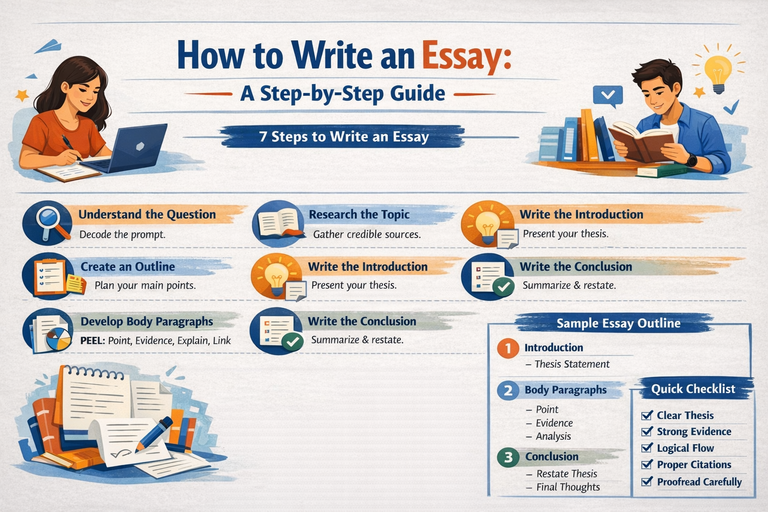
How to Write an Essay: Step-by-Step Guide with Examples
Essay writing is one of the most important academic skills you’ll develop during your studies. It trains you to think critically, organize complex ideas, and support claims with credible evidence. Whether you’re writing for high school, college, or university, strong essays are not about using complicated vocabulary or sounding “smart” they’re about clarity, structure, and logical reasoning.
Many students struggle with essays not because they lack ideas, but because they lack a repeatable process. When you know what to do at each stage before, during, and after writing essay writing becomes far more manageable and less stressful.
This guide walks you through a reliable, step-by-step method you can use for most academic essays, along with a sample outline you can adapt to almost any assignment.
What Makes an Essay “Good”?
While grading criteria vary by subject and instructor, most strong academic essays share a common foundation. A good essay typically includes:
-
A clear thesis statement that directly answers the question
-
Logical structure (introduction → body → conclusion)
-
Focused body paragraphs, each built around one main idea
-
Evidence with explanation, not just quotes or summaries
-
Academic tone, clarity, and formal language
-
Correct citations and referencing (APA, MLA, Chicago, etc.)
-
Careful editing and proofreading for clarity, grammar, and flow
Think of a good essay as a guided argument: the reader should always know what you are arguing, why it matters, and how each paragraph supports your overall claim.
Step-by-Step Essay Writing Process
Step 1: Understand the Question (Decode the Prompt)
Many essays go wrong before writing even begins because the writer misunderstands or only partially answers the question. Before researching or outlining, you must fully decode the prompt.
A. Identify directive keywords
Instruction words tell you how to approach the topic. Common examples include:
-
Discuss – explore the topic from multiple angles; often weigh different viewpoints
-
Analyze – break the topic into parts and explain relationships, causes, or effects
-
Compare – identify similarities (and sometimes differences)
-
Contrast – focus on differences
-
Evaluate – judge strengths or weaknesses using criteria
-
Argue – take a clear position and defend it with evidence
-
Explain – clarify how or why something happens
Misreading these words can lead to an essay that is well-written but poorly graded.
B. Identify topic terms and limits
Look closely for boundaries that narrow the task, such as:
-
Time frame (“in the 21st century,” “since 2000”)
-
Context or location (“in higher education,” “in developing countries”)
-
Scope limits (“two causes,” “one theory,” “three effects”)
Tip: Rewrite the prompt in your own words as a checklist. If you can’t restate it simply and clearly, you’re not ready to outline yet.
Step 2: Research the Topic (Collect Credible Evidence)
Research gives your essay credibility and depth. Even when an essay asks for your opinion, academic writing requires that your claims are supported by reliable sources.
Strong academic sources include:
-
Course textbooks and assigned readings
-
Peer-reviewed journal articles (via library databases)
-
Scholarly ebooks
-
Government, institutional, or university websites (when relevant)
While researching, focus on collecting usable material, not just quotations. Take notes on:
-
Key definitions (paraphrased in your own words)
-
Major scholarly arguments or debates
-
Data, statistics, or case examples
-
Full citation details (author, year, page numbers, DOI/URL)
Rule of thumb: If you don’t understand a source well enough to explain it in your own words, you’re not ready to use it in an essay.
Step 3: Create an Outline (Plan Before You Write)
Outlining is one of the most effective ways to improve essay quality and one of the most skipped steps.
A strong outline helps you avoid:
-
Repetition
-
Weak or unbalanced structure
-
Off-topic paragraphs
-
Writer’s block halfway through the draft
Your outline should clearly show:
-
Your thesis statement
-
2–4 main body points
-
The evidence planned for each paragraph
-
Logical progression between ideas
Tip: If your outline makes sense on its own, your draft will mostly involve expanding ideas rather than figuring out what to say next.
Step 4: Write the Introduction (Set Up the Essay Clearly)
A strong introduction prepares the reader for what’s coming. It should be clear, focused, and purposeful not vague or overly dramatic.
A good introduction typically does three things:
-
Introduces the general topic
-
Narrows the focus to your specific argument
-
Presents your thesis statement
Common introduction structure (4–6 sentences):
-
Context or hook: a general statement to frame the topic
-
Background: brief explanation or definition of key terms
-
Thesis statement: your main argument in one precise sentence
-
Roadmap (optional): the main points you’ll discuss
Thesis tip: A thesis must be specific and arguable not just a statement of fact.
-
Weak: “Social media affects students.”
-
Strong: “Social media affects students’ academic performance primarily by reducing sustained attention, disrupting sleep patterns, and increasing academic procrastination.”
Step 5: Develop Body Paragraphs (One Main Idea per Paragraph)
Body paragraphs are where your argument is built and proven. Each paragraph should focus on one main idea that directly supports your thesis.
A reliable paragraph structure: PEEL
-
P – Point: state the main idea of the paragraph
-
E – Evidence: provide data, examples, or scholarly sources
-
E – Explanation: analyze how the evidence supports your claim
-
L – Link: connect back to the thesis or transition forward
Mini-example:
-
Point: Sleep disruption is a major way social media lowers academic performance.
-
Evidence: Studies link late-night smartphone use to reduced sleep duration and quality.
-
Explanation: Poor sleep impairs attention, memory consolidation, and classroom engagement.
-
Link: As a result, academic performance suffers even when study time remains constant.
Common mistake: inserting a quote and moving on. Evidence only matters when you explain its relevance.
Step 6: Write the Conclusion (Reinforce, Don’t Repeat)
A conclusion should bring the essay together not introduce new arguments.
A strong conclusion:
-
Restates the thesis using different wording
-
Summarizes the key points briefly
-
Explains why the argument matters
Many effective conclusions answer this question:
“What should the reader understand or consider after reading this essay?”
Step 7: Edit and Proofread (Polish for Clarity and Accuracy)
Strong essays are rewritten, not rushed.
A. Edit (big-picture focus)
Check:
-
Does every paragraph support the thesis?
-
Is the structure logical and well-paced?
-
Are transitions clear and effective?
-
Is analysis stronger than summary?
B. Proofread (detail-focused)
Check:
-
Grammar, spelling, and punctuation
-
Wordiness or awkward phrasing
-
Academic tone and consistency
-
Citation style and reference list formatting
Tip: Always edit first, proofread last. Fixing commas before fixing structure wastes time.
Sample Essay Outline (Template)
1) Introduction
-
Brief context
-
Key definition(s) if needed
-
Thesis statement
-
Optional roadmap
2) Body Paragraph 1
-
Topic sentence
-
Evidence
-
Explanation/analysis
-
Link
3) Body Paragraph 2
-
Topic sentence
-
Evidence
-
Explanation/analysis
-
Link
4) Body Paragraph 3
-
Topic sentence
-
Evidence
-
Explanation/analysis
-
Link
5) Conclusion
-
Restated thesis
-
Summary of main points
-
Final insight or implication
A More Detailed Sample Outline (Example Topic)
Prompt: “Analyze the main effects of social media on students’ academic performance.”
Introduction
-
Context: Social media is embedded in students’ daily routines
-
Focus: Academic performance relates to attention, sleep, and study habits
-
Thesis: Social media often reduces academic performance by weakening sustained attention, disrupting sleep patterns, and increasing procrastination, though effects vary by self-regulation
Body Paragraph 1: Attention and Cognitive Load
-
Claim: Notifications and multitasking reduce deep focus
-
Evidence: Research on task switching and attention residue
-
Analysis: Reduced focus lowers comprehension and study efficiency
Body Paragraph 2: Sleep Disruption
-
Claim: Night-time usage delays sleep
-
Evidence: Studies linking screen exposure to sleep loss
-
Analysis: Sleep affects memory, mood, and learning capacity
Body Paragraph 3: Procrastination and Time Displacement
-
Claim: Scrolling replaces planned study time
-
Evidence: Research on procrastination behaviors
-
Analysis: Reduced deliberate practice weakens long-term learning
Conclusion
-
Restated thesis
-
Summary of three mechanisms
-
Implication: Students benefit from boundaries such as notification control and sleep routines
Where to Practice and Find Examples
The fastest way to improve essay writing is to read strong examples and practice often. Free writing guides and sample essays on platforms like JunkyBooks and similar academic resources can help you study thesis development, paragraph structure, and argument flow just remember to use examples for learning, not copying.
Quick Checklist (Before You Submit)
-
Thesis clearly answers the prompt
-
Each paragraph supports the thesis
-
Evidence is relevant and cited correctly
-
Analysis outweighs quotations
-
Conclusion reinforces the argument
-
Grammar, formatting, and citation style meet requirements