Reading as a Competitive Advantage: Why Consistent Learners Outperform Others
In any field, exceptional performance rarely arises from sheer effort alone. The real difference comes from the compounding effect of knowledge the ability to learn faster, retain insights, connect ideas, and apply them effectively under real-world constraints. Among the simplest and most powerful ways to achieve this compounding is consistent reading.
Reading is not inherently “virtuous.” Its value lies in how it strengthens the inputs to performance: judgment, vocabulary, mental models, domain expertise, and the capacity to acquire new skills. In a world where tools evolve rapidly, trends shift, and best practices become obsolete, those who commit to steady, intentional learning often gain the clearest strategic perspective and the most adaptable skills.
This article explores why reading functions as a competitive advantage, what sets consistent learners apart, and how to build a reading system that genuinely improves performance rather than mere consumption.
1. The Compounding Effect: Turning Time Into an Asset
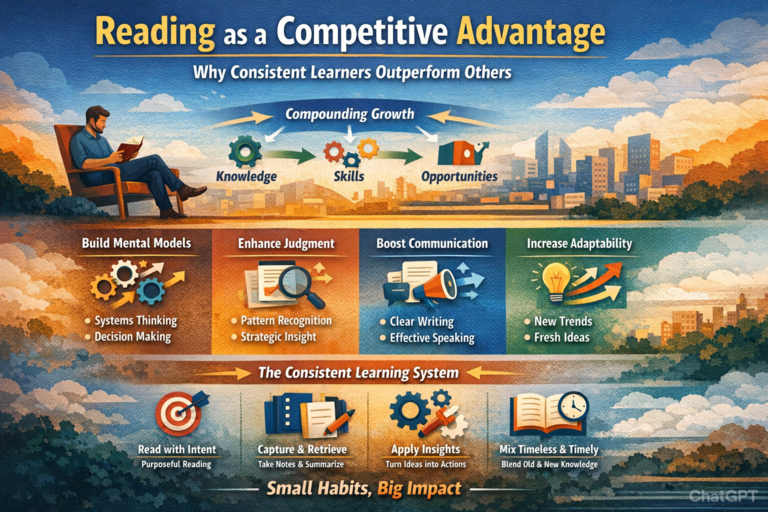
Many advantages credentials, tools, trends eventually decay. Reading, however, compounds in three major ways:
Knowledge compounds: Each new concept links to previous ones, accelerating and deepening future learning.
Skill compounds: Reading enhances writing, speaking, and reasoning skills, improving career outcomes and access to better challenges and mentors.
Opportunity compounds: Readers detect emerging patterns new markets, research breakthroughs, or regulatory changes because they encounter information earlier and more broadly.
Even modest consistency, such as 20–30 minutes per day, can create a measurable gap in:
-
Speed of understanding unfamiliar problems
-
Clarity in communicating solutions
-
Confidence in making decisions under uncertainty
2. Why Consistent Learners Outperform
A) Building Mental Models, Not Just Facts
High performers don’t just accumulate knowledge they organize it effectively. Reading across multiple sources helps construct mental models such as:
-
Incentives and trade-offs
-
Feedback loops and second-order effects
-
Probabilistic thinking and base rates
-
Systems versus symptoms
-
Causal reasoning versus correlation
These models enable better decisions, fewer repeated mistakes, and intuition grounded in evidence critical for roles across engineering, teaching, healthcare, finance, policy, management, and entrepreneurship.
B) Improving Pattern Recognition and Judgment
Expertise often looks like instinct, but it is built on exposure to patterns. Reading provides this exposure efficiently via:
-
Case studies and postmortems
-
Biographies and histories
-
Research summaries
-
Industry analyses
-
Legal and regulatory updates
-
Competitor strategies
This means readers can anticipate problems, choose better strategies, and avoid common pitfalls without experiencing every failure themselves.
C) Strengthening Communication
Knowledge alone isn’t enough performance depends on explaining, persuading, documenting, and teaching. Regular reading enhances:
-
Vocabulary and precision
-
Clarity of argument
-
Comfort with complex ideas
-
Structured writing
-
Responsiveness to critique
Effective communication multiplies performance: leaders trust it, teams adopt it, stakeholders approve it, and clients understand it.
D) Increasing Adaptability
Consistent learners continually update their assumptions. Reading keeps them current with:
-
New tools and standards
-
Adjacent skills for evolving roles
-
Shifts in user behavior or market conditions
-
Early warning signals before they become obvious
This adaptability reduces wasted effort on outdated practices and aligns actions with reality.
E) Enhancing Creativity Through Cross-Pollination
Creative breakthroughs often stem from recombining ideas across domains. Readers have a broader “idea inventory” for this purpose:
-
Applying checklist thinking from aviation to healthcare
-
Using behavioral economics in product onboarding
-
Translating systems thinking to organizational design
-
Leveraging narrative techniques in leadership
The result: more original solutions and strategic options.
3. Readers vs. Consistent Learners
Not all reading yields advantage. The edge comes from intentional, consistent practice:
-
Read with purpose: Focus on current challenges, skill-building, and long-term themes.
-
Capture and retrieve: Take notes, summarize, and revisit key ideas to build a recall system.
-
Apply learning: Turn insights into improved processes, designs, arguments, and teaching.
-
Balance timeless and timely content: Blend foundational theory with current research to remain relevant and grounded.
4. Reading as an Edge Across Domains
Career performance and promotions: Readers propose better projects, write structured plans, manage risk effectively, and onboard faster.
Leadership and management: Reading helps interpret incentives, resolve conflicts, communicate vision, coach effectively, and avoid common management pitfalls.
Entrepreneurship and strategy: Readers leverage market histories, customer psychology, pricing strategies, case studies, and regulatory intelligence to make informed strategic moves.
Technical and scientific fields: Reading accelerates learning from existing solutions, prevents redundant errors, keeps skills current, and deepens foundational knowledge.
5. Building a Competitive Reading Stack
A structured reading approach balances four categories:
-
Core fundamentals (30–40%) – Textbooks, standards, foundational theory
-
Applied practice (30–40%) – Case studies, playbooks, postmortems
-
Frontier updates (10–20%) – Papers, newsletters, blogs, industry reports
-
Cross-disciplinary inputs (10–20%) – History, psychology, economics, philosophy, biology
This prevents reading from becoming either shallow (only trendy content) or outdated (only classics).
6. Reading for Performance, Not Entertainment
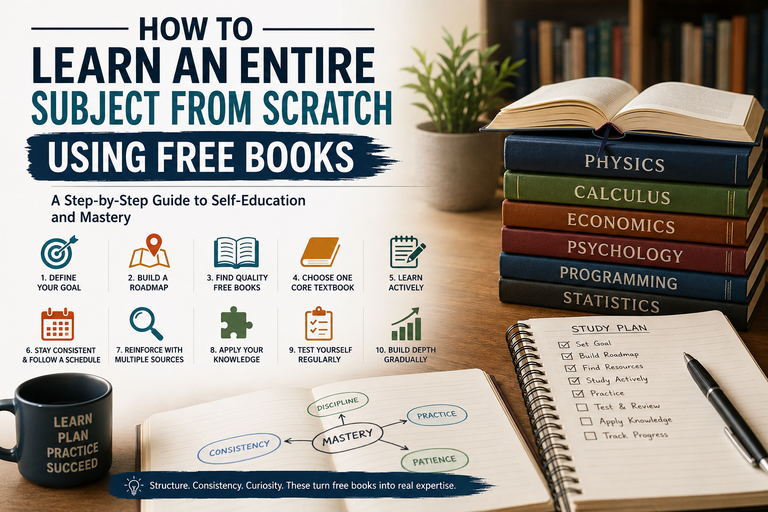
Active reading (3-pass method):
-
Scan headings, summary, and table of contents
-
Deep read sections that shift thinking or aid your work
-
Extract actionable insights and summarize
Use retrieval: Recall key ideas through short summaries or teaching to reinforce learning.
Turn ideas into “moves”: Translate insights into reusable actions practical steps that improve work outcomes.
7. Building the Habit: Consistency Over Intensity
Sustained advantage comes from repeatability, not marathon sessions:
-
5 days/week: 20–30 minutes focused reading
-
1 day/week: summarize key takeaways and select next material
-
Optional: one longer session for deep chapters
Reduce friction: Keep books accessible, pre-select reading material, and maintain a running list of questions to answer.
8. Avoiding Common Misconceptions
-
Speed reading is not the goal: Prioritize comprehension, retention, and application.
-
“I don’t have time”: Use small blocks commute, breaks, waiting periods and deliberate substitution for low-value activities.
-
Reading is passive: Make it active by summarizing, testing ideas, and changing behavior.
-
Articles are enough: Books provide deeper frameworks, coherent arguments, and richer evidence.
9. Measuring the Edge
Evaluate reading’s impact over 3–6 months:
-
Faster onboarding
-
Better writing
-
Improved decisions
-
Tangible process improvements
-
Stronger strategic thinking
-
More credible leadership
If results are missing, the issue is often lack of purpose, inadequate capture of takeaways, or failure to apply learning.
10. Organizational Advantage: Teams That Read
Reading benefits teams and organizations when embedded in culture:
-
Shared reading aligned to priorities
-
Internal summaries and “book memos”
-
Learning sessions where members teach key concepts
-
Postmortems referencing external lessons
Organizations that normalize reading innovate faster, repeat fewer mistakes, and adapt better to change.
Conclusion
Consistent reading is a high-leverage strategy that compounds over time. It builds mental models, improves judgment, strengthens communication, increases adaptability, and fuels creative problem-solving. The top performers are not necessarily the most naturally gifted they are the ones who read steadily, capture insights, and translate learning into action.
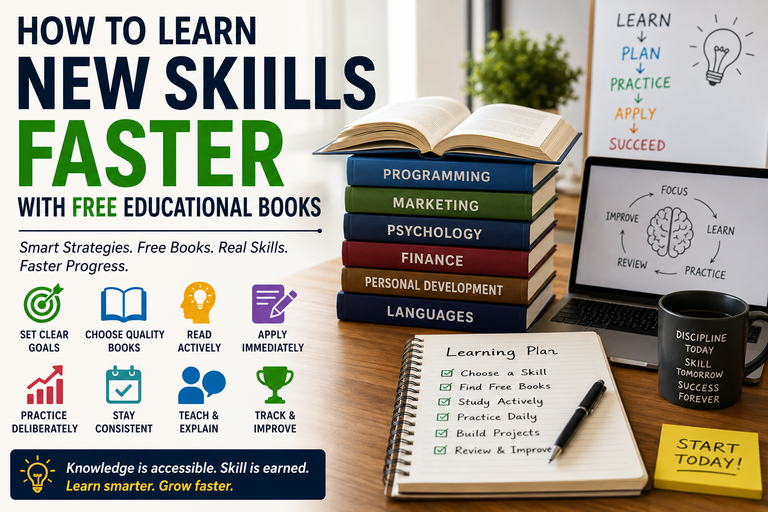
Key principles:
-
Read with intent
-
Retrieve and summarize
-
Apply ideas as actionable “moves”
-
Repeat consistently
In a competitive world, reading is not just a pastime it is an enduring advantage