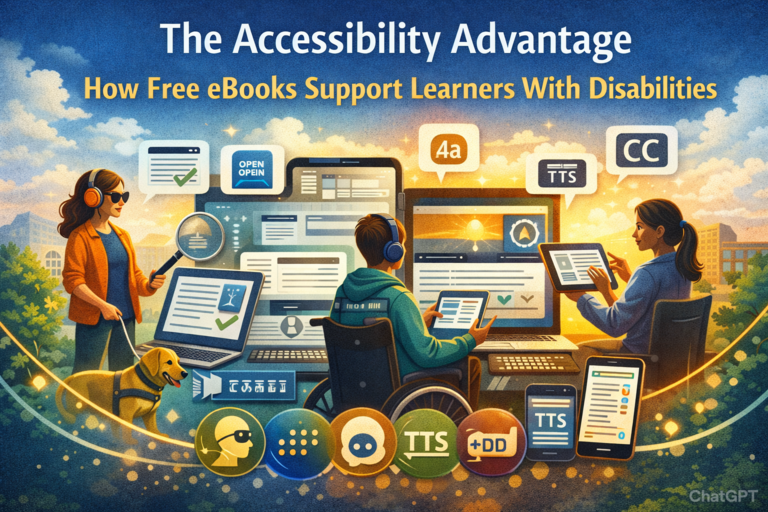
The Accessibility Advantage: How Free eBooks Support Learners With Disabilities
Digital reading has reshaped education, but its biggest impact may be on accessibility. When eBooks are free or openly licensed learners with disabilities can access materials quickly, legally, and in formats compatible with assistive technology. This reduces both cost and barriers, empowering learners to engage on equal footing with peers.
This article explores how free eBooks support learners with disabilities, what accessibility features matter most, where free accessible eBooks come from, and what educators, libraries, and publishers can do to make “free” truly usable.
1) Accessibility Isn’t One Feature It’s Compatibility Plus Choice
Traditional print accessibility often requires separate editions (large print, braille, audio). Digital accessibility, by contrast, can come from a single file supporting multiple ways of reading:
-
Visual reading with adjustable text and contrast
-
Auditory reading via screen readers or text-to-speech (TTS)
-
Tactile reading via refreshable braille displays
-
Simplified navigation and structured headings
-
Captions/transcripts for multimedia
-
Keyboard-only operation
User control is key. Disabilities vary, so settings like font size, background color, line spacing, and navigation aids allow personalization for optimal learning.
2) Why “Free” Matters for Accessibility
A) Faster Access
Accessible materials often take time to convert or receive approval. Free eBooks allow learners to start immediately, avoiding common delays that leave students behind.
B) Lower Cost
Disability can increase educational expenses. Free eBooks reduce recurring costs for textbooks and supplementary reading.
C) Legally Adaptable Formats
Many free eBooks are openly licensed (Creative Commons) or public domain. This allows educators and learners to:
-
Reformat for braille or large print
-
Create audio versions
-
Add alt text and descriptions
-
Simplify language for cognitive accessibility
-
Divide content into navigable sections
Open licensing removes permission barriers that often hinder accessibility.
D) Global Reach
Learners outside well-resourced institutions independent students, rural learners, and those in the Global South can access free, accessible materials without institutional support.
3) Supporting Specific Disability Needs
A) Blindness and Low Vision
Key eBook features:
-
Screen reader compatibility (VoiceOver, NVDA, JAWS, TalkBack)
-
Proper semantic structure (headings, lists, tables)
-
Alt text for images and diagrams
-
Reflowable text
-
Meaningful navigation (table of contents, links)
-
Braille display support
Free eBooks allow users to select platforms and formats suited to their assistive technology.
B) Dyslexia and Reading Disabilities
Helpful features:
-
Adjustable fonts (including dyslexia-friendly fonts)
-
Increased line spacing and reduced visual clutter
-
Text-to-speech
-
Chunked sections and strong headings
Multiple free resources provide varied explanations, aiding comprehension.
C) ADHD and Executive Functioning Challenges
Supports include:
-
Quick search and dictionaries
-
Bookmarks and highlights
-
Short, clearly separated chapters
-
Switchable reading/listening modes
Free eBooks let learners access supplementary explanations and reinforce focus.
D) Mobility Impairments and Chronic Illness
Benefits:
-
Lightweight devices for reading
-
Hands-free TTS or voice control
-
Adjustable layouts for reduced physical strain
-
Offline downloads for flexible reading
E) Deaf and Hard-of-Hearing Learners
Accessible eBooks may include:
-
Captions for videos
-
Transcripts for audio
-
Clear text alternatives
Openly licensed captions and transcripts allow educators to adapt or translate content.
F) Cognitive and Learning Disabilities
Supports:
-
Plain language versions
-
Predictable layouts and navigation
-
Glossaries, summaries, review questions
-
Explanatory visuals
Open licenses make it easier to adapt books to cognitive needs.
4) Formats Matter: Not All Free eBooks Are Accessible
Accessible formats:
-
EPUB 3: reflowable, semantic markup
-
HTML/web books: highly adaptable
-
DAISY: designed for accessible navigation
Problematic formats:
-
Scanned PDFs without tags or reflow
-
PDFs with inaccessible math or charts
Even accessible formats can fail without alt text, MathML, or proper DRM handling.
5) Sources of Free Accessible eBooks
-
Open Educational Resources (OER) and open textbooks: often designed with accessibility in mind
-
Public domain libraries: classics in reflowable text formats
-
Open-access academic books: varying quality in accessibility
-
Library digital collections: often free to borrow with strong assistive features
-
Disability-focused repositories: specialized braille, audio, or accessible formats
6) Hidden Barriers
Even free eBooks can fail learners if they include:
-
DRM restrictions blocking TTS or screen readers
-
Inaccessible scans
-
Broken navigation or inconsistent reading order
-
Charts and diagrams without descriptions
-
Incompatible reading apps
7) Best Practices
Educators & Course Designers:
-
Prefer EPUB/HTML over PDF
-
Provide multiple modalities (text + audio)
-
Pilot-test with assistive technologies
-
Include accessibility notes
Libraries & Digital Managers:
-
Track accessibility issues
-
Prioritize vendors supporting screen readers and TTS
-
Maintain multiple formats
-
Offer clear reporting workflows
Authors & Publishers:
-
Use structured authoring (headings, alt text, accessible math)
-
Avoid image-based text
-
Document accessibility features
Learners & Families:
-
Choose reflowable EPUBs
-
Test with preferred apps
-
Select openly licensed versions for adaptation
8) The Bigger Picture: Inclusive Education
Free accessible eBooks contribute to universal design for learning, benefiting:
-
Students with and without disabilities
-
Multilingual learners
-
Adult learners
-
Anyone facing time, stress, or resource constraints
The accessibility advantage is strongest when free eBooks are available, compatible, adaptable, and discoverable.
Conclusion
Free eBooks can be a powerful accessibility equalizer, reducing cost, accelerating access, and enabling assistive technology use. But the promise is not automatic: inaccessible files and restrictive DRM can negate benefits. Expanding free and open eBook ecosystems while prioritizing accessibility ensures learners with disabilities gain independent, timely access to knowledge on their own terms.
When “free” truly means usable, digital education becomes inclusive for everyone