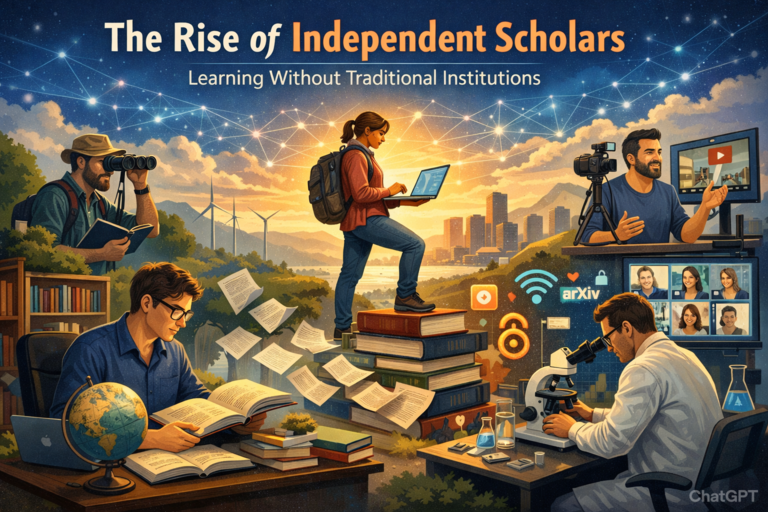
The Rise of Independent Scholars: Learning Without Traditional Institutions
For most of modern history, serious scholarship has been closely tied to universities, national libraries, and research institutes. These institutions concentrated books and journals, laboratories and archives, mentors and peer networks and, crucially, credentials that signaled competence to the wider world.
Today, however, a growing number of people are learning, researching, and publishing outside those formal structures. They are self-directed learners mastering university-level subjects without enrolling in degree programs. They are independent researchers publishing papers and datasets without institutional affiliation. They are citizen scientists contributing to large-scale research projects. They are public intellectuals building substantial audiences without academic appointments.
This shift does not mean universities are obsolete. It does mean the boundaries of who can participate in scholarship are expanding. The rise of independent scholars is one of the most significant changes in knowledge work in the last two decades driven by technology, economics, open access, and new models of collaboration.
Who Counts as an “Independent Scholar”?
An independent scholar is someone who pursues advanced study or research without being enrolled in, employed by, or primarily supported by a traditional academic institution.
This umbrella includes:
-
Self-directed learners pursuing mastery in fields like mathematics, philosophy, history, or computer science outside formal degree programs.
-
Independent researchers conducting original research and publishing in journals, preprint servers, or open repositories.
-
Citizen scientists contributing to data collection, replication studies, and community-based research.
-
Independent historians and writers producing serious, citation-rich scholarship through books, essays, and archival work.
-
Industry practitioners in areas such as AI, cybersecurity, or biotech publishing technical findings and theoretical contributions.
Some independent scholars hold advanced degrees; others do not. Some collaborate with universities; others remain entirely outside them. The common thread is autonomy: they design their own curriculum, assemble their own tools, and set their own research agendas.
Independence Isn’t New Access Is
Independent scholarship is not a modern invention. Many foundational thinkers worked outside universities or on their margins. What is new is the scale and feasibility of independent work.
Historically, barriers were high:
-
Academic journals were locked behind paywalls.
-
Specialized books were difficult to obtain.
-
Scientific tools and datasets were expensive.
-
Publishing and distribution were tightly gatekept.
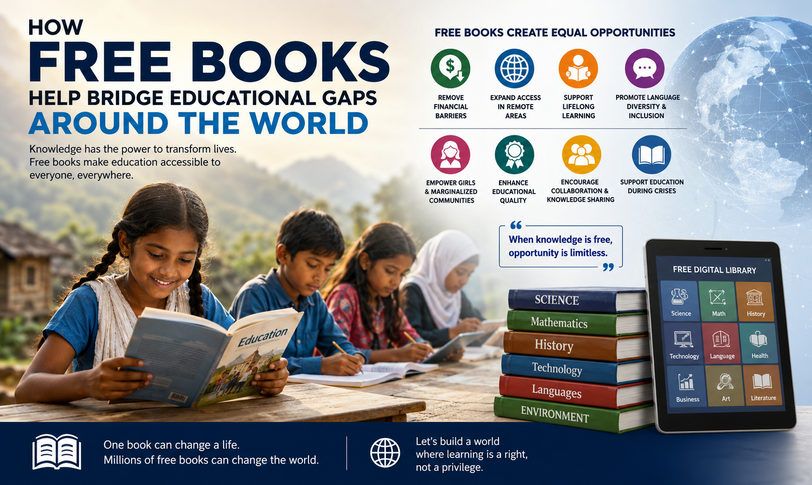
Today, many of these bottlenecks have loosened. The internet did not eliminate gatekeeping but it created alternative pathways to competence, community, and publication.
Why Independent Scholarship Is Rising
1. The Economics of Higher Education
Rising tuition and cost-of-living pressures have made traditional degrees less accessible. Capable learners especially mid-career professionals, caregivers, or those in regions with limited institutions often turn to self-study and open resources as practical alternatives.
Meanwhile, the academic job market has tightened. Tenure-track roles are scarce; adjunct positions can be precarious. For some trained researchers, independence is not merely a choice it is a rational adaptation.
2. The Open Knowledge Ecosystem
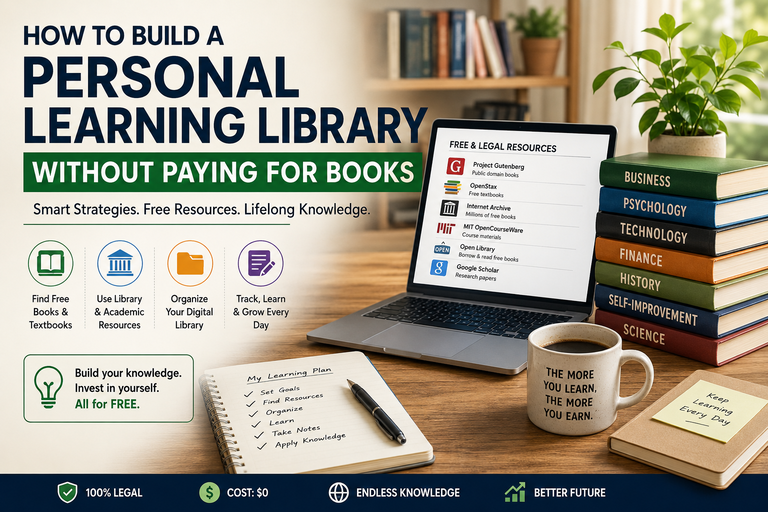
Three major “open” movements have transformed access:
-
Open educational resources (OER): Free textbooks, lecture notes, and full syllabi.
-
MOOCs and recorded lectures: Courses from institutions like MIT and Stanford University accessible globally.
-
Open access and preprints: Research papers shared through platforms such as arXiv and Zenodo.
Even when journals remain paywalled, scholars can often find preprints, author manuscripts, conference slides, datasets, and replication code publicly available.
The result: access to high-level material no longer requires institutional enrollment.
3. Better Tools for Learning and Research
Independent scholars can now assemble a sophisticated research workflow with minimal overhead:
-
Programming & data analysis: Python, R, Jupyter notebooks.
-
Writing & citation management: Zotero, LaTeX, Pandoc.
-
Version control & collaboration: GitHub, Git, Overleaf.
-
Archiving & preservation: Open Science Framework.
-
Identity & attribution: ORCID.
The ability to publish and distribute work once concentrated in institutional channels is now widely available to individuals with technical competence.
4. Communities Beyond Campus
Scholarship depends on critique, peer review, and shared standards. Increasingly, these functions occur outside traditional departments:
-
Field-specific forums and Slack/Discord communities
-
Independent reading groups and seminar series
-
Open-source communities reviewing code and methods
-
Cross-border research collectives
These networks are not identical to academic departments but they can provide mentorship, debate, and methodological scrutiny across disciplines and geographies.
5. Rapid Innovation in Fast-Moving Fields
In domains like machine learning, bioinformatics, and cybersecurity, research and practice evolve rapidly. Independent learners can follow open papers, benchmarks, and code releases in real time sometimes faster than formal curricula update.
The cycle between experimentation and publication is increasingly public and iterative.
What Independent Scholarship Looks Like in Practice
Rigorous Self-Education
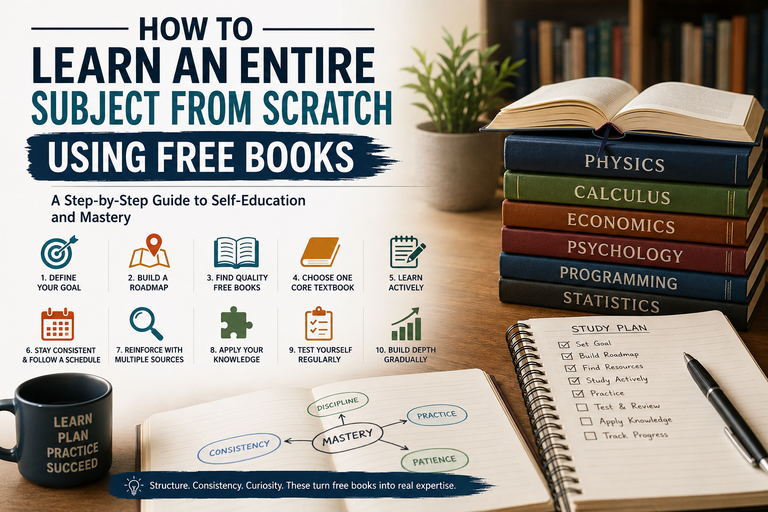
Serious independent learning replicates many features of formal education:
-
Working through canonical textbooks
-
Completing problem sets
-
Following university syllabi
-
Writing essays, proofs, or literature reviews
-
Publishing summaries and solutions publicly
-
Seeking structured peer feedback
A self-taught mathematician might progress from calculus to real analysis, writing formal proofs and posting them for review. A self-taught historian might build a curated bibliography, learn source criticism, and publish annotated translations.
This is not casual browsing it is disciplined, structured study.
Producing Original Research
Independent research can include:
-
Replication studies and methodological audits
-
Meta-analyses using open datasets
-
Theoretical work in philosophy or economics
-
Development of algorithms, tools, or datasets
-
Community-based research in public health or environmental monitoring
Publication channels include:
-
Preprint servers like arXiv
-
Repositories such as Zenodo
-
Peer-reviewed journals accepting unaffiliated authors
-
Long-form essays and books with rigorous citations
Importantly, synthesis and translation are also scholarly contributions. Many independent scholars produce tutorials, surveys, and interpretive essays that bridge fields and make complex ideas accessible.
The Benefits of Independent Scholarship
Intellectual Autonomy
Independent scholars can pursue unconventional questions, interdisciplinary paths, or long-horizon projects without grant incentives or departmental constraints.
Global Accessibility
People excluded by geography, disability, caregiving obligations, or political instability can participate in advanced learning and research.
Faster, Open Iteration
Working in public sharing drafts, code, and datasets early can accelerate feedback and reduce duplicated effort.
Innovation from Outsiders
Fresh perspectives often generate breakthroughs, especially when methods cross disciplines. Open networks increase the visibility of such contributions.
The Real Constraints
Independent scholarship is not frictionless.
1. Credibility and Signaling
Academic credentials function as shorthand for training. Independent scholars must signal competence differently:
-
Strong portfolios (papers, code, essays)
-
Transparent, reproducible methods
-
Collaboration with recognized experts
-
Consistent, high-quality output over time
2. Access Barriers
Some journals remain expensive. Experimental sciences may require specialized labs or institutional approvals.
Workarounds exist but limitations are real.
3. Mentorship and Feedback
Universities embed structured critique. Independent scholars must create feedback loops intentionally: writing groups, conferences, online communities, replication clubs.
4. Funding and Time
Research requires sustained time. Independent scholars often balance employment and family obligations. Sustainable independence may involve consulting, aligned industry work, grants open to unaffiliated researchers, or community patronage models.
5. Quality Control
Open systems allow both high-quality and low-quality work to circulate. Responsible independent scholarship requires:
-
Clear methods
-
Strong citations
-
Transparent data and code
-
Respectful engagement with criticism
Building Legitimacy as an Independent Scholar
Effective strategies include:
-
Publishing reproducible artifacts (code repositories, datasets, notebooks)
-
Using open infrastructure (ORCID IDs, DOIs via Zenodo or OSF)
-
Sharing drafts early and inviting critique
-
Contributing to existing research communities
-
Presenting at conferences open to unaffiliated scholars
-
Starting small and building credibility incrementally
Legitimacy emerges from verifiable competence, not affiliation alone.
Independent Scholars and the Future of Institutions
The future is likely hybrid:
-
Universities remain crucial for lab-based science, credentialing, and large-scale research programs.
-
Independent scholars contribute through replication, open-source research, synthesis, and cross-disciplinary innovation.
-
New institutions emerge: online research labs, independent think tanks, community science spaces, and open peer review platforms.
-
Employers increasingly evaluate portfolios in addition to formal credentials—especially in technical fields.
Rather than replacing universities, independent scholarship is expanding the ecosystem.
Practical Steps to Become an Effective Independent Scholar
-
Adopt disciplinary standards.
Learn what counts as evidence and acceptable method in your chosen field. -
Follow a real curriculum.
Use syllabi, textbook sequences, and qualifying-exam reading lists. Set deadlines. -
Build a public portfolio.
Maintain a website with writing samples, projects, talks, and repository links. -
Create feedback structures.
Join or form reading groups, writing circles, or replication clubs. -
Start with manageable projects.
Small, well-executed work compounds into credibility and collaboration. -
Treat rigor and ethics as non-negotiable.
Be especially careful with medical, statistical, or human-subject research.
Conclusion: Scholarship Is Becoming More Distributed
The rise of independent scholars reflects a broader decentralization of knowledge. Access to information, tools, and global communities has expanded dramatically. At the same time, independence demands responsibility: rigor, transparency, discipline, and openness to critique.
Traditional institutions still matter deeply. But they are no longer the only gateway to serious learning and research. As open ecosystems mature, independent scholarship will likely become a permanent and increasingly respected part of the intellectual landscape where disciplined curiosity and demonstrated contribution matter as much as institutional affiliation