AI and the Future of Reading: Discovery, Translation and Access
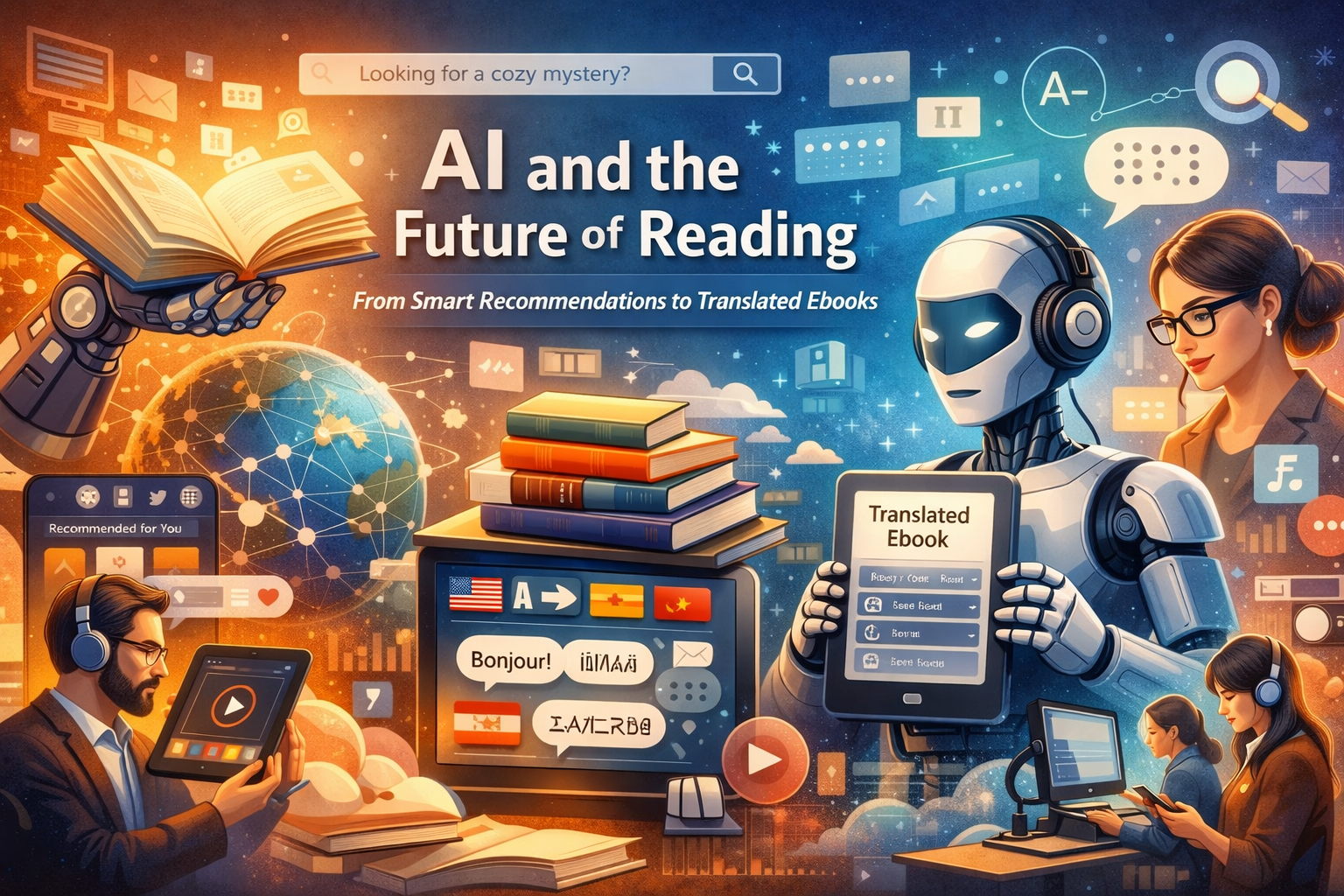
Artificial intelligence is reshaping reading from two directions at once. On one side, it’s transforming how readers discover books, cutting through overwhelming choice with smarter recommendations and search. On the other, it’s changing how books reach readers, through translation, narration, accessibility tools, and adaptive formats.
This shift has enormous potential. AI can help readers find books that truly fit their tastes, bring stories across language barriers, and make reading accessible to people who were previously excluded by format, cost, or ability. At the same time, it raises serious questions about accuracy, bias, copyright, author compensation, privacy, and the risk of reducing literature to whatever an algorithm predicts will “perform.”
The future of reading won’t be decided by technology alone. It will depend on how readers, authors, publishers, and platforms choose to use AI and where they draw limits.
This article explores what’s already happening, what’s likely next, and how AI can expand reading without losing what makes it meaningful.
1) Smart Recommendations: How AI Helps Readers Find the Right Books
The problem AI is solving: choice overload
Today’s readers face a paradox. There are more books available than at any point in history, yet many readers feel stuck, scrolling endlessly and thinking, “There’s nothing to read.”
That’s because discovery systems often fail in predictable ways:
-
Too broad: Genres like “fantasy” or “self-help” contain wildly different books.
-
Too shallow: Star ratings tell you how much people liked a book, not why.
-
Too trendy: Viral titles dominate visibility, crowding out quieter or niche works.
AI-assisted discovery aims to match books to you, not just to popularity metrics.
What “smart recommendations” actually use as signals
Modern recommendation systems analyze a wide range of behavioral and textual signals, including:
-
What you click, save, sample, abandon, or finish
-
Ratings and reviews, including review language
-
Tags and metadata (genre, tropes, themes, pacing, tone)
-
Similarity between books (topics, vocabulary, structure, narrative style)
-
Patterns from readers with overlapping tastes
With enough context, AI can surface highly specific recommendations, such as:
-
“Cozy fantasy with low stakes and older protagonists”
-
“Hard sci-fi with competent adults and minimal romance”
-
“Literary fiction with unreliable narrators and short chapters”
-
“Nonfiction that’s practical, evidence-based, and under 250 pages”
This level of nuance was nearly impossible at scale before AI.
Why explainable recommendations matter
The best recommendation systems don’t just suggest books they explain why:
-
“Recommended because you liked the pacing of X and the themes of Y”
-
“Similar voice to , but more comedic”
-
“Same trope set, different setting”
Explainability builds trust and gives readers control. It also lets readers correct the system: “I liked the prose, not the plot,” or “Less like this, more like that.”
The risks: echo chambers and trend loops
Without safeguards, AI can narrow rather than expand reading habits. Poorly designed systems may:
-
Reinforce existing tastes until discovery stagnates
-
Suppress diverse or experimental voices
-
Amplify already popular titles at the expense of originality
Healthy systems deliberately include serendipity wild cards, adjacent genres, and cross-cultural suggestions that stretch, rather than trap, the reader.
2) AI Search and Conversational Book finding
From keywords to intent
Book search is shifting from rigid keywords to conversational intent.
Instead of typing:
“books like Dune political sci-fi”
Readers increasingly expect to say:
-
“I want epic sci-fi with politics and big ideas, but less dense than Dune.”
-
“I need a motivational book without toxic positivity.”
-
“I want a mystery with no graphic violence and an emotionally satisfying ending.”
AI can interpret constraints, tone, and preferences simultaneously something keyword search struggles to do.
Interactive discovery: the librarian at internet scale
The next evolution is interactive search. Rather than returning static results, AI can ask follow-up questions:
-
“Do you prefer first-person or third-person narration?”
-
“How much romance is okay?”
-
“Are you comfortable with slow pacing?”
This mirrors what great librarians and booksellers have always done now scaled globally.
3) AI Summaries, Highlights, and Reading Assistants
AI doesn’t just change discovery; it changes what happens during reading.
What AI does well (when used carefully)
Thoughtfully applied, AI can support deeper engagement by:
-
Generating chapter summaries to aid retention
-
Creating vocabulary lists and explanations
-
Helping with note-taking and study guides
-
Providing discussion questions for book clubs
-
Mapping themes, characters, and arguments
For students and lifelong learners, this turns reading into a more active, organized process.
The danger: summaries replacing reading
The risk is obvious. Over-reliance on summaries can:
-
Strip away style, voice, and nuance
-
Create false confidence about understanding
-
Reduce literature to plot points or bullet lists
A useful rule of thumb: AI should support reading, not substitute for it.
4) Translation: The Most Transformative Frontier
Of all AI-driven changes, translation may have the deepest cultural impact.
Why translation matters
Most readers live inside a narrow slice of world literature, constrained by language and publishing economics. Traditional translation is slow, expensive, and risky, which means countless excellent books never cross borders.
AI translation lowers these barriers by:
-
Making backlist translation economically viable
-
Enabling niche and regional works to reach global readers
-
Supporting bilingual reading and language learning
Where AI translation already helps
AI translation is particularly useful for:
-
Public-domain works
-
Informal reading where “good enough” is acceptable
-
First-pass drafts for professional translators
-
Translating excerpts or difficult passages on the fly
Where it becomes risky
Literature isn’t just about meaning. It’s about voice, rhythm, humor, subtext, and cultural reference. AI translation can:
-
Flatten style
-
Mistranslate idioms
-
Miss irony or ambiguity
-
Introduce subtle errors that alter meaning
For serious publishing, the emerging best practice is AI-assisted, human-edited translation speed from machines, quality and cultural fidelity from skilled translators.
Ethical and legal realities
Translation is a derivative work. Even if AI can translate instantly, distributing that translation still requires rights clearance unless the text is public domain or openly licensed. Technology doesn’t erase copyright.
5) Audiobooks, Voices, and AI Narration
AI-generated narration is rapidly reshaping the audiobook landscape.
The promise
-
Lower production costs
-
More audiobooks for indie and niche titles
-
Faster backlist conversion
-
Improved access for readers with print disabilities
The tradeoffs
-
Synthetic voices may lack emotional depth
-
Consent and rights issues for human narrators
-
Pressure on creative labor markets
-
Risk of low-quality, mass-produced audio
A likely outcome is tiered narration:
-
Premium human narration for major releases
-
High-quality AI narration for long-tail titles
-
Hybrid approaches combining human direction with AI efficiency
6) Accessibility: AI as a Reading Equalizer
One of AI’s clearest benefits is accessibility.
AI can reduce friction without reducing complexity by offering:
-
Dyslexia-friendly formatting and spacing
-
Live definitions and adjustable reading levels
-
Captioned audiobooks with synchronized text
-
Smarter screen readers
-
Automatic image descriptions
-
Improved OCR for scanned materials
When privacy and accuracy are respected, this is AI at its most humane.
7) Publishing and Writing: How AI Changes What Gets Made
AI affects not just readers, but creators.
Potential benefits
-
Faster brainstorming, outlining, and revision
-
Better metadata, blurbs, and marketing for small publishers
-
Improved discoverability for niche books
Risks to quality and trust
-
Floods of low-effort AI-generated books
-
Review manipulation and fake engagement
-
Reader skepticism about authorship
-
Increased difficulty for human writers to stand out
This makes curation and trust signals essential:
-
Verified author identities
-
Transparent labeling
-
Strong anti-spam moderation
-
Community-driven reviews and lists
8) Copyright, Training Data, and Compensation
The hardest questions aren’t technical they’re ethical.
Key issues include:
-
Use of copyrighted text in training data
-
Whether authors deserve compensation for influence
-
Protecting small creators while enabling innovation
-
Preventing plagiarism at scale
There’s no settled answer yet, but pressure for transparency is growing:
-
Clear sourcing
-
Opt-in and opt-out mechanisms
-
Respect for rights-holders
9) Privacy: Your Reading Life Is Sensitive Data
Your reading history can reveal:
-
Health concerns
-
Political or religious beliefs
-
Relationship struggles
-
Emotional states
Personalization must be balanced with restraint:
-
Data minimization
-
Clear consent
-
Deletable histories
-
On-device processing where possible
-
Limits on advertising use
For many readers, privacy is the line between helpful and intrusive.
10) What the Future of Reading Could Look Like (2025–2030)
1) Multilingual libraries by default
Books available in:
-
Original language
-
AI-assisted translation (clearly labeled)
-
Human-edited translation (premium)
2) Interactive editions
Optional layers such as:
-
Chapter summaries
-
Character maps
-
Glossaries
-
Historical context panels
3) Personal reading copilots
AI assistants that:
-
Track reading goals
-
Suggest books based on mood and time
-
Help you recall previous chapters
-
Create notes for nonfiction
4) Better niche discovery
Recommendations based on:
-
Similar voice
-
Shared tropes
-
Comparable arguments
-
Practical alternatives
11) How Readers Can Use AI Without Losing the Joy of Reading
Use AI to reduce friction, not replace experience.
Good uses:
-
Translating difficult passages
-
Vocabulary help
-
Light summaries as refreshers
-
Study questions
Risky uses:
-
Reading only summaries
-
Treating AI interpretations as authoritative
-
Skipping primary sources
Protect serendipity by adding:
-
A book from another culture
-
A classic outside your comfort zone
-
Short stories or essays
Check quality signals in AI-assisted books:
-
Clear labeling
-
Editor or translator credits
-
Reviews mentioning translation or narration quality
-
Sample chapters or audio
12) How Platforms Can Build a Better AI Reading Future
Healthy platforms will prioritize:
-
Transparent labeling of AI use
-
Human-in-the-loop moderation
-
Respect for copyright and creators
-
Explainable recommendations with user controls
-
Privacy-first personalization
-
Community curation to balance algorithms
The strongest systems combine machine intelligence with human judgment.
Conclusion: AI Will Expand Reading If We Guard What Matters
AI is already reshaping reading. It’s making books easier to find, easier to access, and easier to adapt to individual needs. It’s opening doors across languages, formats, and abilities that were once firmly closed.
But progress isn’t automatic. Without care, AI can narrow tastes, exploit creators, erode privacy, and flatten culture into whatever data predicts will sell.
The real challenge isn’t whether AI belongs in reading it does. The challenge is shaping it toward:
-
More access without exploitation
-
More personalization without surveillance
-
More convenience without losing depth
-
More global exchange without flattening voices
If we strike that balance, the future of reading may be not only larger, but richer and more inclusive than any era before it.