Free Books, Real Impact: How JunkyBooks Is Closing the Global Education Gap
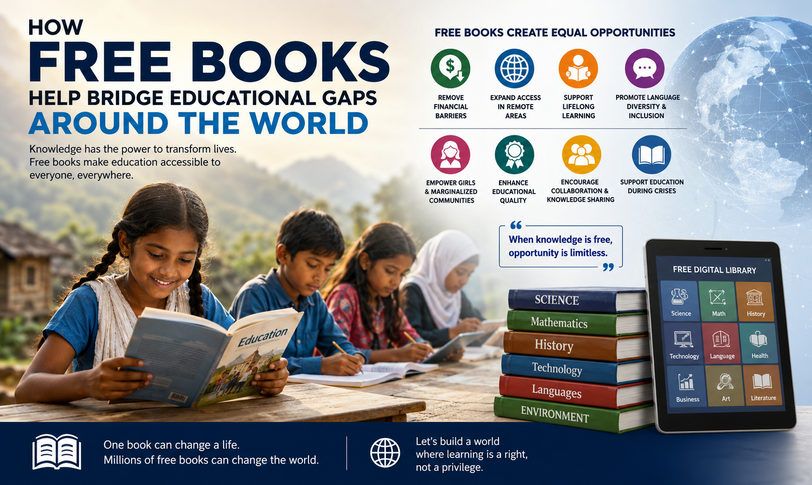
Across the world, education is still shaped by a stubborn imbalance. In some classrooms, students choose between multiple editions of the same textbook. In others, a single worn copy is shared by an entire class or there are no books at all. This gap is not just an academic issue; it is a life-outcomes issue. Literacy levels, employment opportunities, health awareness, civic participation, and even intergenerational mobility all track closely with access to learning materials.
In this unequal landscape, the simplest tools often have the greatest power. A physical book is durable, shareable, low-tech, and immediately useful. When that book is free especially for learners who would otherwise go without it becomes more than a resource. It becomes a lever for change.
That belief sits at the heart of JunkyBooks: making books available at no cost to learners and communities who need them most, and transforming surplus books into measurable educational impact.
The Global Education Gap Isn’t Just About Schools It’s About Materials
Discussions about education inequality usually focus on schools themselves: classrooms, teacher training, infrastructure, or internet access. All of these matter. But learning materials are the daily fuel of education, and scarcity shows up in direct, practical ways:
-
Students cannot practice reading at home if there is nothing to read.
-
Teachers cannot assign meaningful homework if students lack textbooks.
-
Libraries cannot function as community learning hubs if shelves are empty.
-
Adult learners cannot upskill if resources are unaffordable or inaccessible.
Even in regions where school enrollment is rising, educational quality often lags because students lack age-appropriate reading books, basic subject texts, or reference materials. In many cases, the barrier is not motivation it is access.
Why “Free Books” Is a Serious Strategy, Not a Slogan
Books are among the highest “impact-per-dollar” educational inputs when they reach the right readers.
A single donated book can be read by multiple siblings, classmates, and neighbors. It requires no electricity or internet connection. It can be used in formal classrooms, informal tutoring sessions, after-school programs, shelters, refugee settings, prisons, and homes. It travels easily and lasts for years.
Most importantly, books support both sides of learning:
-
Foundational literacy: learning to read, expanding vocabulary, and improving comprehension
-
Applied learning: using books to study science, math, history, languages, trades, and life skills
Free books do not replace teachers or schools they amplify them.
What JunkyBooks Does Differently
Many book donation programs exist, but they often struggle with predictable challenges: inconsistent supply, wrong-language materials, outdated academic editions, high shipping costs, or the “dumping” of irrelevant books without local coordination.
JunkyBooks’ mission is to simplify and sharpen book access: take books that would otherwise sit unused—or be discarded and route them into environments where they become part of daily learning.
At its best, a platform like JunkyBooks helps close the education gap by addressing four core problems at once.
1. Turning Surplus Into Supply
In wealthier communities, books accumulate faster than they are used. Homes declutter, schools change curricula, libraries weed collections, and organizations dispose of duplicates. Meanwhile, other communities face severe shortages.
JunkyBooks bridges this mismatch. When surplus becomes supply, the impact is immediate: more reading material, more practice, and more confidence for learners.
2. Reducing the Cost Barrier to Near Zero
Even “affordable” books are expensive when incomes are low and basic needs are urgent. Low-cost is still exclusionary in many contexts.
By providing books for free, JunkyBooks removes price as a gatekeeper, ensuring access for children, families, and adult learners who would otherwise opt out entirely.
3. Making Distribution Community-Based
Book access is not just about moving items it is about placing the right books in the right hands with local ownership.
An effective community-based approach can include:
-
Delivering books to schools, shelters, clinics, and learning centers
-
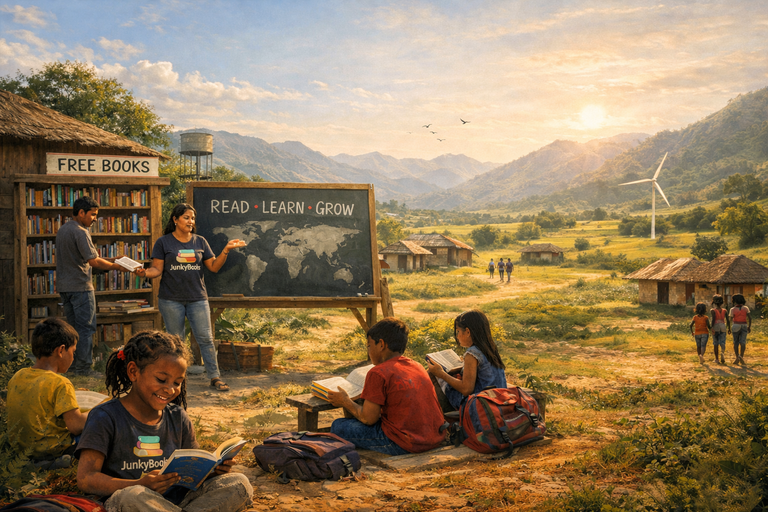
Supporting community libraries and micro-libraries
-
Partnering with local educators and NGOs to identify needs
-
Creating pickup points that reduce last-mile barriers
When communities help define what “useful” looks like, books become embedded in daily routines rather than forgotten donations.
4. Building a Culture of Reading, Not Just a Shipment of Books
The true goal is not volume it is habit.
Books create impact when they are read aloud, borrowed, discussed, reread, and shared. JunkyBooks’ role is not simply to distribute books, but to help turn them into a living reading ecosystem.
This means prioritizing materials that people actually use:
-
Early readers and picture books
-
Young adult fiction
-
Basic skills books (numeracy, writing, language learning)
-
Relevant reference books
-
High-interest, accessible nonfiction
The Ripple Effects: How Free Books Change Outcomes
The most visible impact of book access is improved literacy but the ripple effects extend far beyond that.
Stronger early literacy and school readiness
When children have books at home or consistent access through community programs, reading becomes normal. This turns reading from an “assignment” into a growing, self-reinforcing skill.
Better classroom performance
Textbooks and supplementary materials allow students to study independently, complete homework, and review lessons. Teachers can plan more effectively when students have consistent access to content.
Support for girls’ education and gender equity
In many contexts, girls face additional barriers to consistent schooling. Accessible reading materials—especially outside formal classrooms help sustain learning even when attendance is interrupted.
Lifelong learning and workforce readiness
Books support adult literacy, vocational training, language acquisition, and entrepreneurship skills. Education does not stop at childhood, and books remain relevant at every stage.
Community resilience
Libraries, reading clubs, and shared book spaces often become stabilizing institutions. In crisis or displacement settings, books can provide both learning continuity and emotional grounding.
The Practical Challenges JunkyBooks Must Solve
Any initiative distributing free books at scale must be honest about operational realities. The difference between a feel-good program and a high-impact one is execution.
Matching: the “right book” problem
Donations often skew toward outdated textbooks or niche titles.
What helps: clear donation guidelines, basic sorting, reading-level labels, and needs-based requests from partners.
Logistics: shipping costs
Books are heavy, and shipping can quickly erase the value of “free.”
What helps: local redistribution, regional hubs, logistics partnerships, and bulk shipments to trusted institutions.
Quality control
Damaged or unusable books can become burdens.
What helps: minimum condition standards, simple repair processes, and responsible recycling pathways.
Avoiding “dumping”
Random, irrelevant books undermine trust.
What helps: ongoing partnerships with educators, feedback loops, and smaller curated deliveries instead of one-off drops.
Measuring Real Impact Beyond Numbers
Counting books distributed is easy. Measuring educational change is harder but essential.
JunkyBooks can demonstrate credibility by tracking indicators such as:
-
Number of partner schools and learning centers served
-
Improvements in book-to-student ratios
-
Library circulation or borrowing rates
-
Participation in reading programs or clubs
-
Teacher and student feedback
-
Repeat requests from communities
Transparent, lightweight reporting builds trust and attracts long-term partners.
Why This Model Matters Now
Economic pressure, displacement, climate disruption, and uneven digital access are reshaping global education. While technology can help, it is not universal especially where devices, connectivity, or electricity are unreliable.
Books remain one of the most scalable and dependable learning tools available. A well-managed free-book pipeline can reach learners that other interventions miss.
JunkyBooks reflects a broader shift toward practical, decentralized solutions: empower local learning environments with tangible resources, delivered consistently and guided by real needs.
How People Can Support the Mission
Closing the education gap is a collective effort. One of the strengths of JunkyBooks is that almost anyone can contribute:
-
Individuals: donate quality books, host book drives, or sponsor distribution
-
Schools and universities: share surplus books and involve students in sorting and labeling
-
Publishers and bookstores: donate overstock or returns
-
Companies: support logistics, warehousing, or regional hubs
-
Local organizations: act as distribution points and run reading activities
Conclusion: Small Objects, Big Outcomes
A book is a small object with an outsized ability to change a life especially when it reaches someone who has been excluded from learning resources. Free books are not symbolic gestures; they are practical interventions that raise literacy, strengthen classrooms, and build community learning cultures.
JunkyBooks’ power lies in its simplicity: redirect what is underused to where it is urgently needed, remove cost barriers, and help communities turn books into daily learning.
Closing the global education gap will require many tools. But few are as proven, as accessible, and as immediately transformative as a book placed deliberately into a reader’s hands.