
Request, Read, Repeat: How JunkyBooks Uses Book Requests to Build a Community Library
The internet has never had more books available and yet readers still run into the same familiar wall. The title they need isn’t there. The edition is outdated. The format won’t open on their device. The audiobook is missing. Or the book exists somewhere online, but not in a form that’s actually usable.
This gap between what platforms offer and what readers genuinely need is where most digital libraries quietly lose trust.
JunkyBooks approaches this gap differently. Instead of treating missing content as a failure point, it turns it into a collaboration. At the heart of this approach is the Book Request feature a deceptively simple tool that transforms JunkyBooks from a static collection into a living, evolving, community-driven library.
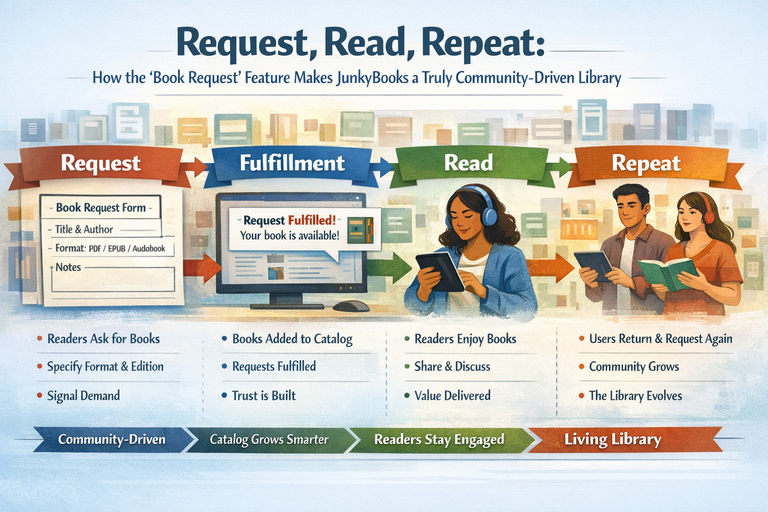
The result is a powerful loop: Request → Read → Repeat. And that loop is what keeps the platform relevant, responsive, and deeply human.
What “Community-Driven Library” Really Means
Most digital libraries still operate on a one-way model:
-
The platform decides what to acquire
-
Users search and download
-
If the book isn’t there, users leave or look elsewhere
A community-driven library flips that relationship entirely:
-
Readers signal demand
-
The platform responds with supply
-
The community validates usefulness and quality
-
The catalog evolves in public view
On JunkyBooks, the Book Request feature is the bridge that makes this possible. It gives readers a voice—and ensures that voice directly shapes the library.
The Core Problem Book Requests Solve
1. Catalog gaps are inevitable
No platform no matter how large can predict every need. New releases trend overnight. Academic syllabi change. Professional exams update. Regional titles and niche interests don’t show up on bestseller lists.
A request system acknowledges this reality instead of pretending completeness is possible.
2. Search doesn’t capture intent
A search bar only tells you what someone tried to find. It doesn’t reveal:
-
What they couldn’t find
-
How urgently they needed it
-
Whether ten or a thousand others want the same book
Book requests convert silent failure into visible demand.
3. Readers want agency
When users can influence the collection, they stop treating the platform like a vending machine and start treating it like a shared space. That sense of agency is what turns users into contributors.
Request, Read, Repeat: The Flywheel That Builds the Library
The power of the Book Request feature isn’t the button—it’s the loop it creates.
1) Request
A reader states their need in clear, human terms.
A strong request typically includes:
-
Book title and author
-
Preferred format (PDF, EPUB, MOBI, Audiobook)
-
Language or edition
-
Optional notes (“2nd edition,” “illustrated,” “exam version,” etc.)
At this moment, JunkyBooks isn’t guessing demand it’s receiving it directly from the source.
2) Fulfillment
When a requested book is added, something critical happens: trust is built.
Fulfilled requests don’t just matter to the requester. They matter to everyone watching. Each successful fulfillment proves that:
-
Requests are taken seriously
-
The platform is actively maintained
-
Community input leads to real outcomes
This visibility turns participation into confidence.
3) Read
Once the book is available, the request becomes real value. The reader engages, reads, and benefits. The book joins the library not as clutter, but as a meaningful addition with guaranteed relevance.
This is where community effort converts into long-term utility.
4) Repeat
After a positive experience, users don’t just return they return with intention. They request again. They recommend the platform. They stay engaged.
That’s retention powered by participation, not advertising.
How Book Requests Change User Behavior
From frustration to momentum
Without requests: “It’s not here” ends the session.
With requests: “It’s not here” starts a process.
That shift replaces disappointment with possibility.
From consumers to stakeholders
When readers help shape the catalog, they feel partial ownership. Stakeholders are more likely to:
-
Return frequently
-
Be patient with delays
-
Help refine requests
-
Advocate for the platform
From passive browsing to discovery
A request feed becomes a discovery surface. Readers often realize:
-
“I wanted that too”
-
“I didn’t know this book existed”
-
“I need the companion workbook”
Requests function like a public wish list—one that others can learn from.
What Book Requests Reveal About the Community
Over time, request data becomes a living map of reader priorities:
-
Career and skill shifts: spikes in programming, AI, certifications, and interview prep
-
Mental health trends: demand for anxiety, habit-building, and therapy workbooks
-
Global growth: requests for translations and regional editions
-
Education cycles: exam prep and textbooks aligned with academic calendars
Requests don’t just build a library they tell a story about what the community is experiencing right now.
Improving the Catalog: Quality Over Quantity
A request-driven library naturally prioritizes relevance:
-
High-demand titles instead of random accumulation
-
Correct editions and usable formats, not generic uploads
-
Accessibility needs, like OCR text or low-size files
-
Long-tail and niche content algorithms usually ignore
Over time, the catalog becomes sharper, deeper, and more intentional.
Transparency Builds Community Trust
The strongest request systems feel real because users can see progress. Effective elements include:
-
Request status (received, in progress, fulfilled, unavailable)
-
Upvotes or “me too” signals to aggregate demand
-
Notifications when a request is fulfilled
-
Comments for edition or format clarification
-
Duplicate detection to avoid fragmentation
Even without every feature, the principle is clear: a request should feel like a real ticket, not a suggestion box.
Making the System Sustainable
A community-driven feature needs structure to stay useful. Healthy guardrails include:
-
Rate limits for new users
-
Clear request guidelines
-
Moderation tools
-
Duplicate detection
-
Reputation or trust signals
These controls keep the system focused, clean, and respectful of everyone’s time.
Why Book Requests Are an Underrated Growth Engine
Most platforms chase growth through ads, SEO, and social campaigns. Book Requests drive growth differently: they create reasons to return.
A fulfilled request triggers:
-
A notification moment
-
Immediate satisfaction
-
Word-of-mouth sharing
-
Future engagement
It’s retention and advocacy built into a single interaction.
The Human Side: How Requests Create Culture
Over time, Book Requests subtly reshape how the platform feels:
-
Readers help each other refine submissions
-
Micro-communities form around genres, exams, or professions
-
The library feels alive, responsive, and shared
This is the closest a digital library comes to a physical one—where patrons can ask, wait, and feel reflected in the collection.
“Request, Read, Repeat” in One Sentence
The Book Request feature makes JunkyBooks truly community-driven by turning missing books into a shared roadmap and every fulfilled request into a reason for readers to return, contribute, and shape the library together.
Optional Add-Ons for a Blog Version
To boost engagement and SEO, you can include:
-
A short “How to Request a Book” walkthrough
-
A “Top Requested Categories This Month” section
-
Mini success stories (“Requested Monday, fulfilled Friday”)
Together, these elements reinforce the core message: on JunkyBooks, the library grows with its readers not around them