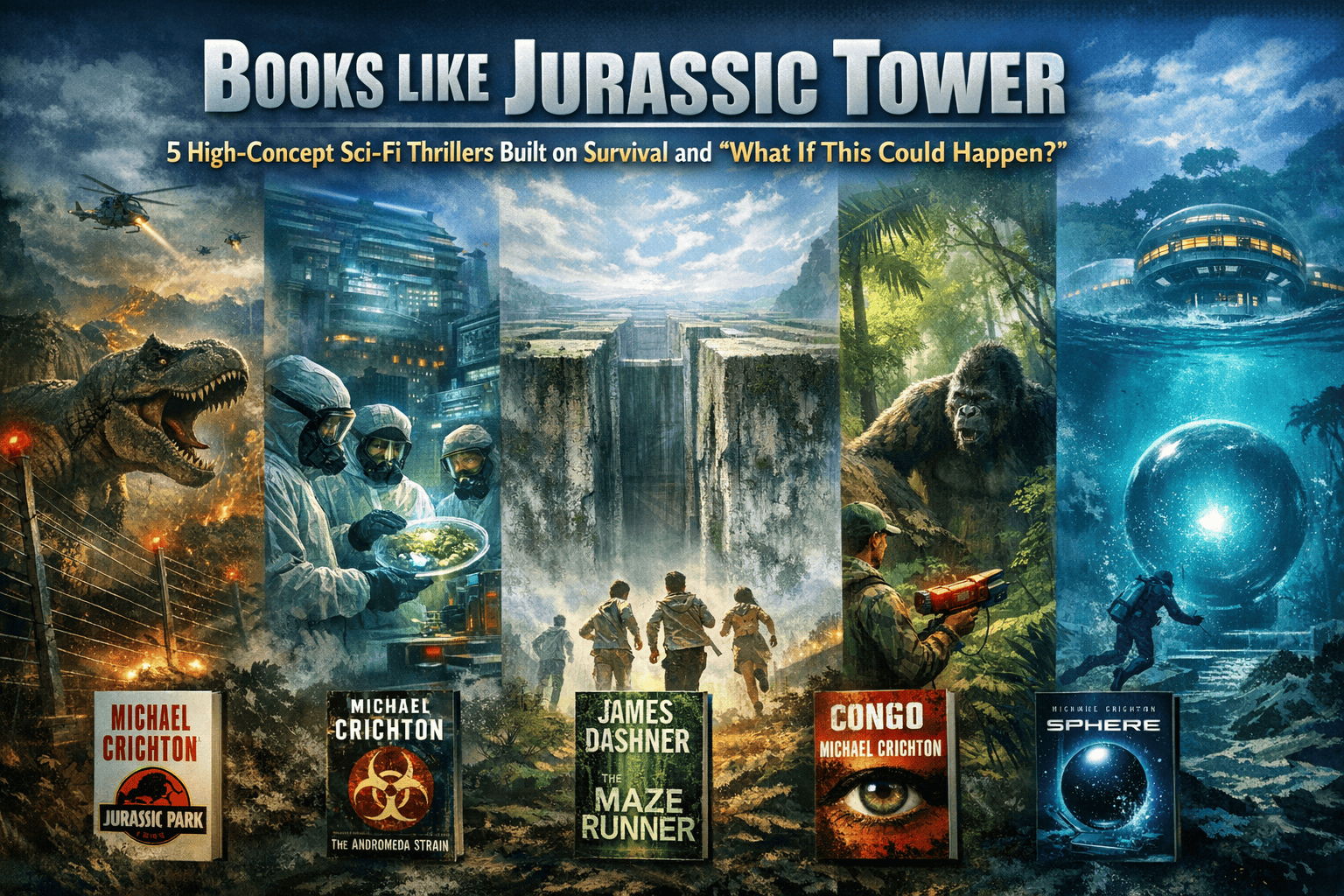
Books Like Jurassic Tower: 5 High-Concept Sci‑Fi Thrillers You Can’t Put Down
If Jurassic Tower hooked you, the attraction is usually a very specific blend: a dangerous environment you can’t easily escape, smart speculative ideas, and relentless survival stakes. These are stories where the setting itself becomes an antagonist, the science feels almost too plausible for comfort, and every new discovery makes staying alive harder not easier.
The best read-alikes keep the pacing tight while grounding their thrills in systems, rules, and human error. Below are five books that hit that same sweet spot fast, high-concept, and packed with escalating danger plus what each one does especially well.
What Makes a “Jurassic Tower–Style” Thriller Work
Readers who love this lane of sci-fi thrillers tend to want:
-
A contained setting (facility, island, structure, expedition site) that becomes its own antagonist
-
Competent characters under pressure (scientists, trainees, specialists) forced to make rapid, high-stakes decisions
-
Science-driven peril where the threat has rules even if those rules are terrifying
-
Relentless momentum, with revelations arriving just as survival gets harder
-
A disturbingly possible vibe, where the premise feels like a logical next step of real technology
With that in mind, here are five of the strongest matches.
1) Jurassic Park by Michael Crichton
Why it fits: Science gone wrong, contained catastrophe, survival under intelligent predation.
This is the blueprint for the modern techno-thriller. Jurassic Park combines ambitious science, corporate arrogance, and a carefully controlled environment that collapses into chaos. If Jurassic Tower appealed to you because it trapped characters inside a system designed by humans but ultimately ruled by something far more powerful this novel delivers that sensation perfectly.
What you’ll get:
-
A bold, high-concept premise executed like a runaway experiment
-
Rapid escalation from “minor technical glitches” to total systemic failure
-
Action grounded in logistical reality: security systems, infrastructure, and human error
Best for readers who loved: the sense that once the rules break, there’s no easy way out.
2) The Andromeda Strain by Michael Crichton
Why it fits: Scientific realism, procedural tension, and an unthinking, unstoppable threat.
Where Jurassic Park relies on teeth and claws, The Andromeda Strain terrifies through microscopes and protocols. The danger here isn’t malicious it’s biological, alien, and governed by rules the characters must uncover before time runs out. If Jurassic Tower impressed you with its plausibility and methodical tension, this novel is essential.
What you’ll get:
-
A pressure-cooker investigation driven by strict procedures
-
Suspense built from problem-solving rather than chase scenes
-
The creeping horror of containment measures slowly failing
Best for readers who loved: the “this could really happen” aspect more than the action.
3) The Maze Runner by James Dashner
Why it fits: Survival inside a hostile structure, rules learned the hard way, constant danger.
If the “tower” itself was what fascinated you the idea of a massive, engineered environment designed to test or trap The Maze Runner leans heavily into that appeal. The science is looser than Crichton’s work, but the survival mechanics are relentless. Every wrong decision carries immediate consequences.
What you’ll get:
-
A group forced to build order inside a lethal, rule-based system
-
High pacing, cliffhanger endings, and constant escalation
-
A setting that functions like a puzzle box with deadly penalties
Best for readers who loved: the idea of decoding a structure while trying to stay alive.
4) Congo by Michael Crichton
Why it fits: Expedition danger, tech-driven adventure, and environments that actively fight back.
Congo shifts the tension outward, placing its characters in an unforgiving wilderness rather than a sealed structure. Still, it scratches the same itch as Jurassic Tower: advanced technology, scientific ambition, and the realization that preparation doesn’t guarantee survival.
What you’ll get:
-
A team-on-mission narrative with constant external threats
-
Science and technology shaping every decision
-
Escalating danger as the expedition pushes deeper into hostile territory
Best for readers who loved: teamwork under pressure and survival against an environment that doesn’t care.
5) Sphere by Michael Crichton
Why it fits: Isolation, unknown forces, and fear rooted in psychology as much as danger.
Sphere is for readers who want their thrills quieter, stranger, and more claustrophobic. The setting is sealed, the threat is undefined, and the real danger often lies in how fear warps perception. If Jurassic Tower made you uneasy because the characters never fully understood what they were facing, Sphere takes that uncertainty to its extreme.
What you’ll get:
-
A locked-room atmosphere except the “room” is vast and lethal
-
Suspense driven by paranoia, misinterpretation, and stress
-
A concept that turns inner fear into external catastrophe
Best for readers who loved: psychological pressure and slow-burn dread.
Which One Should You Read Next?
If your favorite part of Jurassic Tower was…
-
“Science created this problem.” → Jurassic Park
-
“The research and realism made it scarier.” → The Andromeda Strain
-
“The structure itself is the trap.” → The Maze Runner
-
“Expedition + tech + nonstop danger.” → Congo
-
“Isolation and psychological unraveling.” → Sphere
Why These Books Stay So Addictive
These novels don’t just promise danger they design systems: a park, a lab, a maze, a jungle expedition, a sealed habitat. Then they let those systems fail in cascading, logical ways. That’s what makes them impossible to put down. Each chapter solves one problem only to reveal a worse one underneath.
If Jurassic Tower left you craving that same mix of survival, speculation, and terrifying plausibility, these five books deliver the same pulse-pounding experience each from a slightly different angle, but all built on the same unforgettable question:
What if this really could happen?