
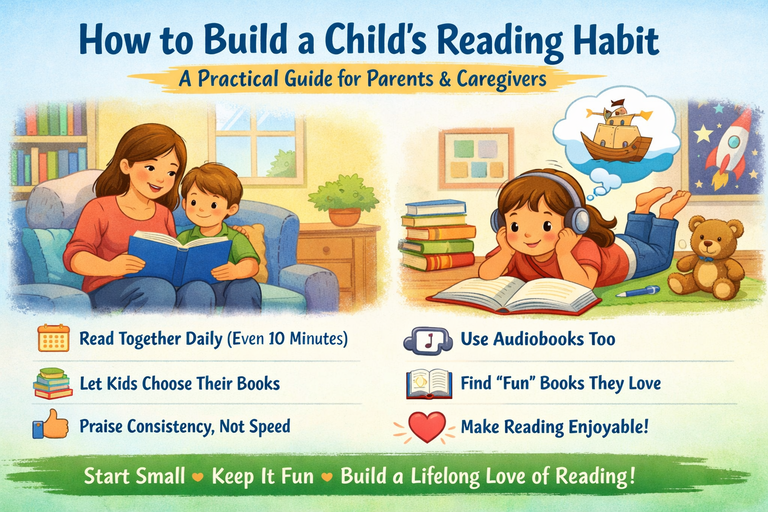
How to Build a Child’s Reading Habit | A Practical Guide for Parents
A Practical Guide for Parents and Caregivers
A strong reading habit isn’t built by forcing long reading sessions or treating books like homework. It’s built the same way most lifelong habits are built: small, repeatable routines paired with positive emotions.
When reading becomes a daily and enjoyable part of a child’s life even for just 10 minutes they are far more likely to continue reading independently as they grow. Reading stamina, speed, and skill can develop later. The habit comes first.
This guide focuses on how parents and caregivers can gently, consistently, and realistically build a child’s reading habit without battles, pressure, or burnout.
Why “Habit” Beats “Long Reading Sessions”
Many well-meaning adults believe children must read for long stretches to improve. In reality, long reading blocks can backfire when they feel like pressure, correction, or performance.
A habit-based approach works better because it:
Reduces friction: “Just 10 minutes” feels manageable, even on busy or low-energy days.
Builds identity: Children begin to see themselves as “someone who reads.”
Preserves enjoyment: Pleasure is the fuel that keeps children returning to books.
Research consistently shows that regular exposure to books especially through warm, shared reading supports language development and literacy far more effectively than stressful or forced reading. The American Academy of Pediatrics emphasizes shared reading from early childhood as essential for language growth and healthy parent child relationships (AAP, 2014).
Core Principles That Make the Reading Habit Stick
1. Make It Daily, Not Long
A habit is something done most days, not something done perfectly.
Start with a tiny, dependable minimum:
5–10 minutes for younger children
10–15 minutes for older children
More time only when the child wants it
Consistency matters more than duration.
2. Protect Choice and Autonomy
Children are far more motivated when they feel ownership over what they read. Letting them choose even if the books seem silly, easy, or repetitive makes reading feel like their activity, not yours.
According to Self-Determination Theory (Deci & Ryan), autonomy is a powerful driver of intrinsic motivation. When children feel control, they engage more deeply and persist longer.
3. Keep Reading Emotionally Safe
If reading time is filled with constant corrections
“Sound it out.”
“No, try again.”
“That’s wrong.”
children quickly associate books with failure and anxiety.
Skills can be taught without turning every page into a test. A safe emotional environment keeps children willing to try.
4. Praise Consistency, Not Speed
Praising effort and routine (“You showed up again today”) builds persistence far more effectively than praising talent or performance.
Carol Dweck’s work on growth mindset shows that children praised for effort develop stronger resilience and long-term motivation than those praised for being “smart” or “fast.”
Practical Tips You Can Start Today
Read Together Daily (Even for 10 Minutes)
This is the single most reliable habit-builder.
How to make it work:
Choose a predictable anchor: after dinner, before bed, after school, or during breakfast.
Keep the minimum tiny: “One book” or “10 minutes.”
Let it expand naturally if the child wants more.
What “read together” can look like:
You read aloud while they listen.
You take turns reading pages.
You read your book while they read theirs (parallel reading).
Younger children “read” by describing pictures this still builds real literacy skills.
If your child is restless, let them hold a small toy, draw quietly, or lie down while listening. Listening still counts.
Let Children Choose Their Own Books
Choice almost always beats the “perfect reading level.”
If a child wants to:
Re-read the same series
Choose books slightly below their level
Read comics, joke books, or magazines
That’s okay. Fluency and confidence grow through volume and enjoyment.
Easy ways to support choice:
Create a “Yes Basket”: any book in it is always allowed.
Use the 3-page rule: try three pages; if it doesn’t click, switch without guilt.
Mix formats: graphic novels, comics, sports biographies, game guides, magazines.
Graphic novels and comics are legitimate reading. They build vocabulary, inference, and narrative understanding and are often powerful entry points for reluctant readers.
Use Free Ebooks to Remove Pressure
When every book feels like a purchase decision, it creates stress: “What if they don’t like it?”
Free access encourages experimentation.
Excellent free or low-cost options include:
Your public library’s digital apps (Libby, OverDrive, Hoopla)
Junkybooks: https://www.junkybooks.com/books
Local library storytimes, book bundles, and summer reading programs
If screens are distracting, use an e-ink reader or turn on airplane mode during reading time.
Praise Consistency, Not Speed
What to praise:
“You showed up for reading again today.”
“You kept going even when that word was tricky.”
“I love how you found a book you’re excited about.”
What to avoid overemphasizing:
“You’re so smart.”
“You’re such a fast reader.”
“You finished before your sister.”
Speed is not the goal. Comprehension, enjoyment, and regularity are.
Creating an Environment That Invites Reading
Make Books Easy to Reach
If books are stored like decorations, they won’t be used.
Place them where life happens:
A small shelf in the living room
A basket near the bed
A few books in the car or backpack
Rotate a small selection weekly to keep things fresh without overwhelming.
Model Reading (Without Lecturing)
Children imitate what they see. Even 10 minutes of you reading novels, recipes, articles, or nonfiction shows that reading is a normal adult activity.
Keep it casual:
“I’m going to read for a bit.”
“This part is interesting listen to this sentence.”
No speeches required.
A Simple Routine That Works for Most Families
The 10-Minute Daily Plan
Same time and place every day (attach it to an existing routine).
Child chooses the book (or chooses between two options for younger kids).
Adult reads aloud for 5 minutes.
Child reads or “reads pictures” for 5 minutes.
End on success. Stop before exhaustion or tears when possible.
If bedtime is tense, move reading to after school or after dinner. The best reading time is the time you can do consistently.
What to Do When a Child Resists Reading
Resistance usually signals one of these issues:
The book is too hard or too boring.
Reading feels like evaluation.
The child is tired and needs a smaller dose.
They haven’t found their type of book yet.
Try this sequence:
Shrink the task: “Let’s do 3 minutes together.”
Switch the format: audiobooks, graphic novels, short stories.
Change the role: you read, they listen.
Increase choice: expand topics beyond “school-ish” books.
Use Audiobooks Strategically
Audiobooks are not cheating.
They build vocabulary, comprehension, and story familiarity and often serve as a bridge into print, especially when paired with a physical book. Many libraries offer free audiobooks through apps like Libby.
Supporting Children Who Struggle With Reading
If reading is genuinely difficult, habits can collapse because every session feels exhausting.
Make reading doable:
Keep read-aloud as the main event.
Choose high-interest, lower-reading-level books.
Try echo reading: you read a sentence, they repeat it.
Use paired reading: read together and gradually lower your voice.
If you suspect dyslexia or another learning difference, early support matters. A child can love stories deeply and still need targeted help with decoding.
Choosing Books That Actually Hook Kids
A practical rule: follow the child’s curiosity, not your ideal reading list.
High-interest categories often include:
Humor and joke books
Mysteries and cliffhangers
Animal and survival stories
Sports stories and athlete biographies
“How things work” nonfiction
Graphic novels and illustrated chapter books
Choose-your-own-adventure books
Re-reading is welcome. Re-reading builds fluency and confidence.
Common Mistakes to Avoid
Turning reading into a punishment: “No TV until you read.”
Overcorrecting every word.
Treating book choice as a moral issue (“That’s not real reading”).
Chasing perfect reading levels instead of engagement.
Helpful Scripts That Keep Reading Positive
“Do you want to start, or should I?”
“Pick any book our goal is reading time, not the perfect book.”
“Let’s stop here while it’s still fun. We’ll continue tomorrow.”
“That word is tricky. I’ll tell you this one keep going.”
The Bottom Line
Building a reading habit matters more than forcing long reading sessions.
Start small. Read together daily even for 10 minutes. Let children choose their books. Use free ebooks and library resources to remove pressure. Praise consistency, not speed.
When reading feels enjoyable not compulsory children naturally return to it, and the habit grows for life.