Best Books for Teachers: Classroom Management + Lesson Planning
A practical, budget-friendly guide to building your teaching toolkit
Great teaching takes more than subject expertise. Day-to-day success usually comes down to two leverage points:
- Classroom management: the routines, relationships, expectations, and responses that keep learning possible.
- Lesson planning: the decisions that make instruction clear, efficient, and inclusive.
When you strengthen these, you typically gain more instructional minutes, fewer behavior spirals, and lessons that “land” for more students. Evidence reviews also show that explicit classroom management practices (clear expectations, active supervision, opportunities to respond, positive reinforcement, consistent consequences) are associated with improved classroom behavior and learning conditions. (See the What Works Clearinghouse/IES practice guidance and syntheses of evidence-based management practices.)
Citations: IES/WWC practice guide resources hub (free PDFs) https://ies.ed.gov/ncee/wwc/PracticeGuides ; Simonsen et al., 2008, Education and Treatment of Children (evidence-based classroom management practices)
Below is a curated set of widely used books plus high-quality free educational ebooks/PDFs organized by what teachers most often need.
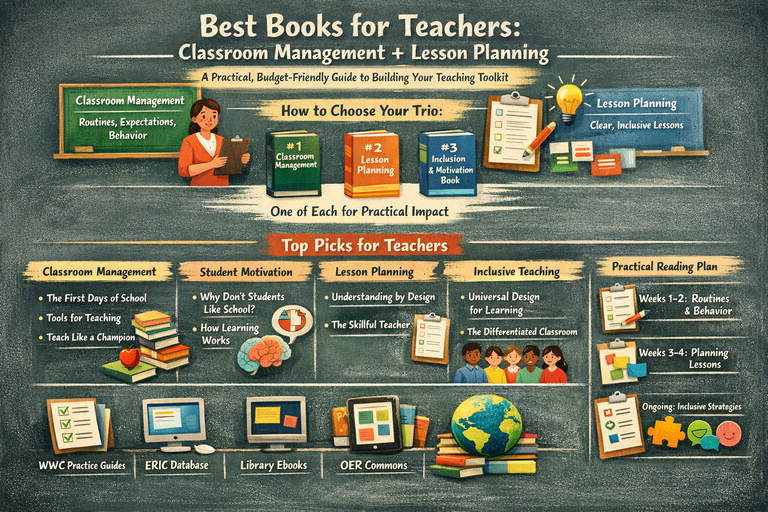
How to choose the right books (so you actually use them)
Before you buy or borrow anything, pick your “problem statement.” Examples:
- “My transitions take too long, and side conversations derail instruction.”
- “I spend hours planning, but students still don’t get the objective.”
- “I need inclusive routines that support neurodivergent learners.”
- “I want calmer consequences that don’t escalate conflict.”
Then choose:
- 1 classroom management book (for systems/routines)
- 1 lesson planning/instruction book (for planning + delivery)
- 1 inclusion/motivation lens (for student needs + equity)
That trio usually gives more practical results than reading five books in the same category.
Best books for classroom management and discipline strategies
1) The First Days of School — Harry K. Wong & Rosemary T. Wong
Best for: new teachers, teachers changing grade levels, anyone rebuilding routines
Why it helps: focuses on procedures, expectations, and “how we do things here” systems that prevent chaos before it starts.
Use it for: entry routine, materials, turning in work, group work norms, transition scripts.
2) Tools for Teaching — Fred Jones
Best for: tightening pacing, reducing off-task behavior, stopping “nagging loops”
Why it helps: practical techniques like body language, room arrangement, and quick-response strategies that reduce disruptions.
Use it for: “work first” routines, independent work expectations, help signals.
3) Teach Like a Champion — Doug Lemov
Best for: concrete, high-leverage moves you can try tomorrow
Why it helps: breaks teaching and management into specific techniques (entry routines, tracking, cold call, crisp directions).
Use it for: directions that stick, participation systems, accountable talk.
4) Classroom Management That Works — Robert J. Marzano, Jana S. Marzano & Debra J. Pickering
Best for: a more research-framed view of management
Why it helps: connects management to prevention, teacher-student relationships, and consequences.
Use it for: building expectations, hierarchy of responses, monitoring.
5) Lost at School — Ross W. Greene
Best for: chronic behavior issues, “why is this student melting down?”
Why it helps: reframes challenging behavior as lagging skills and unsolved problems; offers collaborative problem-solving.
Use it for: recurring conflicts, shutdowns, explosive behavior patterns.
6) Better Than Carrots or Sticks — Lee Canter / Dominique Smith (various editions/authors depending on version)
Best for: teachers who want structure but not harshness
Why it helps: gives a clearer menu of responses and emphasizes consistency and dignity.
Use it for: consequence ladders, reflection sheets, restorative follow-ups.
7) Conscious Discipline — Becky A. Bailey
Best for: early childhood and elementary, trauma-sensitive classrooms
Why it helps: focuses on adult regulation, connection, and skill-building language.
Use it for: calming routines, conflict scripts, class meetings.
Quick “management stack” recommendation: If you can only pick two, many teachers do well with The First Days of School (systems) + Teach Like a Champion (techniques).
Best books for student motivation techniques
Motivation books are most useful when they lead to better tasks, clearer success criteria, and more belonging—not just “pep talks.”
1) Why Don’t Students Like School? — Daniel T. Willingham
Best for: designing lessons that match how students think and remember
Why it helps: practical cognitive science insights for keeping attention and building understanding.
2) How Learning Works — Susan A. Ambrose et al.
Best for: improving learning conditions across diverse students
Why it helps: bridges motivation, prior knowledge, practice, feedback, and classroom climate.
3) Make It Stick — Brown, Roediger & McDaniel
Best for: planning practice that actually “sticks”
Why it helps: emphasizes retrieval practice, spacing, interleaving useful for lesson planning and review design.
(These aren’t “classroom management” books, but they help you build lessons students are more likely to engage with often reducing behavior issues as a side effect.)
Best books for lesson planning frameworks
1) Understanding by Design — Grant Wiggins & Jay McTighe
Best for: lesson and unit planning that stays focused
Why it helps: the classic “backward design” framework start with goals and evidence of learning, then plan instruction.
Use it for: unit maps, aligned assessments, essential questions.
2) The Skillful Teacher — Jon Saphier et al.
Best for: turning plans into strong instruction
Why it helps: combines planning, classroom culture, lesson delivery, and reflection into one coherent approach.
Use it for: lesson arcs, checking for understanding, building responsibility.
3) The Writing Revolution — Judith C. Hochman & Natalie Wexler
Best for: building writing into any subject with clear routines
Why it helps: gives sentence-level to paragraph-level activities that strengthen thinking and learning.
4) Learning That Lasts / “principles of instruction” resources (see free section below)
Best for: planning explicit instruction sequences
Why it helps: helps you plan modeling → guided practice → independent practice with frequent checks.
Best books for inclusive teaching methods
“Inclusive” doesn’t mean lowering standards. It means removing unnecessary barriers and planning multiple pathways to success.
1) Universal Design for Learning — Meyer, Rose & Gordon (UDL)
Best for: planning lessons that work for more learners the first time
Why it helps: emphasizes multiple means of engagement, representation, and action/expression.
Reference organization: CAST (UDL framework) https://www.cast.org/impact/universal-design-for-learning-udl
2) The Differentiated Classroom — Carol Ann Tomlinson
Best for: managing readiness differences without creating chaos
Why it helps: clear approaches to differentiating content, process, and product while keeping classroom routines stable.
3) Culturally Responsive Teaching and the Brain — Zaretta Hammond
Best for: engagement, trust, and rigorous instruction across cultures
Why it helps: connects culture, relationships, and learning readiness.
4) The Behavior Code — Jessica Minahan & Nancy Rappaport
Best for: students whose behavior is driven by anxiety/trauma patterns
Why it helps: practical behavior plans and prevention strategies that are not purely punitive.
Free educational ebooks and PDFs for continuous improvement
You often can’t get the newest “teacher bestseller” as a free ebook legally but you can build a strong professional library for free using the sources below.
1) What Works Clearinghouse practice guides (free, evidence-based)
These are some of the best “no-fluff” documents for teachers because they translate research into actionable steps and examples.
Start here: https://ies.ed.gov/ncee/wwc/PracticeGuides
A particularly relevant one for management is the IES guide on reducing behavior problems (search within the WWC practice guide library).
(These are designed to be implemented directly and include recommendation levels and classroom examples.)
Citation: IES/WWC Practice Guides https://ies.ed.gov/ncee/wwc/PracticeGuides
2) ERIC (free education research + many free full-text PDFs)
ERIC is a huge database of education articles, practitioner papers, and reports.
https://eric.ed.gov/
Search ideas:
- “classroom routines elementary”
- “opportunities to respond classroom management”
- “explicit instruction lesson design”
- “UDL lesson planning examples”
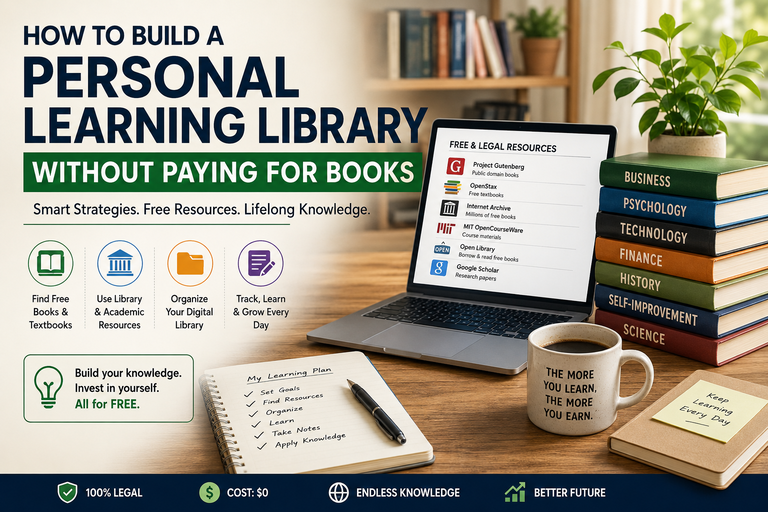
3) Public library apps (free borrowing of teacher books)
Many teacher books are available as ebooks/audiobooks through library systems. Common access points:
- Libby (OverDrive)
- Hoopla (varies by library)
4) Open Library (controlled digital lending, borrowing model)
Useful for previewing older editions and professional texts.
https://openlibrary.org/
5) OER Commons and open educator resources
For free lesson plans, units, and materials you can adapt:
https://www.oercommons.org/
A practical reading plan teachers actually finish
If you want results without overload, try this:
Week 1–2 (management):
- Read 20–30 pages/day from one management book.
- Implement one routine: entry, transition, independent work, or small-group rotation.
- Track one metric: “minutes to settle,” “number of redirects,” or “smooth transition count.”
Week 3–4 (planning):
- Use a backward design template for one unit or mini-unit.
- Add two high-impact planning moves:
- clear “I can…” success criteria
- planned checks for understanding every 5–10 minutes
Ongoing (inclusion):
- Choose one inclusive strategy to standardize (choice in output, visuals, sentence frames, chunking, calm-down routine).
Recommended “starter set” by teacher need
New teacher, survival mode:
The First Days of School + Teach Like a Champion + WWC practice guides (free)Behavior challenges and frequent disruptions:
Tools for Teaching + Lost at School + WWC “behavior” guidance (free)Planning takes too long:
Understanding by Design + Why Don’t Students Like School? + open lesson resources (OER Commons)Inclusion and differentiation:
UDL book (Meyer/Rose/Gordon) + Tomlinson + CAST UDL resources (free framework site)
Bottom line
The best “teacher books” aren’t just inspirational they change what you do on Monday: tighter routines, clearer directions, better checks for understanding, and more inclusive lesson design. If budget is a concern, you can still improve steadily using free practice guides (IES/WWC), ERIC PDFs, OER repositories, and library ebook borrowing and reserve purchases for one or two truly foundational books you’ll reuse for years.