BookTok vs. BookTube vs. Bookstagram: Where Readers Discover Books in 2025 (and How JunkyBooks Fits In)
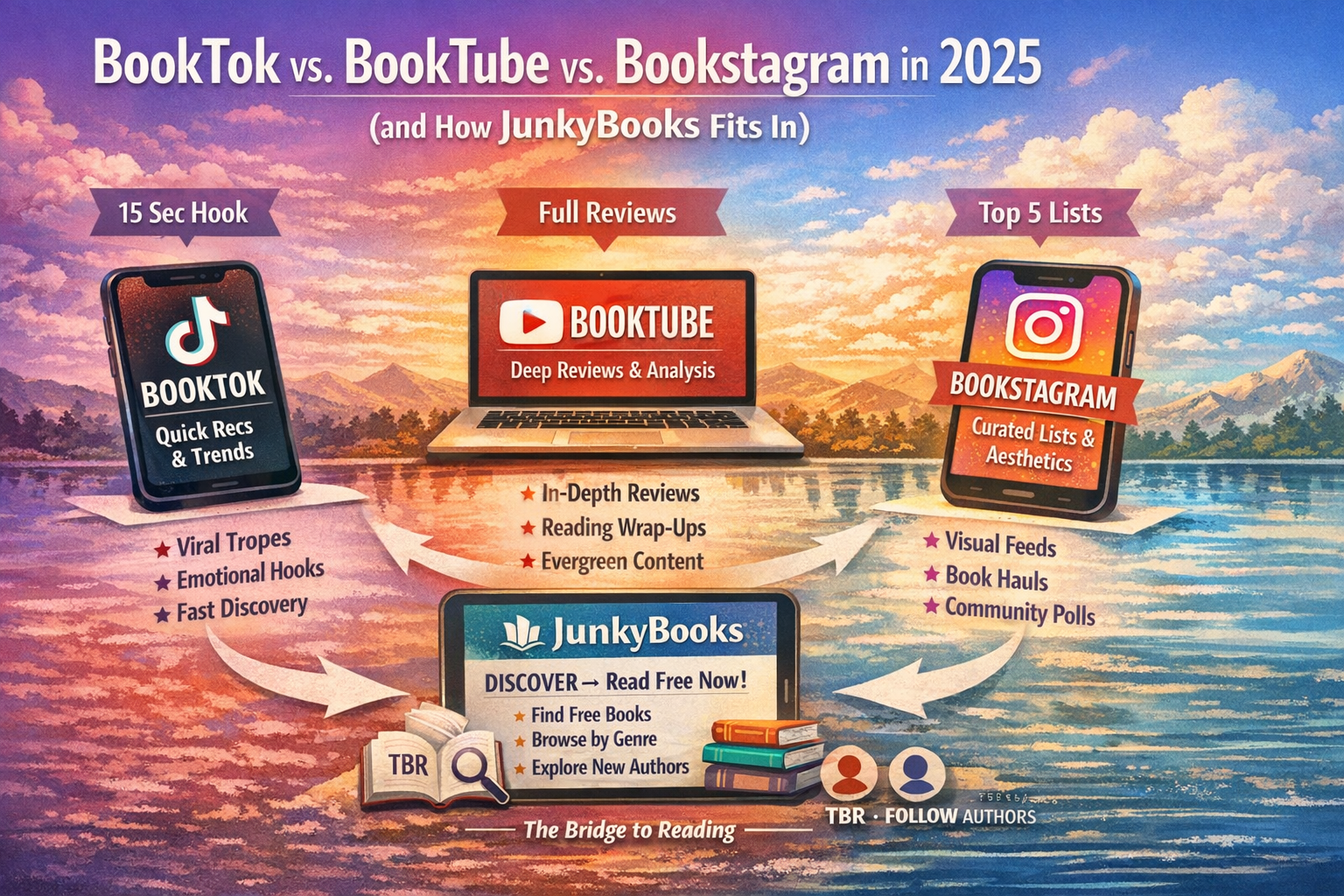
Readers have never had more ways to discover books or more noise to cut through. In 2025, the big three social discovery engines remain BookTok (TikTok), BookTube (YouTube), and Bookstagram (Instagram). Each platform has its own culture, strengths, and blind spots, and each attracts a slightly different kind of reader.
Understanding these differences helps you decide where to spend your attention as a reader or where to invest your energy as an author or creator.
But discovery is only half the story. Once a reader finds a book that looks interesting, a practical question follows: Where do I actually get this book, and what do I read next? That’s where platforms like JunkyBooks come in acting as a discovery bridge, a free-reading hub, and a connection point between readers and authors inside a larger ecosystem.
1) The 2025 Book Discovery Landscape: What’s Changed (and What Hasn’t)
What hasn’t changed
Some fundamentals of reader behavior remain constant:
-
Vibes sell books. Readers still respond more to mood, tropes, and emotional promises than to detailed plot summaries.
-
Short hooks win. Even on long-form platforms, the first few seconds determine whether someone keeps watching.
-
Community beats ads. Peer recommendations, trusted creators, and niche communities drive discovery far more effectively than traditional marketing.
What has changed
The ecosystem itself has evolved:
-
Multi-format dominance. Platforms are no longer single-format. YouTube has Shorts, Instagram prioritizes Reels, and TikTok supports longer videos. Most creators cross-post.
-
Micro-niches are stronger than ever. Discovery now happens inside hyper-specific taste clusters:
“Cozy fantasy with low stakes,” “dark academia but hopeful,” “hard sci-fi with competent adults,” and dozens more. -
Direct-to-reader paths matter. Readers expect a frictionless journey: link → synopsis → sample → read now. The shorter the path, the higher the conversion from interest to reading.
2) BookTok in 2025: The Fastest Discovery Engine with the Highest Virality
BookTok remains the most powerful top-of-funnel discovery platform in publishing.
What BookTok does best
-
Rapid discovery. You can collect 10 book ideas in five minutes.
-
Emotional matching. “This made me sob,” “healed my inner child,” or “pure cozy comfort.”
-
Trend ignition. Backlist titles can explode years after release.
-
Trope fluency. Creators speak in reader shorthand—tropes, vibes, and emotional outcomes—making matching fast and intuitive.
BookTok formats that drive reads
-
“If you like ___, read ___”
-
Trope stacks (enemies-to-lovers + forced proximity + only one bed)
-
10–20 second quotes or excerpts with music
-
Reaction videos and reading vlogs
-
“Books that feel like…” (weather, aesthetics, playlists)
BookTok’s weaknesses
-
Hype inflation. Viral books can disappoint readers who aren’t the target audience.
-
Limited nuance. Short videos rarely cover pacing, prose quality, or content warnings.
-
Trend saturation. A handful of titles can dominate feeds, reducing variety.
Best for readers who…
-
Want fast recommendations
-
Enjoy popular genres like romance, fantasy, thrillers, and YA
-
Choose books primarily by mood and vibe
3) BookTube in 2025: Deep Context, Higher Trust, Longer Shelf Life
While BookTok excels at speed, BookTube excels at depth.
What BookTube does best
-
Long-form analysis. Reviews cover pacing, character arcs, prose style, themes, and structure.
-
Taste alignment. Viewers follow creators whose preferences closely match their own.
-
Evergreen discovery. A well-made video can recommend books for years.
-
Structured reading culture. Readathons, themed months, and “best of” lists shape long-term habits.
BookTube formats that influence choices
-
20–40 minute monthly wrap-ups
-
Deep-dive reviews and critiques
-
Author interviews and publishing discussions
-
Niche recommendation videos
-
Long reading vlogs that build parasocial trust
BookTube’s weaknesses
-
Time investment. It’s slower to browse casually.
-
Lower virality for unknowns. New or indie titles need strong hooks to break through.
-
Fragmentation. Discovery depends heavily on search, thumbnails, and consistency.
Best for readers who…
-
Care deeply about writing quality
-
Want fewer “misses”
-
Enjoy discussion, analysis, and context
4) Bookstagram in 2025: Aesthetic Discovery and Community Signals
Bookstagram sits between speed and depth, emphasizing curation.
What Bookstagram does best
-
Visual browsing. Covers, shelves, themed stacks, and book hauls.
-
Community engagement. Buddy reads, story polls, comment discussions.
-
Consistent taste profiles. Many accounts focus tightly on specific genres or moods.
-
List culture. Seasonal recs, wishlists, and “top 5” carousels.
Bookstagram formats that drive reads
-
Carousel posts (“10 cozy reads for fall”)
-
Reels with short recommendations or unboxings
-
Story polls (“Pick my next read”)
-
Quote graphics and mood boards
-
Mini reviews with star ratings and trope lists
Bookstagram’s weaknesses
-
Aesthetic bias. Beautiful covers often get disproportionate attention.
-
Moderate depth. More nuanced than short video, less than long-form reviews.
-
Link friction. Improved, but still less direct than other platforms.
Best for readers who…
-
Love curated lists and seasonal themes
-
Track community trends
-
Respond strongly to visual branding
5) So Where Do Readers Discover Books in 2025?
Most readers don’t choose just one platform. Instead, they follow a loop:
-
BookTok for fast ideas and hype
-
Bookstagram for list curation and community validation
-
BookTube for deep confirmation before committing time or money
The key moment, however, is conversion turning discovery into actual reading. That’s where friction often appears, and where platforms like JunkyBooks add real value.
6) How JunkyBooks Fits In: The Missing Middle Between “Seen It” and “Read It”
JunkyBooks functions as the action layer after social discovery especially for readers seeking free or low-risk reading and for authors building reachable audiences.
For readers: JunkyBooks as a “read-now” bridge
After discovering a book, readers often hit obstacles:
-
The book is expensive
-
It’s unavailable at the library
-
They want something similar right now
-
They want to try a new author without risk
How JunkyBooks helps:
-
Genre-based browsing when you don’t have a specific title
-
Free-reading discovery for budget-conscious readers
-
Backlist exploration within niches
-
A “next read” engine powered by tags and tropes
For authors: JunkyBooks as an audience builder
Social platforms generate attention but not permanence.
JunkyBooks provides:
-
A stable home for your books
-
Long-term discoverability inside genre categories
-
A no-cost entry point for curious readers
It becomes a place where:
-
Readers can try your work immediately
-
Tags and categories drive organic discovery
-
Your author profile acts as a mini storefront
The ecosystem model that works best
-
BookTok / BookTube / Bookstagram: discovery media
-
JunkyBooks: reading and catalog hub (free-first)
-
Newsletter / website: direct reader connection
7) Practical Tips: How Readers Can Use Each Platform Better
On BookTok
-
Search by tropes and vibes, not just titles.
-
Save videos into collections (TBR, Cozy, Dark).
-
Look for “who should read this” and “honest review” takes.
On BookTube
-
Follow 3–5 creators with aligned taste.
-
Prioritize wrap-ups over individual reviews.
-
Use timestamps and comment sections for extra recs.
On Bookstagram
-
Follow niche list-makers, not just aesthetic accounts.
-
Save carousels as shopping lists.
-
Notice recurring favorites repetition signals genuine love.
Building a free-reading pipeline
-
Use social platforms for inspiration.
-
Use JunkyBooks to search by genre and tags, build a TBR, and find immediate free reads.
-
Keep your library organized so discovery turns into actual reading.
8) Practical Tips: How Authors Can Match Platform to Strategy
Authors who thrive on BookTok
-
Communicate tropes quickly
-
Have strong covers and titles
-
Write emotionally driven genres
Best content: trope hooks, vibe reels, micro excerpts
Authors who thrive on BookTube
-
Write complex or idea-heavy books
-
Enjoy long-form discussion
Best content: deep dives, craft breakdowns, Q&As
Authors who thrive on Bookstagram
-
Have strong visual branding
-
Enjoy community engagement
Best content: carousels, mood boards, quote graphics
Where JunkyBooks fits
-
A low-friction destination for “read now”
-
Internal discovery via categories and tags
-
A way to convert attention into long-term readers
9) The 2025 Reader Journey That Converts
A realistic modern flow looks like this:
-
See a 15-second trope hook on BookTok
-
Save it
-
Check Bookstagram for similar recs
-
Watch a BookTube wrap-up for context
-
Decide whether to read now
-
Use JunkyBooks to find the book or a close match
-
If you love it, follow the author and leave a review
Platforms don’t compete they hand off attention.
Conclusion: Choose Your Discovery Style and Use JunkyBooks as the Action Step
In 2025:
-
BookTok sparks discovery fastest.
-
BookTube builds trust through depth.
-
Bookstagram curates taste through visuals and community.
-
JunkyBooks bridges discovery and reading, offering a practical, low-friction way to explore, sample, and commit.
The smartest readers and authors don’t pick one platform. They build an ecosystem where discovery flows naturally into reading, and reading turns into lasting connection